
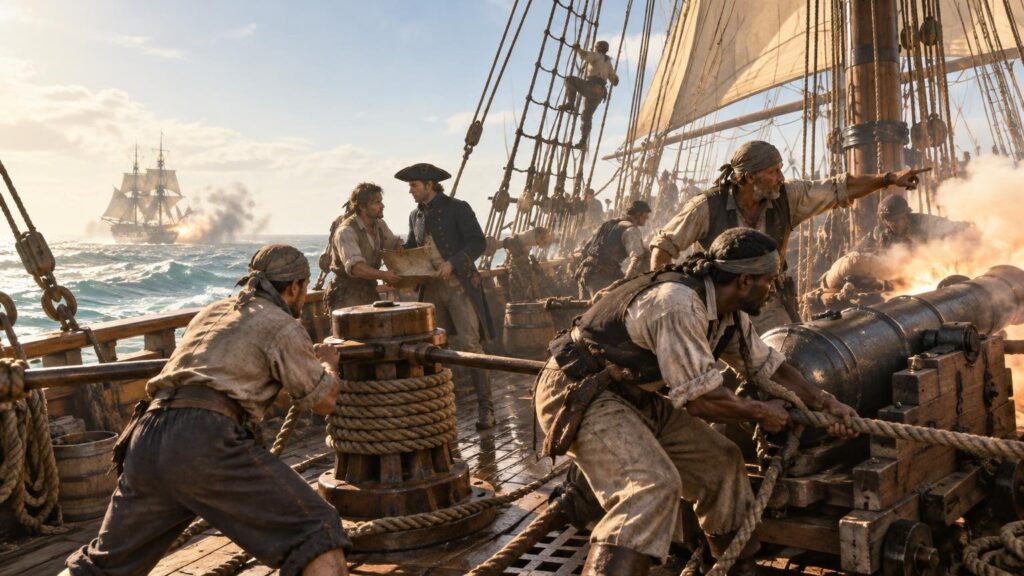
Master and Commander: The Far Side of the World makes naval combat exciting by refusing to treat the crew as decorative background. Captain Jack Aubrey may give the orders, but HMS Surprise moves, fights and survives through a crowded network of specialists. Every rope hauled, wound treated and gun loaded gives the action weight because Peter Weir shows that command is only effective when other people can turn a decision into coordinated work.
That is the film’s real achievement. Plenty of action movies build heroes by making everyone around them conveniently useless. Master and Commander takes the opposite approach: Aubrey looks capable because he recognizes capability in others. His authority matters, but so do the limits of that authority. The result is an unusually persuasive study of expertise, delegated trust and the human costs concealed inside a crisp command.
The Surprise works like a system, not a stage
Released in 2003, the film was directed by Peter Weir from a screenplay by Weir and John Collee, with Russell Crowe as Aubrey and Paul Bettany as surgeon and naturalist Stephen Maturin. Its story combines material associated with Patrick O’Brian’s Master and Commander with the pursuit structure of The Far Side of the World rather than adapting one novel directly. That blended construction helps the film feel less like a single adventure and more like an extended test of how this floating society functions.
The opening engagement establishes the principle immediately. When Surprise is attacked and loses its rudder, information moves up the chain, Aubrey makes a rapid decision, and the crew lowers boats to tow the damaged vessel into fog. Maturin simultaneously attends to the wounded while repairs begin elsewhere. The AFI Catalog’s account of the film records the sequence as a chain of distinct actions, which is exactly how Weir shoots it: survival comes from overlapping competence, not a miraculous solo intervention.
The period context supports that structure without turning the film into an infallible history lesson. Royal Museums Greenwich’s overview of life at sea in the age of sail describes ships as organizations containing specialist roles such as surgeon, master gunner, boatswain, carpenter, quartermaster and cook, alongside shared duties including watches and sail handling. It also emphasizes the sharp hierarchy and class divisions aboard such vessels. Master and Commander dramatizes both realities: the ship is collectively operated, but it is not democratically governed.
Expertise makes the action readable
Weir rarely reduces the crew to a blur of shouting men. Orders travel through identifiable stations, and the camera lets us understand enough of the work to grasp what is at stake. The sailors do not simply “prepare for battle.” They clear decks, handle lines, move powder, aim guns and respond to damage. Aubrey drills the gunnery crews before the later confrontation, making combat readiness the product of repetition rather than last-minute inspiration.
That preparation gives the battles something many larger action movies lack: causality. A cannon fires because several people completed a dangerous sequence correctly. A maneuver succeeds because the crew understood the order and executed it under pressure. Geography remains clear because the film connects decisions to physical labor. Noise and smoke never become an excuse for visual mush.
The craft reinforces this argument. The film received 10 Academy Award nominations and won for Russell Boyd’s cinematography and Richard King’s sound editing. The Academy’s 2004 awards record confirms those honors. They are especially fitting because image and sound make the ship’s work tangible: timber groans, rigging strains and cannon fire lands with horrifying force. The spectacle belongs to the crew because we understand the machinery they are struggling to control.
Aubrey leads by using other people’s knowledge
Aubrey is charismatic and decisive, but the film does not mistake those traits for omniscience. Maturin brings medical and scientific authority that can challenge naval priorities. Historically, surgeons and commanding officers could occupy competing spheres of authority during the French Wars, according to Royal Museums Greenwich’s discussion of naval medicine and disability. That context does not prove every disagreement in the film is historically exact, but it clarifies why Aubrey and Maturin’s arguments are more than friendly bickering.
Their relationship gives the movie its intellectual tension. Aubrey thinks in terms of mission, discipline and tactical opportunity; Maturin keeps pulling individual bodies and moral consequences back into view. Neither perspective can simply absorb the other. The friendship works because disagreement is allowed to remain disagreement, not because the doctor eventually learns that the captain is always right.
This is also why the film’s teamwork feels richer than generic camaraderie. Trust does not mean everybody shares one personality or judgment. It means distinct forms of knowledge can affect the final decision. Aubrey’s strongest moments come when he converts what others know into action rather than treating their expertise as a threat to his command.
Spoilers Ahead: Command has a body count
The second half turns delegated trust into something harsher. Content warning: the following discussion includes suicide and graphic medical injury.
Midshipman Hollom exposes the cruelty inside a system built on rank. He has failed his officer’s examination twice, lacks the authority his position is supposed to project and becomes isolated as the crew brands him a Jonah. His death by suicide is not a simple lesson about one weak man. It shows how quickly a community organized around discipline can redirect fear toward somebody who cannot perform his assigned identity convincingly.
Maturin’s injury tests expertise differently. Refusing treatment from Higgins, he operates on himself with Killick assisting by holding a mirror. The sequence is gruesome, but it also strips competence of glamour. Knowledge does not make Maturin invulnerable; it makes him responsible for acting while frightened, wounded and dependent on someone else’s steady hands.
The climactic deception develops from Maturin’s observation of a phasmid insect. Surprise is disguised as a whaler to draw the Acheron close, turning scientific observation into tactical advantage. During the ensuing action, Aubrey leads the boarding party while the young Blakeney is left with responsibility aboard Surprise. Blakeney’s quick response prevents the enemy guns from firing. The sequence completes the film’s argument: a commander succeeds by preparing other people to act intelligently when he is elsewhere.
Victory still carries an invoice. Mr. Allen and Peter Calamy die, and Aubrey promotes Peter posthumously so his family can receive a pension. The gesture is compassionate, but it cannot reverse the loss. It is an administrative response to an irreversible human consequence—the kind of detail that prevents the finale from becoming uncomplicated triumph.
The action matters because everyone matters
Master and Commander is not claiming that hierarchy becomes harmless when the captain is likable. It shows something more interesting: authority is strongest when it respects specialist knowledge, builds competence and accepts accountability for the people carrying out its decisions.
That is why the film still feels so substantial. Its battles are not interruptions delivered at regular blockbuster intervals. They are examinations of whether the social and practical machinery aboard Surprise will hold. Viewers interested in another war film that emphasizes the human cost beneath military purpose can continue with MovieBunker’s review of All Quiet on the Western Front. Master and Commander reaches its own conclusion with every splintered deck and repeated order: the captain chooses the course, but the crew makes that choice real.
References
- Master and Commander: The Far Side of the World | 20th Century Studios
- AFI|Catalog
- Life at sea in the age of sail | Royal Museums Greenwich
- 2004 Academy Awards | Oscars.org | Academy of Motion Picture Arts and Sciences
- Unfit for service: disability and old age in the British Navy during the French Wars | Royal Museums Greenwich