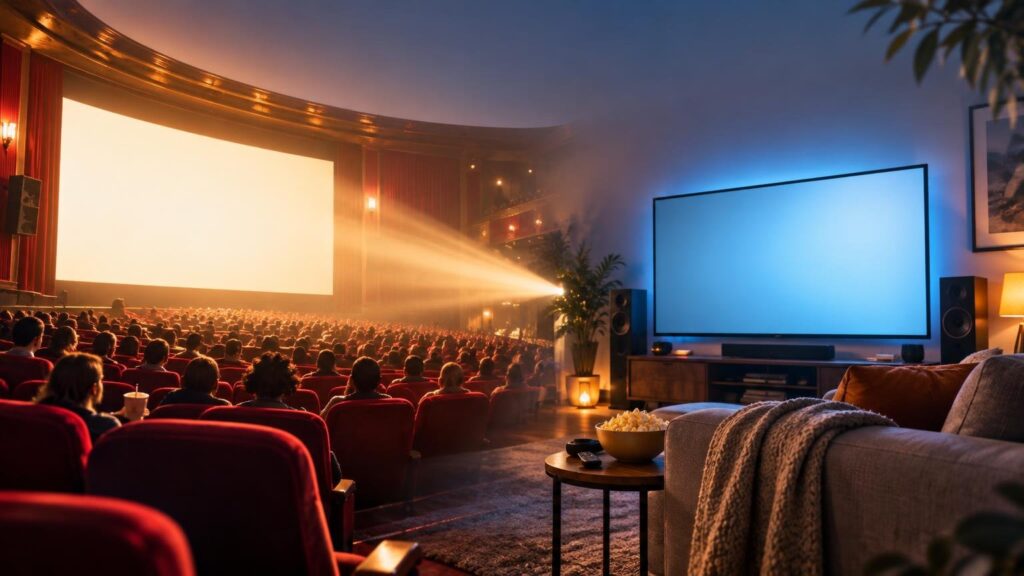
TLDR: Choose the theater when a movie’s scale, sound, crowd reaction or spoiler risk will materially change your experience. Wait for home viewing when comfort, cost, scheduling and playback control matter more. Judge the specific movie, your actual local auditorium and your real home setup—not an imaginary perfect cinema against a phone balanced on a cereal box.
When the question is “see movie in theaters or wait for streaming?”, the best answer is not “blockbusters belong in cinemas” or “everything is better at home.” It is whether this particular film gains enough from theatrical presentation to justify the complete outing: tickets, travel, time, concessions and the chance that somebody nearby treats the auditorium like their personal group chat.
Waiting is not a second-rate choice. In a 2025 AP-NORC poll of 1,182 U.S. adults, 75% said they had watched a recently released movie on streaming instead of seeing it theatrically at least once during the previous year. Home viewing is now a normal part of how audiences handle new releases, not an admission that they have abandoned movies.
Start with this quick decision rule
Ask one question first: what would you genuinely lose by watching this at home?
If the answer is imposing images, physical sound, contagious laughter, collective tension or protection from spoilers, buy the theater ticket if the cost is comfortable. If the answer is mainly “a larger version of something I can watch equally attentively at home,” waiting is usually sensible.
The key word is genuinely. Marketing calls practically every release an event. Your calendar and bank account do not have to agree.
Picture scale matters when the composition uses it
Action, science fiction, fantasy, animation, nature documentaries, concert films and landscape-heavy epics are obvious theatrical candidates. A large image can reveal spatial relationships, background detail and physical scale that become less forceful on a television. A figure crossing a huge desert is not merely bigger in a cinema; the empty space around that figure becomes part of the experience.
That does not mean every expensive production deserves a ticket. Bigger presentation cannot rescue flat lighting, incoherent editing or weightless visual effects. Look for evidence that the film uses composition, movement, texture or environment—not merely that its trailer contains several explosions.
Compare the formats you will actually use. A premium auditorium versus a modest television is an easy theatrical win. A poorly maintained standard screen versus a large home display in a dark room is a much closer contest. Seat position also matters: an enormous image viewed from an uncomfortable front row may provide plenty of scale and very little pleasure.
Sound can be a stronger reason than screen size
Cinema sound is not just volume. A capable auditorium can create separation, direction, low-frequency impact and a wide dynamic range between quiet details and large musical or action peaks. Digital cinema standards account for multichannel and object-based audio presentation, although standards do not guarantee that every auditorium is configured or maintained equally. Readers interested in the technical foundation can consult the Digital Cinema Initiatives specifications.
Musicals, concert films, war movies, creature features and carefully mixed action films may gain substantially from that physical sound. The rumble of machinery or the pressure of a score can make an image feel heavier and more immediate.
There are practical exceptions. Some theaters play films more loudly than a viewer enjoys. Poor seat placement can weaken the balance, and not every auditorium delivers premium sound. At home, a solid speaker system or good headphones may preserve more detail while giving you control over volume, subtitles and interruptions. If loud sound is uncomfortable rather than exciting, theatrical power is not an automatic benefit.
A crowd can improve comedy and horror—or ruin both
Comedy and horror often gain the most obvious social advantage. Laughter can loosen a room, while collective silence can make suspense almost unbearable. A study of people watching emotional film scenes alone and in a group found differences in empathy and emotional intensity depending on the emotion involved. That supports a limited but useful point: the presence of other viewers can affect how a scene lands, even though it does not make every crowd or genre better. The published cinema study provides the research context.
The same audience can also become the evening’s main villain. Talking, glowing phones, late arrivals and performative shouting can flatten concentration. Decide whether you enjoy opening-weekend energy or prefer a quieter screening. A packed Friday-night horror show and a nearly empty weekday matinee are not interchangeable experiences.
Friend-group plans count too. A broad comedy that looks merely pleasant may be worth seeing because laughing with people you know is the event. Conversely, there is no prize for paying premium prices to sit beside strangers when you would rather watch a delicate film without distraction.
Quiet dramas are not automatically home movies
Dialogue-driven dramas often lose less on a smaller screen, especially when their power comes from writing and performance rather than physical scale. Home viewing also offers subtitles, pauses, familiar seating and the freedom to choose a time when you can concentrate.
But “quiet” does not mean visually disposable. Intimate films may depend on faces, silence, subtle sound and sustained attention. A dark auditorium removes the temptation to check messages, fold laundry or pause every twelve minutes. Long takes and restrained performances can feel more intense when the movie has your complete attention.
Be honest about your habits. If waiting means watching the film carefully on a good display, home may preserve nearly everything that matters. If it means scrolling through your phone while the movie becomes expensive wallpaper, the theater offers something more valuable than screen size: enforced focus.
Spoilers and cultural conversation create real urgency
Franchise installments, mysteries, twist-driven thrillers and surprise-heavy horror films become harder to approach cleanly after release. If knowing a reveal would significantly reduce your enjoyment, an early screening may be worth more than the presentation alone.
Social conversation matters as well. Some viewers enjoy discussing a major release while theories, jokes and arguments are still fresh. Others do not care about joining that first wave. Neither approach is more devoted to cinema; they simply assign different value to immediacy.
Do not let manufactured fear of missing out turn every release into an emergency. Mute keywords, avoid trailer breakdowns and decide how spoiler-sensitive you really are. Urgency deserves weight only when waiting would change the experience for you.
Calculate the full cost of going to the theater
The relevant price is not just the number beside the showtime. Add the entire outing:
- Tickets and online booking fees
- Premium-format or preferred-seat surcharges
- Fuel, transit fares, parking or rideshare costs
- Concessions, if they are part of the plan
- Childcare or other scheduling expenses
- Travel, advertisements and the time spent waiting
- The opportunity cost of committing a fixed block of the day
This calculation does not automatically favor streaming. A theater trip can be an affordable social occasion, while a premium digital rental watched by one person may offer weak value. Matinees, discount days, memberships, loyalty rewards and skipping concessions can narrow the difference. Compare realistic versions of both choices rather than the most luxurious theater trip with a subscription you already pay for.
Accessibility belongs in the same calculation. Transportation, seating, caption availability, sensory needs and the ability to pause may decide the issue before image quality enters it. The best format is the one in which you can comfortably experience the movie.
Do not assume streaming is only a few weeks away
There is no universal countdown from theatrical opening to home availability. Release windows vary by title, distributor and performance. Some movies reach premium video on demand relatively quickly, while others remain theatrical exclusives longer. Variety has reported that certain releases can become eligible for premium digital availability after 17 days under one studio arrangement, but that is not a rule readers should apply to every film.
It is also important to distinguish paid digital access from subscription streaming. A movie advertised as “coming to digital” may initially be available only to rent or buy. Inclusion in a streaming service you already have could come later, and an announced home date can refer to a different stage of that process.
Before deciding to wait, check the film’s official distributor and likely streamer announcements. If no date has been confirmed, treat the wait as uncertain. Do not build the decision around a rumored date from a social post or a generic claim about theatrical windows.
The “see movie in theaters or wait for streaming” checklist
Give one point to the theater for every “yes” answer to questions one through five. Give one point to waiting for every “yes” answer to questions six through eight. This is not science; it is a way to expose what you actually value.
- Would the movie’s landscapes, action, animation or visual detail lose impact on your home screen?
- Is music, bass, spatial sound or dynamic range a major part of its appeal?
- Would a lively audience improve the comedy, horror, concert or fan-event experience?
- Would spoilers or delayed participation in the conversation materially reduce your enjoyment?
- Does the screening itself feel like an occasion—a date, group outing, filmmaker event or premium-format presentation?
- Would the full cost or fixed schedule make the outing stressful?
- Does your home setup preserve the movie’s important strengths while offering useful control over volume, captions and pauses?
- Is a confirmed and reasonably near home release available at a price you are willing to pay?
A clear theater lead suggests going now. A clear home lead suggests waiting without guilt. A tie means use the most practical tiebreaker: which option makes you more likely to give the movie your full attention?
How the framework works in practice
An effects-heavy science-fiction sequel
The theater probably wins if the appeal is enormous environments, complex action and forceful sound. Choose a good auditorium rather than assuming any screening will do. If local projection is unreliable or premium tickets strain the budget, waiting for a strong home presentation is reasonable.
A broad comedy with friends
The images may not require a giant screen, but the group experience could justify the outing. Here, shared laughter and the social plan—not cinematic scale—create the value.
A dialogue-driven relationship drama
Wait if you have a quiet home environment, appreciate subtitles and are unlikely to be distracted. Go if the theater’s enforced focus will stop the performances from competing with chores and notifications.
A twist-heavy thriller
The theater gets extra points for spoiler protection and collective tension. If you can avoid spoilers and a confirmed home release is close, waiting becomes much easier to defend.
A three-hour prestige epic
This is the hardest call. Scale and concentration favor the cinema; comfort and playback control favor home. Decide whether an intermission-free screening will deepen immersion or merely make you spend the final hour thinking about your knees.
Choose the experience the movie actually needs
See the movie in theaters when scale, sound, shared reaction or urgency changes what the film can do to you. Those are meaningful advantages, not nostalgic talking points. But when the essential experience survives at home—and home offers better comfort, access, focus or value—waiting is often the smarter way to watch.
Theater versus streaming is not a loyalty test. It is a title-by-title decision. Spend the ticket money on films that genuinely use the room, and give the rest the patient, attentive home viewing they deserve.