
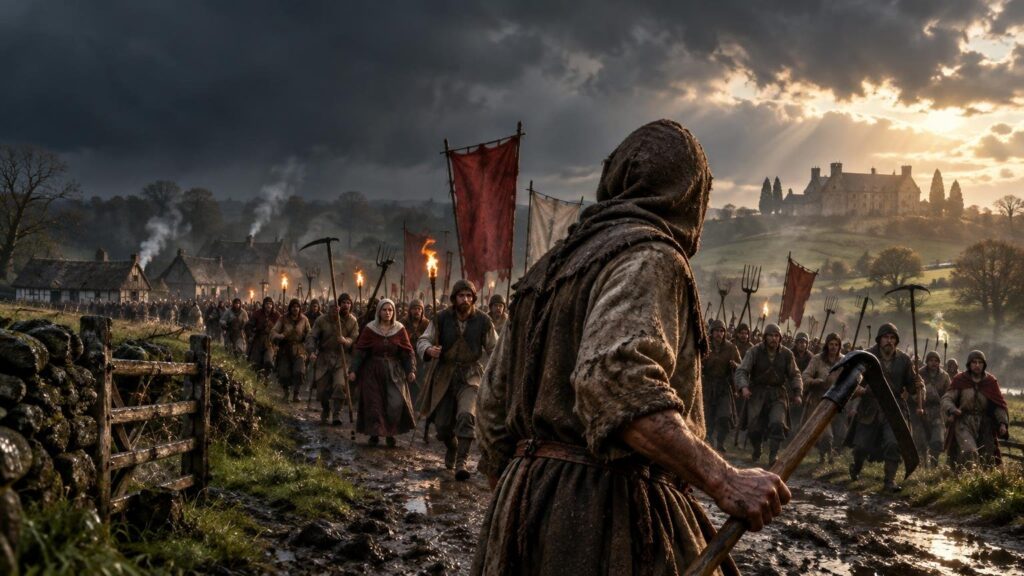
The short version of this The Uprising review is that Paul Greengrass has made a bruising, politically angry medieval drama that is much better at starting a rebellion than finishing one. Its crowded streets, desperate farmers and eruptions of close-range violence give the Peasants’ Revolt frightening momentum. Yet the more the film tries to transform its invented hero into a Robin Hood-adjacent legend, the more its distinctive class conflict hardens into familiar mythology.
Our verdict Paul Greengrass gives this medieval revolt bruising urgency and serious political anger, but thin characterization, disorienting action and an awkward drift toward folk-hero mythology keep The Uprising from becoming truly rousing.
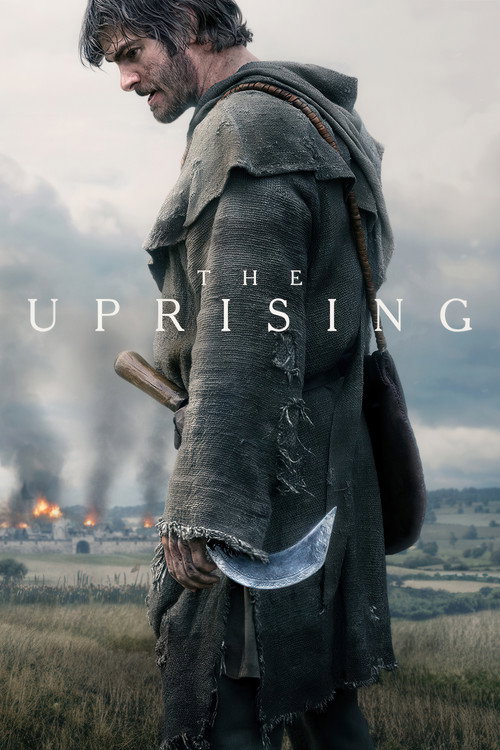
The Uprising (2026)
I like The Uprising most when it stays close to the ground. Hunger, taxation and accumulated humiliation push ordinary people toward collective action, and Greengrass understands that a revolt is not a clean march from oppression to liberation. It is unstable, exhilarating and vulnerable to people who discover that righteous anger can also provide cover for vengeance. That moral tension gives the film its real power, even when thin characterization and disorienting action prevent it from becoming genuinely rousing.
The Uprising review: Class conflict gives the film its pulse
The film follows an ordinary farmer known as the Ploughman, played by Andrew Garfield, as he becomes caught up in the 1381 rebellion against King Richard II. Greengrass wrote and directed the fictional story, placing the invented protagonist among historical figures including John Ball and Wat Tyler. This is a sensible route into a complicated event: rather than treating history as a procession of famous names, the film asks what political crisis feels like to someone expected to work, pay and obey without ever being heard.
That perspective matters because the conflict is not merely historical wallpaper for sword fights. The real revolt involved peasants and craftspeople rising against the government amid heavy taxation connected to England’s war with France. The National Archives’ account of Richard II and the revolt provides the broader historical context, but the film’s achievement is making those conditions feel personal. Taxes become food missing from a table, authority becomes a man standing in your home, and political resentment becomes a physical pressure shared across a community.
Greengrass is strongest when he shows individual grievances merging into a collective force that nobody can fully control. The movement begins with recognizable demands for economic dignity, but the film refuses to assume that a just cause makes every act committed in its name just. Violence alters the people using it. Old scores creep into public action. The distinction between punishment and revenge becomes dangerously convenient.
That ambiguity keeps The Uprising from becoming a simple tale of virtuous peasants and sneering aristocrats. Its sympathies are obvious, as they should be, but sympathy does not become moral absolution. The rebels have been denied power, and then discover that possessing power—even briefly—creates its own temptations. For me, this is the film’s most interesting idea: rebellion may be necessary while remaining terrifying.
Greengrass turns medieval England into a pressure cooker
The atmosphere is the movie’s strongest achievement. This medieval England feels harsh, cramped and ready to ignite. Mud, blood, timber and bodies crowd the image, giving the story a texture of constant physical discomfort. Greengrass does not present history as a stately pageant viewed from the safe end of a banquet hall. He makes it feel like an argument conducted at arm’s length, often with farm tools and blades.
The escalation from rural grievance to public disorder is especially effective. Early tension comes from the possibility of violence; later scenes show how quickly violence becomes the language everyone expects. Greengrass has always been drawn to institutions losing control under pressure, and the medieval setting gives that interest a rawer shape. Orders pass through unreliable chains, crowds move faster than leaders can think, and political authority looks formidable until people stop agreeing to fear it.
The bloody close-quarters action supports that interpretation. The Uprising is rated R for violence and bloody images, and its 128-minute runtime gives the revolt room to expand from a local grievance into a larger crisis. The fighting has force because it is rarely elegant. Bodies collide, formations collapse and panic spreads. This is not heroic combat presented as choreography; it is social order disintegrating in real time.
The problem is that Greengrass’s handheld urgency does not always preserve enough spatial clarity. A shaking camera can place us inside panic, but panic still needs shape. When weapons, bodies and rapid movement fill the same tight frame, the action becomes something to absorb rather than understand. I could feel the violence without always being able to follow its geography. That tradeoff may suit Greengrass devotees, but it repeatedly blunts the impact of otherwise persuasive staging.
Readers interested in another attempt to balance muddy historical violence with national legend may also find a useful comparison in our review of Medieval. The Uprising is the more politically immediate film, but it wrestles with a similar danger: once history is organized around a heroic emblem, the difficult collective forces surrounding that figure can start to look like supporting scenery.
Andrew Garfield’s Ploughman is an effective symbol but a thin man
Garfield gives the film an accessible center. His alertness and natural decency make the Ploughman easy to follow as private grievance develops into political purpose. He can register fear without reducing the character to a passive witness, and he carries enough conviction to make the farmer’s growing importance plausible within the movie’s heightened terms.
But the screenplay equips the Ploughman a little too neatly for his historical assignment. He is noble enough to earn trust, politically clear-sighted enough to articulate the film’s argument and capable enough to survive its expanding violence. Those qualities make him a functional protagonist, yet they leave too little psychological friction. His transformation should feel like a person being changed—and perhaps damaged—by history. Too often, it feels like an emblem moving into position.
Greengrass has explained that the Ploughman was invented to center ordinary people rather than tell the rebellion only through its documented leaders. Greengrass’s account of the film’s historical approach makes the creative logic clear. The irony is that the character becomes less ordinary as the film progresses. Instead of deepening his contradictions, the story gradually enlarges his symbolic importance.
The surrounding characters suffer from the same compression. They represent competing attitudes toward faith, authority, compromise and retaliation, but relatively few develop enough interior life to surprise us. The dialogue regularly carries political meaning more efficiently than human messiness. People state positions, challenge positions and then march toward the next escalation. The ideas remain compelling; the drama built to contain them is more schematic.
The folk-hero turn shrinks a more interesting rebellion
The official framing connects this fictional narrative to a rebellion said to have helped inspire the Robin Hood legend. As a loose folk dimension, that idea has potential. History often becomes legend because communities reshape complicated events into stories that can travel. The problem is not that The Uprising embraces myth, but that its myth is less interesting than the political drama it replaces.
The ordinary rebels are already the movie’s most compelling subject. Their collective anger has contradictions, competing motives and no guaranteed destination. Redirecting that energy toward one increasingly iconic figure feels like a concession to familiar storytelling. The film begins by asking how deprivation produces mass action and drifts toward asking how a heroic legend might be born. Urgency survives the transition, but specificity does not.
That drift also weakens the final stretch. At more than two hours, the film sustains tension surprisingly well, and its violence continues to carry physical conviction. Yet momentum is not the same thing as payoff. Because the Ploughman remains more symbol than psychologically complicated individual, the conclusion cannot fully convert the rebellion’s accumulated force into emotional resolution.
I wanted the film to trust the unruly movement it had created. Its strongest scenes understand that history belongs to crowds as well as leaders, and that collective action can be morally necessary without being morally tidy. The broader legend-building smooths away some of that danger precisely when the movie should be pressing harder into it.
A forceful historical drama that stops short of greatness
The Uprising is recommended with reservations for viewers who enjoy Greengrass’s breathless style and want historical action powered by class conflict rather than courtly intrigue. Its anger has purpose, its medieval world feels appropriately inhospitable, and its refusal to romanticize rebellion gives the violence more weight than a conventional folk adventure would manage.
Those looking for cleanly mapped battles, a deeply individualized protagonist or a straightforward Robin Hood story may find it frustrating. The camera frequently sacrifices clarity for panic, while the screenplay’s effort to manufacture a legend narrows what began as a fascinating portrait of collective fury.
Still, there is something bracing about a medieval epic that understands taxation and economic humiliation can be as dramatically combustible as a disputed crown. The Uprising does not become the great political action film hiding within its first half, but its mud, anger and moral instability give it real force. See it for the revolt at ground level, not for the cleaner legend the film eventually tries to build above it.