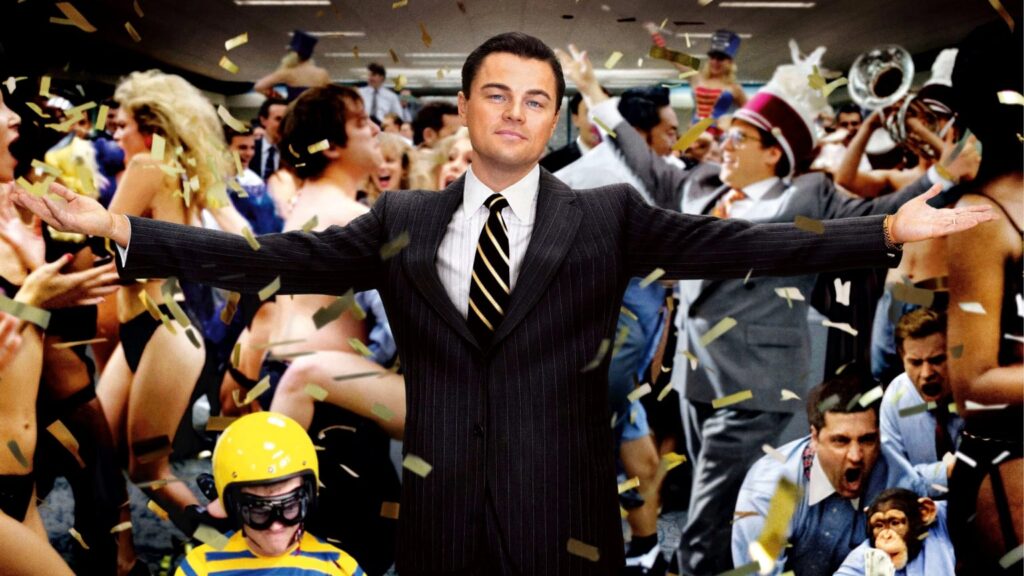
TL;DR: Martin Scorsese’s The Wolf of Wall Street is a blisteringly funny, formally intoxicating endurance test. Leonardo DiCaprio turns Jordan Belfort into a human sales pitch, while the movie’s speed and vulgarity make his fraudulent empire frighteningly seductive. The excess becomes repetitive and leaves Belfort’s victims at the margins, but its seductiveness is also the point: Scorsese wants us to feel why hollow men with confident voices keep finding an audience.
Our verdict Scorsese turns greed into a blisteringly funny, formally intoxicating endurance test. DiCaprio’s fearless performance and the film’s relentless momentum make this three-hour carnival of corruption both wildly entertaining and deliberately difficult to stomach.
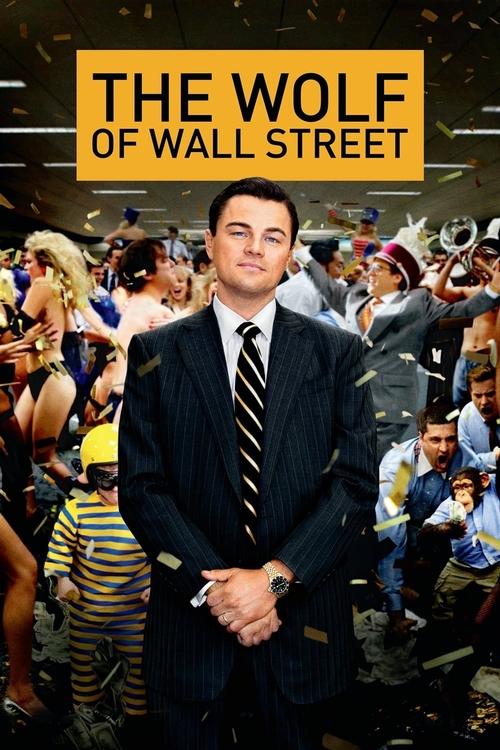
The Wolf of Wall Street (2013)
The central argument of this The Wolf of Wall Street 2013 review is that the movie’s seductiveness is not separate from its indictment. Scorsese makes Belfort’s world exhilarating because that is how men like Belfort acquire power: they make greed look like freedom, exploitation sound like ambition and surrender feel like admission to an exclusive club. The result is wildly entertaining, morally unstable and deliberately difficult to stomach.
The Wolf of Wall Street review: the sales pitch is the trap
Adapted by Terence Winter from Jordan Belfort’s memoir, the film follows a stockbroker who builds a brokerage empire through penny-stock fraud, aggressive sales tactics and conspicuous consumption. Leonardo DiCaprio plays Belfort, with Jonah Hill as Donnie Azoff, Margot Robbie as Naomi Lapaglia and Kyle Chandler as federal agent Patrick Denham. That setup could have produced a familiar rise-and-fall biography. Scorsese instead constructs the movie like one of Belfort’s pitches: loud, intimate, flattering and always moving too quickly for the customer to inspect what is being sold.
Belfort narrates relentlessly, addresses the camera and treats the audience as another room waiting to be conquered. These devices are funny, but they are not merely joke-delivery systems. They turn language into an instrument of control. Belfort can bury an ethical objection beneath swagger before anyone finishes forming it, and his certainty gives empty appetite the appearance of expertise. A successful con artist does not merely conceal the truth. He gives people a more exciting story to believe instead.
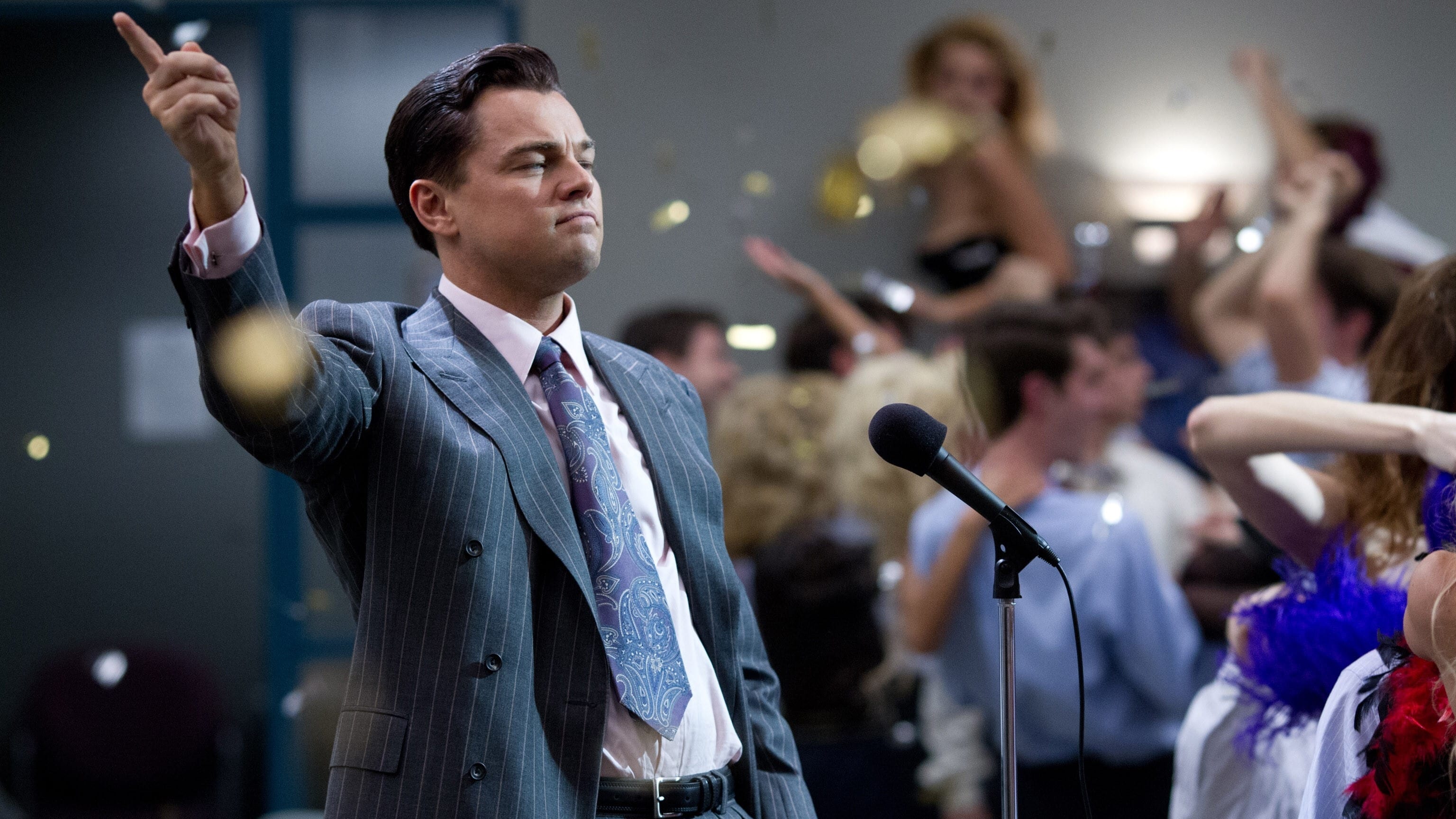
That is why the limited psychological depth inside Belfort works for me. He is not secretly profound or tragically misunderstood. He is appetite equipped with exceptional presentation skills. Everyone around him keeps mistaking volume, wealth and certainty for substance, yet the movie repeatedly reveals how little remains once the performance breaks down. The frightening part is not that Belfort possesses some mysterious genius. It is that his crude impersonation of success is enough.
DiCaprio makes charisma look like a dangerous physical condition
DiCaprio gives one of the great comic performances of his career. His Belfort can shift from polished persuasion to animal panic without losing the vanity connecting both states. Even when his body rebels against him, his ego keeps trying to direct the scene. That combination makes his authority immediately legible while preventing the character from becoming a cosy outlaw hero.
The extended drug-impaired sequence provides the performance’s most spectacular physical breakdown. DiCaprio makes Belfort appear to lose his normal operating instructions, turning a supposedly powerful man into a desperate tangle of limbs, grunts and catastrophic calculations. Washington Post critic Ann Hornaday described the sequence as elaborate, ugly and viciously funny physical comedy. Hornaday’s assessment of DiCaprio’s physical performance is useful because it identifies the tension powering the whole role: Belfort’s self-image remains grandiose even when the evidence of his collapse is dragging itself across the floor.
DiCaprio’s magnetism also intensifies the movie’s central risk. Belfort dominates the room even while the screenplay exposes him, and viewers are given no reassuring moral chaperone to announce when the fun has become unacceptable. I do not think that automatically amounts to glamorization. It means the critique depends on us noticing the emptiness beneath the charisma and recognizing that feeling entertained by a salesman is not the same as accepting his values.
The supporting characters provide resistance and consequence, but they do not receive comparable dramatic space. Donnie is primarily an accomplice and grotesque reflection of Belfort. Naomi can puncture Jordan’s delusions, yet she is still defined largely by her relationship to his appetites. Denham supplies the pressure of federal scrutiny without becoming an equally developed counterweight. Belfort makes everything about himself, so the imbalance has a clear dramatic logic, but it also leaves the human cost less vivid than the spectacle of causing it.

Three hours move at the speed of a bad decision
The Wolf of Wall Street runs 179 minutes, but it rarely behaves like a conventional three-hour drama. Thelma Schoonmaker’s rapid editing, Rodrigo Prieto’s cinematography and Scorsese’s aggressive deployment of music keep the film hurtling between sales rallies, direct addresses, domestic confrontations and chemically assisted disasters. Hornaday likewise identified the pacing, music and large-scale staging as major sources of its propulsion.
That velocity matters because Belfort’s operation depends on momentum. His employees are not invited to think; they are trained to shout, celebrate and sell. The office becomes a predatory carnival where humiliation and exploitation are repackaged as team spirit. Scorsese gives these gatherings the fever of a revival meeting, while Schoonmaker’s editing barely permits a moment of recovery. We understand the organization by feeling its pressure.
For me, this audiovisual assault is the film’s strongest formal achievement. Exposition becomes performance. Financial wrongdoing that could have disappeared beneath diagrams and solemn speeches instead emerges through rhythm, repetition and escalating confidence. Belfort teaches his staff to sell garbage while selling his mythology directly to us. Form and subject lock together with almost indecent precision.
The limitation is that the episodic pattern eventually becomes familiar: success leads to debauchery, debauchery produces a louder catastrophe, and the catastrophe becomes another anecdote Belfort can use to center himself. The exhaustion is purposeful, but purpose does not make every escalation equally revealing. There are passages in which the movie has already established the spiritual vacancy of this lifestyle and then proves it again at greater volume.
Some viewers will feel trapped at the party long after they have understood the point, and that response is reasonable. I find the endurance test productive because pleasure gradually turns into nausea without the movie announcing the transition. Even so, a more selective final stretch could have retained the suffocating effect while giving individual consequences greater dramatic weight. The film is brilliantly paced from moment to moment, yet deliberately repetitive when viewed as a whole; both things can be true.
The emotional thinness is both the method and the weakness
Hornaday’s original review found Scorsese’s film easier to admire than to love and argued that Belfort’s relationships with Donnie, Naomi and Denham were not fully realized. I agree with the diagnosis but not entirely with the resulting distance. The relational thinness weakens the victims’ dramatic presence, yet it also traps us inside a culture where other people register mainly as customers, accessories, obstacles or applause.
That distinction matters. A warmer treatment of the supporting characters could have made the damage more immediate, but it might also have given viewers a comfortable moral refuge outside Belfort’s world. Scorsese offers very little refuge. Nearly every interaction is contaminated by selling, status or possession, and that emotional poverty becomes part of the atmosphere.
Still, the movie occasionally permits its commitment to Belfort’s perspective to crowd out the people harmed by him. The fraud’s victims remain more abstract than the men spending their money. That is the strongest objection to the film’s approach because satire does not gain automatic moral clarity merely by becoming exhausting. Scorsese’s strategy succeeds for me, but it succeeds on a knife-edge: the spectacle has to reveal its own hollowness before it simply becomes spectacle.
Scorsese implicates the culture, not just the criminal
Scorsese said that anger and frustration with a culture of getting rich at all costs helped motivate the film. In his Los Angeles Times discussion of the film’s anger, he placed Belfort within a broader system of predation rather than treating him as an isolated celebrity criminal. That context matters because the movie’s real subject is not simply the existence of one corrupt stockbroker. It is the appetite that makes his performance marketable.
Belfort’s employees want his approval. His audiences want his formula. The film repeatedly returns to people watching him because spectatorship is part of the machinery. He thrives whenever proximity to wealth matters more than asking how it was created. The laughter catches because the movie understands how easily vulgarity can masquerade as honesty and how readily exploitation can be sold as liberation from ordinary rules.
This is why I part company with the simplest criticism of the excess. Yes, drugs, parties and wealth occupy far more screen time than the people damaged by the fraud. Yes, the spectacle sometimes threatens to overwhelm the indictment. But making Belfort’s world dull or transparently fraudulent from the first frame would avoid the harder question: why is this nonsense persuasive?
Scorsese’s answer is that predation often arrives as entertainment. Belfort makes exploitation look communal, converts vulgarity into supposed authenticity and sells greed as personal emancipation. The film recruits us into that excitement and then makes our enjoyment increasingly uncomfortable. It is not a clean arrangement, but cleanliness would allow everyone to leave feeling superior to a culture that is still listening for the next pitch.
The refusal of easy catharsis completes the argument. Conventional justice may address an individual offender without dismantling the desire that made him successful. Scorsese is less interested in reassuring us that consequences exist than in asking what remains unchanged after they arrive. His bleak answer is that the salesman can fall while the audience for his fantasy keeps waiting.
A corrosive comedy worth enduring
The Wolf of Wall Street is essential viewing for adults who enjoy abrasive dark comedy, dazzling filmmaking and crime stories that refuse stable moral footing. It is also a knowingly hostile experience: 179 minutes of manipulation, vulgarity, drugs and sensory overload, populated by people whose charisma greatly exceeds their capacity for empathy.
Viewers seeking a more restrained Scorsese character study can revisit our analysis of Taxi Driver and Scorsese’s approach to alienation. For a later film that places exploitation and complicity within a very different historical and emotional framework, our discussion of Killers of the Flower Moon offers a useful counterpoint.
I recommend The Wolf of Wall Street not despite its moral discomfort, but because Scorsese turns that discomfort into its governing idea. The comedy attracts us, the filmmaking overwhelms us and DiCaprio sells us a man who has almost nothing inside except the ability to keep selling. The party is too long, the casualties remain too distant and the spectacle occasionally threatens to win. Yet the film’s lasting sting comes from understanding that this is exactly how hollow men become cultural heroes: they find an audience eager to mistake the thrill of the pitch for the value of what is being sold.