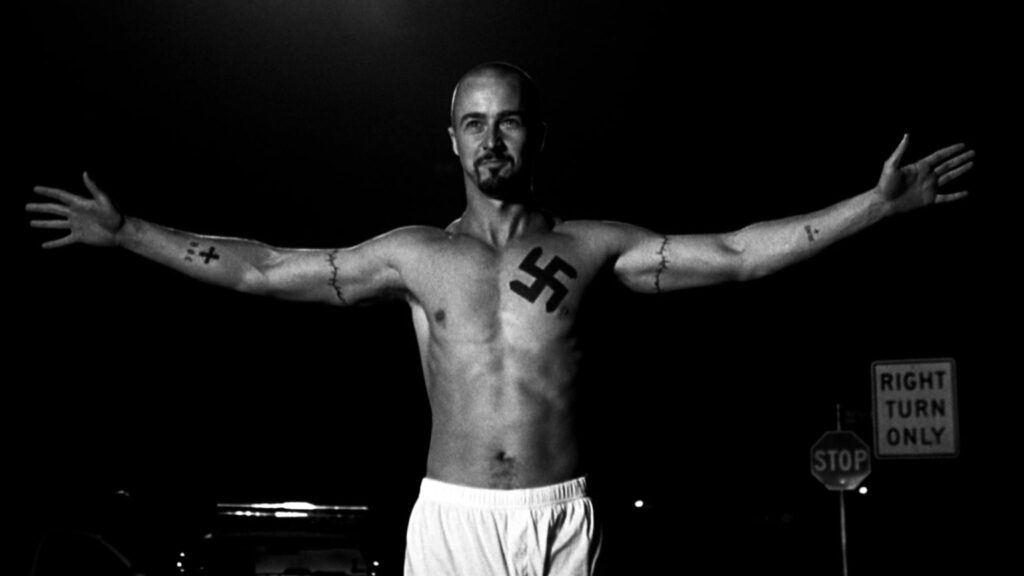
American History X remains a bruising, visually forceful drama because it understands that hatred rarely advertises itself as hatred. It arrives disguised as certainty, fellowship and an explanation for every grievance. Edward Norton makes that seduction frighteningly credible, while director Tony Kaye gives it an apocalyptic visual charge that is difficult to shake. The film is less persuasive when it tries to explain ideological transformation, but its emotional and performative force carries it through the bluntest parts of David McKenna’s screenplay.
Our verdict American History X is a bruising, visually forceful drama powered by Edward Norton’s fearless performance. Its psychology can be blunt and its imagery uncomfortably seductive, but few films portray hatred’s contagious sense of belonging with comparable intensity.
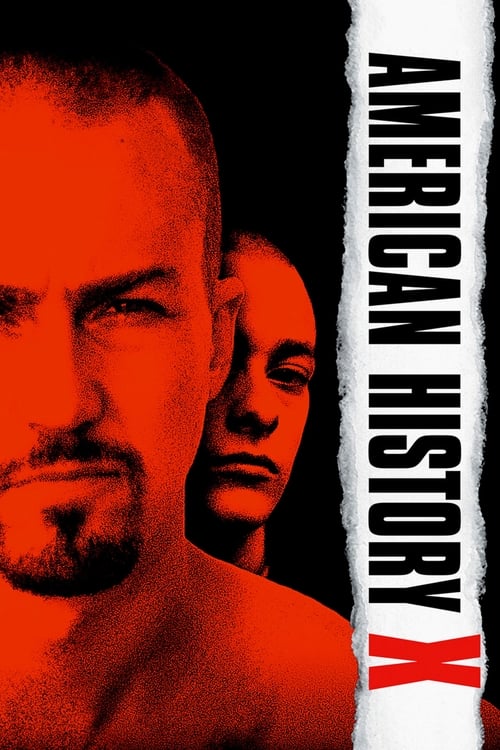
American History X (1998)
The central argument of this American History X 1998 review is that the film works best as a study of influence. Derek Vinyard does not simply hold poisonous beliefs; he projects the absolute confidence that makes other people want to borrow them. Norton’s performance turns charisma into a threat, and the family story shows how radicalization can move through admiration and proximity before anyone recognizes it as indoctrination.
American History X makes charisma feel dangerous
The spoiler-safe setup follows Derek, a former white-supremacist leader returning from prison, as he attempts to leave that ideology behind and stop his younger brother Danny from following him into the same movement. Tony Kaye directed the 1998 drama from a screenplay by David McKenna, with Edward Furlong playing Danny opposite Norton’s Derek. That premise could easily have produced a schematic message movie in which one brother represents redemption and the other represents innocence at risk. Norton and Furlong make the relationship more uncomfortable than that.
Norton’s physical transformation is striking, but the performance is not powerful merely because he looks intimidating. Derek’s real weapon is control. He can dominate a room through posture, timing and the unnerving confidence with which he reduces complicated social problems to simple enemies. Norton understands that demagogic certainty can be magnetic even when the content is repulsive. He never needs to make Derek secretly gentle or misunderstood to explain why Danny watches him so closely.

That distinction matters. The film does not ask us to excuse Derek’s history; it asks us to confront the social force he possesses. His intelligence and command make him more dangerous, not less culpable. Norton can shift between aggression, calculation and vulnerability without erasing what the character has done. It is a fearless performance because it refuses the easier routes of cartoon villainy and sentimental rehabilitation.
Furlong’s quieter work gives that force somewhere to land. Danny’s attraction to Derek’s worldview is inseparable from his attraction to Derek himself. He is not engaging with ideology at an academic distance. He is looking toward an admired older brother for identity, protection and a way of interpreting anger. That turns the film’s political conflict into a family emergency: a hateful movement is reproducing itself inside a home.
Belonging is the film’s most convincing weapon
For me, the film’s strongest scenes are not its eruptions of violence but the moments surrounding them—the speeches, social gatherings and displays of group loyalty that make violence possible. Kaye presents extremism as a community before presenting it as an argument. The movement offers its recruits companionship, status and the thrill of sharing forbidden convictions. Hatred becomes a membership card.
That is why the rhetoric has such a volatile charge. Derek understands how to turn private frustration into collective resentment, then direct it toward a target. The reasoning is fraudulent, but the emotional transaction is clear: surrender uncertainty and receive an enemy, a family and a sense of purpose. American History X sees how attractive that bargain can become to people already searching for somewhere to belong.
The social spaces consequently feel dangerous before anyone throws a punch. Conversation becomes intimidation; camaraderie starts to resemble recruitment. The film’s tension grows from watching grievance harden into identity and identity become permission. This is not conventional action filmmaking, even when Kaye’s staging becomes muscular. The suspense comes from the possibility that another person will accept Derek’s certainty as his own.

Roger Ebert similarly praised the film’s handling of skinhead group belonging while arguing that it never fully maps Derek’s path into racism. Ebert’s contemporary review describes a film containing powerful individual scenes without enough connective shape. I agree with the diagnosis more than the severity of his verdict. The missing psychological steps are a genuine weakness, but Norton makes the lived experience of Derek’s influence so tangible that the drama retains its power even when the screenplay skips necessary development.
The black-and-white past refuses to stay buried
Kaye separates black-and-white scenes from the color present, using flashbacks and narration to construct Derek and Danny’s history. Contemporary coverage also identified that visual division as a defining part of the film’s structure. It is an emphatic device, hardly interested in subtlety, but its severity suits a story about memory functioning as both evidence and mythology.
The monochrome imagery gives the past a monumental quality. It does not feel safely concluded; it feels carved into the family’s understanding of itself. Kaye’s Venice, Los Angeles can appear almost apocalyptic, an environment shaped by simmering resentment and the expectation of violence. Ebert singled out that visual character in his review, and it remains central to the film’s impact.
There is an ethical complication here, and the film never entirely resolves it. Kaye photographs hateful rhetoric and racist brutality with such intensity that condemnation sometimes competes with spectacle. Contemporary critics raised the concern that this vivid staging could draw cinematic energy from the very hatred the film opposes. The problem is not that American History X endorses Derek’s ideology—it plainly does not. The problem is that a commanding image can retain its seductive force after the intended moral judgment has been attached.
That tension is partly productive. A visually timid film might fail to communicate why Derek commands attention. We need to understand his force if Danny’s fascination is to make sense. Yet American History X occasionally pushes beyond depicting charisma and begins packaging it. The poses become too iconic, the violence too operatic. The movie wants viewers to recoil, but it also knows exactly how powerful Norton looks at the center of the frame.
The screenplay explains what the performances already show
McKenna’s screenplay is much more convincing about membership in a hateful movement than about the complete psychological journey into and out of it. Individual confrontations hit hard, but the connective development can feel compressed. Major changes are sometimes communicated through speeches, narration or melodramatic emphasis when quieter behavioral detail would have made them more convincing.
The dialogue also has a habit of underlining ideas that the performances have already delivered. Norton can show Derek’s authority through a pause or a change in posture; the script will then hand him another declaration to make the point unavoidable. Avery Brooks brings valuable steadiness as a counterweight to Derek’s certainty, but some exchanges feel engineered to carry the film’s argument rather than emerging naturally from the characters.
This bluntness does not make the film intellectually empty. Its sharpest insight remains embedded in the relationship between the brothers: ideology spreads through emotional bonds as well as political persuasion. The family material therefore deepens the political story, even when the screenplay pushes it toward melodrama. Danny is vulnerable not because he has examined every racist claim and found it persuasive, but because those claims arrive in the voice of someone he reveres.
The released film also emerged from a severe post-production dispute involving Kaye, New Line and Norton, with contemporary reporting documenting Kaye’s objections and Norton’s participation in a later edit. That history may offer context for some of the structural roughness, but it does not settle authorship or replace criticism of what appears on screen. Whatever happened in the editing room, the finished movie remains uneven in its transitions and remarkably unified in its emotional aggression.
A punishing film that still earns its recommendation
American History X is not subtle political psychology, and viewers looking for a patient account of radicalization may be frustrated by how quickly it moves between decisive stages in Derek’s life. Its imagery can lend troubling grandeur to the hatred it seeks to expose, while its dialogue sometimes turns complicated human change into a sequence of forceful lessons.
But the film’s central warning remains potent. Extremism does not spread only because people are angry or ignorant. It spreads because someone makes anger feel coherent, turns isolation into fellowship and offers identity in exchange for obedience. Norton embodies that process with terrifying conviction, while Furlong makes its transmission personal rather than theoretical.
Viewers interested in other formally distinctive films from the same year can also revisit our reviews of Christopher Nolan’s Following and Wes Anderson’s Rushmore, two very different examples of how 1998 cinema used strong visual identities to organize character-driven stories.
This is essential viewing for Norton admirers and strongly recommended for audiences prepared for graphic violence, explicit racist language and an emotionally punishing family drama. American History X is too blunt to be definitive and too visually charged to be morally uncomplicated. It is also too powerful to dismiss. Its most disturbing achievement is making hatred recognizable not merely as rage, but as an invitation—and showing why that invitation can be so difficult to refuse.
References
- AFI|Catalog
- American History X (1998) directed by Tony Kaye • Reviews, film + cast • Letterboxd
- American History X movie review
- Skin-Deep Racial Lessons – Los Angeles Times
- Will Audiences Love New Line's Hate-Crime Film? – Los Angeles Times
- 'HISTORY X': HATE WITH A PASSION – The Washington Post
- AN UNHAPPY BEGINNING – The Washington Post
- Kaye Walks His Talk – Los Angeles Times