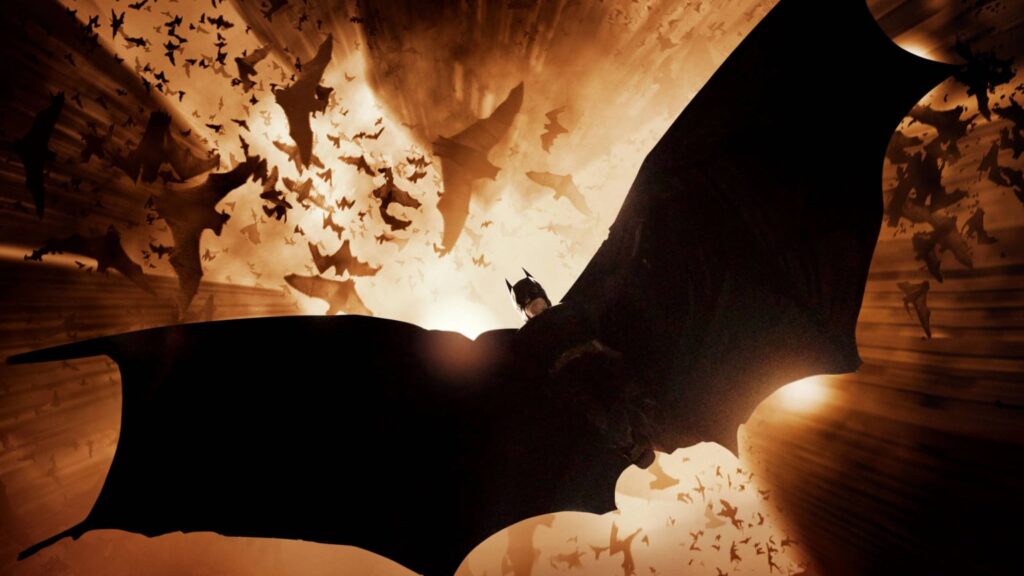
Batman Begins understands that the interesting part of an origin story is not acquiring equipment or choosing a logo. It is the decision to become someone else. Christopher Nolan’s 2005 reinvention makes Bruce Wayne’s transformation feel psychologically earned, physically tangible and genuinely mythic. As this Batman Begins 2005 review argues, its greatest achievement is treating the construction of Batman as the main drama rather than paperwork to complete before the explosions begin.
Our verdict Christopher Nolan makes Batman’s origin feel psychologically earned, physically tangible and genuinely mythic. Some muddled action and an overblown finale cannot undo a superb character-first blockbuster built from fear, moral purpose and atmosphere.

Batman Begins (2005)
The result is a superb character-first blockbuster: solemn without becoming hollow, spectacular without abandoning its human foundation, and atmospheric enough to make Gotham feel like a city that might actually need Batman. Some confused close-quarters action and an oversized finale prevent every element from operating at the same level. They do not diminish the force of Nolan’s central idea. Bruce does not simply put on a suit. He takes the fear that has governed his life and deliberately turns it into a public weapon.
Batman Begins makes becoming Batman the story
Directed by Nolan and written by Nolan and David S. Goyer, Batman Begins follows Bruce Wayne from personal tragedy and self-imposed exile through his study of crime, fear and anger. He eventually returns to a corrupt Gotham with training, resources and a moral code, but without a finished heroic identity. That distinction matters. Batman is not waiting in a cupboard for Bruce to assemble him; the symbol emerges from a succession of difficult choices.
Christian Bale anchors that process as a Bruce who is wounded, isolated and uncertain about what his anger should become. He can project cold authority, but the performance is most persuasive when Bruce is still testing the boundaries between justice and revenge. Bale does not play Batman as an inevitable endpoint. He shows us a man deciding what he will refuse to become, which gives the eventual transformation far more weight than another montage of expensive equipment ever could.

The screenplay keeps returning to the difference between a man and a symbol. Bruce understands that one furious billionaire cannot permanently change Gotham, but a theatrical figure capable of occupying the criminal imagination might. The cape, voice and dramatic entrances are therefore more than familiar iconography. They are conclusions Bruce reaches about fear, power and his own limitations. The disguise expresses an argument: Bruce Wayne is vulnerable and temporary, while Batman might become larger than the person beneath the mask.
That emphasis also explains why the technology works. The gadgets are impressive, but they arrive after Bruce has established a purpose for them. In his contemporary review, Roger Ebert identified this priority as the film’s defining break from spectacle-led superhero filmmaking, praising its concentration on Bruce’s tortured development and its preference for story and character over hardware. Roger Ebert’s 2005 review That historical response remains revealing because Batman Begins arrived before psychologically grounded superhero reboots became an industry reflex. Nolan did not merely darken the color palette; he rebuilt the genre around the act of self-creation.
Gotham turns Bruce Wayne’s fear into architecture
For me, Gotham’s oppressive atmosphere is the film’s greatest achievement. Cinematographer Wally Pfister and production designer Nathan Crowley create a city of looming shadows, industrial grime, fog and constricted urban spaces. Lee Smith’s editing and the forceful music by Hans Zimmer and James Newton Howard add nervous momentum, while the sound design makes Batman’s appearances feel like violent interruptions in the environment. Pfister, Crowley, Smith, Zimmer and Howard are among the film’s principal credited craftspeople.
Gotham is not a generic backdrop waiting for a hero to clean it up. It feels like the external form of Bruce’s interior life: frightened, angry, divided between privilege and desperation, and never entirely visible. That connection is why Nolan’s seriousness works. The imagery makes Bruce’s theatrical response seem proportionate to the world around him. In a polished, reassuring city, this Batman would look like a billionaire having an elaborate breakdown. In Nolan’s Gotham, he feels necessary.
The city also gives the film a scale that does not depend on constant destruction. Corruption appears embedded in institutions, streets and private rooms rather than confined to one colorful villain. Batman consequently feels like a response to an ecosystem. Bruce cannot fix Gotham by punching a single designated problem until it stops moving; he must create a symbol capable of challenging the fear that keeps the entire system functional.

The supporting cast populates that system with different models of responsibility. Michael Caine’s Alfred offers loyalty without surrendering his right to challenge Bruce. Gary Oldman’s James Gordon represents decency trying to survive inside a compromised institution, while Morgan Freeman’s Lucius Fox turns Bruce’s abstract plans into practical tools. Liam Neeson, Cillian Murphy, Katie Holmes and Tom Wilkinson occupy other positions within Gotham’s web of fear, authority and corruption.
Not every supporting figure is as richly developed as the city itself. Several function primarily as guides, obstacles or moral counterweights in Bruce’s journey. That is one of the screenplay’s few limitations: Gotham seems to possess endless layers, while parts of the ensemble can feel engineered to push Bruce toward his next realization. Bale and Caine overcome much of that imbalance. Their exchanges provide warmth, friction and a sense that Bruce’s crusade has consequences for someone who knows the person behind the performance.
Physical spectacle gives the mythology weight
Batman Begins grounds its fantasy through a hybrid production approach. In Nolan’s Directors Guild of America discussion of the production, he described combining full-scale sets, complex stunt work and detailed miniatures with digital enhancement. The train climax used full-size carriages on a gimballed stage, large models and fully digital shots designed to match photographed material. Nolan’s account of the effects work
That mixture matters because Batman should appear to occupy physical space. Vehicles have mass, environments have texture, and Gotham’s infrastructure seems to resist the people moving through it. The digital work extends the illusion rather than replacing its foundation. Even when the film reaches comic-book extremes, there is usually a wall, machine, costume or moving piece of infrastructure giving the image tangible weight.
The approach shares the respect for physical presence that helps older action movies endure. It is a very different kind of film, but that same resistance and texture are central to why Predator remains an action-thriller classic. Batman Begins wants its mythology to feel touchable. Nolan’s Gotham is heightened, but it seldom feels frictionless.
The frustration is that the close-quarters action does not always showcase that physical work clearly. Several fights use rapid cutting and restricted framing to make Batman seem like a frightening blur. I understand the intention: criminals should struggle to see where he is or how he is attacking. Yet disorienting Batman’s targets and disorienting the audience are not automatically the same achievement. When movement becomes difficult to parse, the editing briefly undermines the bodily credibility that the sets, costumes and stunt work establish so effectively elsewhere.
The film remains exciting because its best action is built around anticipation, space and threat rather than choreography alone. Batman’s arrival can matter more than the exchange of blows that follows. Nolan is especially good at turning absence into presence: darkness suggests a figure before the frame fully reveals him, and nervous reactions sell the idea that the symbol is already working. The hero becomes myth through other people’s fear.
The finale gets bigger without becoming more interesting
The other substantial weakness is the final escalation. For most of its runtime, Batman Begins builds tension through Bruce’s moral education, Gotham’s institutional decay and the question of what kind of force Batman should become. The concluding movement shifts toward louder, more conventional blockbuster machinery. It remains entertaining, and the production’s practical heft keeps it from becoming disposable, but the explosions are less distinctive than the patient psychological construction preceding them.
This is where the movie briefly behaves as though becoming Batman was preparation for a standard action climax rather than the point of the story. Scale replaces some of the intimacy, and momentum pushes aside the more interesting question of what Bruce’s choices demand from him. The finale does not erase the thematic work; it simply expresses it in a less individual way. Nolan has spent the movie carefully building a singular hero, only to place him inside climax mechanics that could have accommodated someone less complicated.
The intense tone can also push the dialogue toward over-solemnity. Characters frequently speak as though they know their words will be quoted over a trailer twenty years later. Yet the commitment of the performers and the consistency of the atmosphere prevent that gravity from collapsing into accidental parody. Batman Begins believes fear, justice and civic responsibility are worthy subjects for a superhero blockbuster. I would rather see it risk too much seriousness than smother Bruce’s transformation beneath jokes designed to apologize for the premise.
A superhero origin story with moral purpose
What remains most impressive is how confidently the film links psychology, imagery and theme. Bruce’s trauma is not merely a shortcut to audience sympathy. It is the problem he must examine, discipline and redirect. His refusal to surrender entirely to vengeance matters because the film presents that boundary as a choice made under pressure, not a marketability rule handed down to the hero from outside the story.
That commitment separates Batman Begins from origin stories that confuse familiarity with inevitability. Audiences already know what Bruce Wayne becomes, but Nolan restores suspense by asking what that identity means and why this particular man would create it. Compare its patient construction with the more conventional framework discussed in our Ant-Man review. Personality can enliven a familiar template, but Batman Begins goes further by making the creation of the template part of its character study.
The film also points toward the bruised emotional seriousness that later superhero movies would pursue more openly. Viewers drawn to character-first comic-book storytelling should also read our review of Logan and its tragic vision of Wolverine. Batman Begins is less elegiac, but both films understand that an iconic costume or name becomes dramatically valuable only when attached to pain, choice and consequence.
Verdict: an essential Batman origin
Batman Begins is essential viewing for superhero fans who want character, atmosphere and moral purpose alongside spectacle. Its severe tone may frustrate anyone seeking breezy entertainment, and the occasional muddle of its fights prevents the action from consistently matching the strength of its production design. The final movement is also more conventional than the film deserves.
Those flaws are overwhelmed by the confidence of the transformation at its center. Bale gives Bruce Wayne enough vulnerability and determination to make Batman feel built rather than preordained. Nolan gives Gotham enough menace to justify the symbol rising within it. Most importantly, the film understands that an origin story should not merely explain where the equipment came from. It should explain why a person would need to become an idea. Batman Begins does exactly that, and it remains an emphatic recommendation.