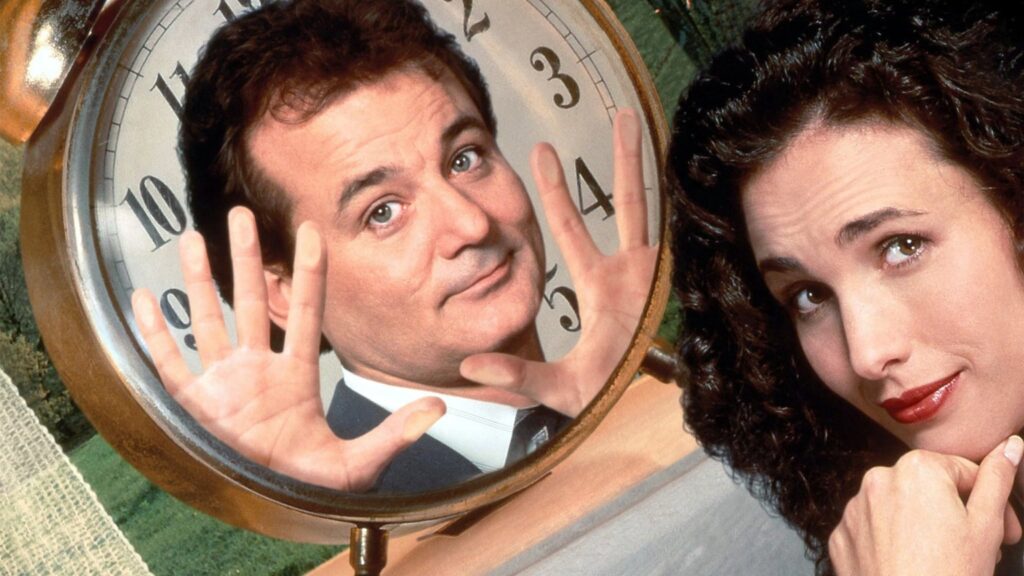
Groundhog Day is one of those high-concept comedies that became so culturally familiar that its smartest choice is easy to overlook: it never explains the concept. This Groundhog Day 1993 review finds Harold Ramis’ film enduring not because it supplies ingenious time-travel rules, but because it understands that rules would be a distraction. The repeating day is not a mystery box. It is a machine built to dismantle Phil Connors’ smug certainty that every problem can be beaten, manipulated or escaped.
Our verdict Groundhog Day remains a sharp, warm time-loop comedy because it treats repetition as a test of character rather than a puzzle to solve, although its broad opening and tidy romantic turn soften the premise’s stranger possibilities.
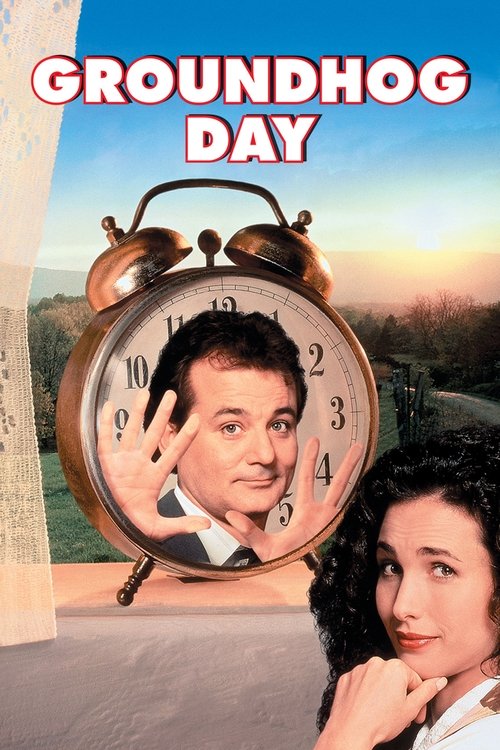
Groundhog Day (1993)
That decision turns an excellent comic premise into an accessible argument about change. Phil cannot charm the universe, outsmart the calendar or locate the correct supernatural loophole. He can only keep meeting himself. Bill Murray makes that confrontation funny, sour and eventually moving, although the film’s broad opening and reassuring romantic destination prevent it from fully embracing the stranger possibilities buried inside its premise.
The unexplained loop is Groundhog Day’s smartest idea
The setup is beautifully clean. Cynical television weatherman Phil Connors travels to Punxsutawney to cover its Groundhog Day festivities, gets stranded after a blizzard and begins waking to the same morning. Ramis establishes Phil’s contempt for the assignment, the town and nearly everyone around him before repetition starts applying pressure. That clarity matters because the film never needs to pause later and explain what kind of man is trapped: we already know him.
Danny Rubin and Ramis share screenplay credit, with Rubin also credited for the story. Rubin has discussed an earlier version that began with Phil already inside the loop, delayed the explanation and used voice-over. The finished film chooses the more conventional route of establishing the ordinary day before replaying it. It sacrifices a little mystery, but gains comic precision. Each repeated encounter works because the audience can measure it against a clearly defined original.
More importantly, the cause of the loop remains absent. Rubin and producer Trevor Albert have explained that attaching a concrete origin to Phil’s condition would redirect the story toward defeating a plot mechanism. They were right. A curse, scientific malfunction or divine instruction manual would give Phil something external to blame. By withholding an answer, the film turns his predicament inward. The question is no longer simply “How does he get out?” but “What does endless freedom reveal about him?”
That is why Groundhog Day remains more satisfying than many puzzle-driven descendants. It does not confuse mythology with meaning. The recurring day creates opportunities for escalating jokes, but the structure keeps returning to character: knowledge initially makes Phil more powerful without making him wiser. Repetition gives him new tactics while preserving the personality that caused the problem. Escape only becomes imaginable once he stops treating every person and event as another obstacle in his private game.
I also like that the movie trusts the audience to accept uncertainty. The missing explanation does not feel like an omitted piece of lore because the screenplay never pretends that lore is its destination. Ramis uses the loop as pressure rather than decoration. Every reset strips away another excuse, leaving Phil with fewer places to hide from the obvious problem: wherever the day begins, he is still the person bringing his contempt into it.
Bill Murray makes redemption difficult enough to matter
Murray’s caustic delivery gives the early film its bite. Phil does not merely dislike the assignment; he behaves as though the universe has committed an administrative error by asking him to share space with ordinary people. The performance is funniest when Murray lets hostility sit underneath professional polish. A smile becomes a threat, a weather report becomes an insult, and basic conversation feels like an exhausting favor Phil is extending to humanity.
That abrasive foundation is essential. A softer performance might have made Phil’s eventual growth easier to accept, but it would also have made the journey far less interesting. Murray allows the film to become warm without pretending its protagonist was secretly lovely all along. His contempt is real, and the recurring day gradually wears through it rather than simply revealing a hidden sweetheart beneath the sarcasm.
Murray also stops the redemption arc from becoming completely syrupy. Even as Phil develops patience and vulnerability, the performance retains enough guarded posture and dry timing to connect the changed man with the earlier one. The film does not ask Murray to turn Phil into a different species. It asks him to redirect the intelligence and attention that previously served his ego.
There is a comic cost to that movement. Roger Ebert observed that Murray is funnier in Phil’s sour mode than after the character becomes more likable. On the narrow question of laughs, I agree: early Phil generates friction simply by entering a room, while the later version fits more comfortably within the community and therefore produces fewer sparks. But I would not trade the complete arc for a consistently nastier comedy. Losing some of that hostility is the point, and the film would be dramatically hollow if it preserved Phil’s funniest qualities merely to keep the joke machine running.
Woodstock becomes both refuge and enclosure
The small-town setting does more than provide quaint scenery. Groundhog Day was filmed primarily in Woodstock, Illinois, rather than Punxsutawney, with Ramis describing Woodstock as “the classic small town of the imagination.” The AFI Catalog’s production history documents the use of the town’s opera house as Phil’s hotel, the construction of the Tip Top Café and festival set, commissioned ice sculptures, and work involving a groundhog performer and stand-ins.
That tangible production work gives the movie an idealized but convincing geography. The streets, café, hotel and festival square become familiar through repetition without feeling like interchangeable studio spaces. Ramis needs the town to function in two contradictory ways: it must be cozy enough that Phil could plausibly learn to value it, yet enclosed enough that his inability to leave feels maddening.
For me, that tension is the atmosphere’s strongest quality. Woodstock initially resembles Phil’s idea of punishment: cheerful, communal and aggressively pleased with its own traditions. As his perspective changes, the same spaces become inviting without the production design itself needing to transform. The town was never the real prison. Phil’s habit of seeing other people as inconveniences, targets or background decoration created much of the confinement.
The effect makes Groundhog Day an interesting counterpoint to darker stories about suffocating communities, including MovieBunker’s review of The Beasts and its poisonous small-town grudges. Ramis uses enclosure toward the opposite emotional end. Familiarity gradually creates connection rather than deepening suspicion, even if the film never loses the faintly uncanny idea of a world resetting around one conscious man.
The romantic warmth works—but it also makes the film safer
Ramis brings a warmer romantic-comedy sensibility to Rubin’s premise, and that accessibility is a major reason the film survives as more than an admired screenplay mechanism. Rubin has credited Ramis with pushing the material toward greater warmth and romance. Andie MacDowell’s Rita gives Phil’s transformation an emotional focal point, but the movie works best when she represents more than a reward at the end of his self-improvement project. Her resistance confronts him with the limits of performance: collecting the right information is not the same as becoming worth knowing.
The sincerity is earned because Murray’s initial hostility gives it something substantial to overcome. Still, the romantic-comedy shape tidies the premise. A man trapped in an unexplained pocket of time could anchor a horror film, an existential breakdown or a cruel study of consequence-free power. Groundhog Day approaches darker emotional territory, but its destination is reassuring. The universe appears less interested in destroying Phil than educating him with supernatural patience.
That gentleness is both limitation and appeal. In his contemporary review, Kenneth Turan found the film charming but argued that its opening leaned too heavily on broad Hollywood shtick. More than three decades later, that criticism still identifies the section that has aged least gracefully. The introductory comedy sometimes feels routine, as though the movie is killing time before reaching the structure that makes it special. Phil’s hostility is necessary, but not every broad beat used to establish it is equally sharp.
My larger reservation comes later. Once redemption and romance take control, some of the premise’s unsettling ambiguity gets polished into conventional uplift. Phil’s softer register is emotionally satisfying but less consistently funny, and the movie becomes safer just as its concept seems capable of becoming stranger. Viewers primarily drawn to the existential trap may find the destination a little too neat.
Yet conventional does not automatically mean false. Groundhog Day’s warmth works because it grows out of accumulated attention rather than one miraculous declaration. Its central moral idea is not that a grand gesture repairs a life. It is that repeated choices slowly alter the person making them. That is a sturdier emotional foundation than many formula-driven romances manage; readers interested in the genre’s more predictable modern habits can compare it with our review of About Fate.
Groundhog Day still earns another viewing
Groundhog Day remains highly recommended for viewers who like dry Bill Murray performances, high-concept comedies and redemption stories sincere enough to risk sentiment. Its opening takes a little too long to clear the runway, and the later romantic neatness softens what might have been a stranger, harsher film. Anyone primarily interested in elaborate time-loop mythology will also need to look elsewhere; Ramis is deliberately uninterested in drawing a diagram.
That refusal is precisely why the film lasts. Groundhog Day does not solve repetition by finding the correct exit. It uses repetition to expose the emptiness of Phil’s old way of moving through the world. The result is clever without becoming mechanical, sweet without entirely losing Murray’s acid edge, and optimistic without denying how difficult genuine change can be. The loop is ingenious. The character trapped inside it is the reason the movie matters.
References
- Groundhog Day | Rotten Tomatoes
- Groundhog Day credits – Metacritic
- Big Think Interview With Danny Rubin – Big Think
- Groundhog Day: How a Gypsy Curse Plot Nearly Ruined the Film
- Groundhog Day movie review & film summary
- AFI|Catalog
- MOVIE REVIEW : Bill Murray's 'Groundhog Day': It's Deja Vu All Over Again – Los Angeles Times