
Alfonso Cuarón’s Y tu mamá también is a raunchy road movie with unusually sharp peripheral vision. It understands why Julio and Tenoch find their private adventure thrilling, but it never mistakes their excitement for the whole world. The film keeps widening around them, making room for Luisa’s perspective, the class divide inside their friendship and a Mexico carrying on beyond the boys’ sexual fantasies. That tension is what makes the movie funny, tender and quietly devastating.
Our verdict A sexually candid road movie that turns adolescent swagger into something warmer, sadder and socially alert. Cuarón’s loose dialogue and widening narration make a familiar coming-of-age journey feel remarkably alive.

Y tu mamá también (2001)
The central argument of this Y Tu Mamá También 2001 review is simple: Cuarón turns adolescent self-absorption into a point of view rather than an endorsement. The boys think they are starring in a story about freedom, friendship and sex. The film knows they are merely passing through a much larger landscape, barely noticing what their own journey reveals. It is sexually explicit and often very crude, but its candor serves a coming-of-age story interested in vulnerability, inequality and the short shelf life of youthful certainty.
A road trip trapped inside a teenage worldview
The spoiler-safe setup follows teenage best friends Julio and Tenoch, played by Gael García Bernal and Diego Luna, as they travel with Luisa, an older Spanish woman played by Maribel Verdú. Julio and Tenoch come from different social classes, although their shared appetite for boasting initially lets them behave as if those differences are irrelevant. Luisa’s arrival changes the chemistry of that friendship and gives their imagined escape a perspective neither boy can control.
Cuarón does not immediately correct the boys or force them into tidy lessons. He indulges their energy, competitive friendship and ridiculous confidence long enough for us to understand the appeal of their bubble. Their immaturity is not disguised as sophistication. Every attempt to sound worldly exposes how little they know about sex, one another and the emotional consequences of their behavior.
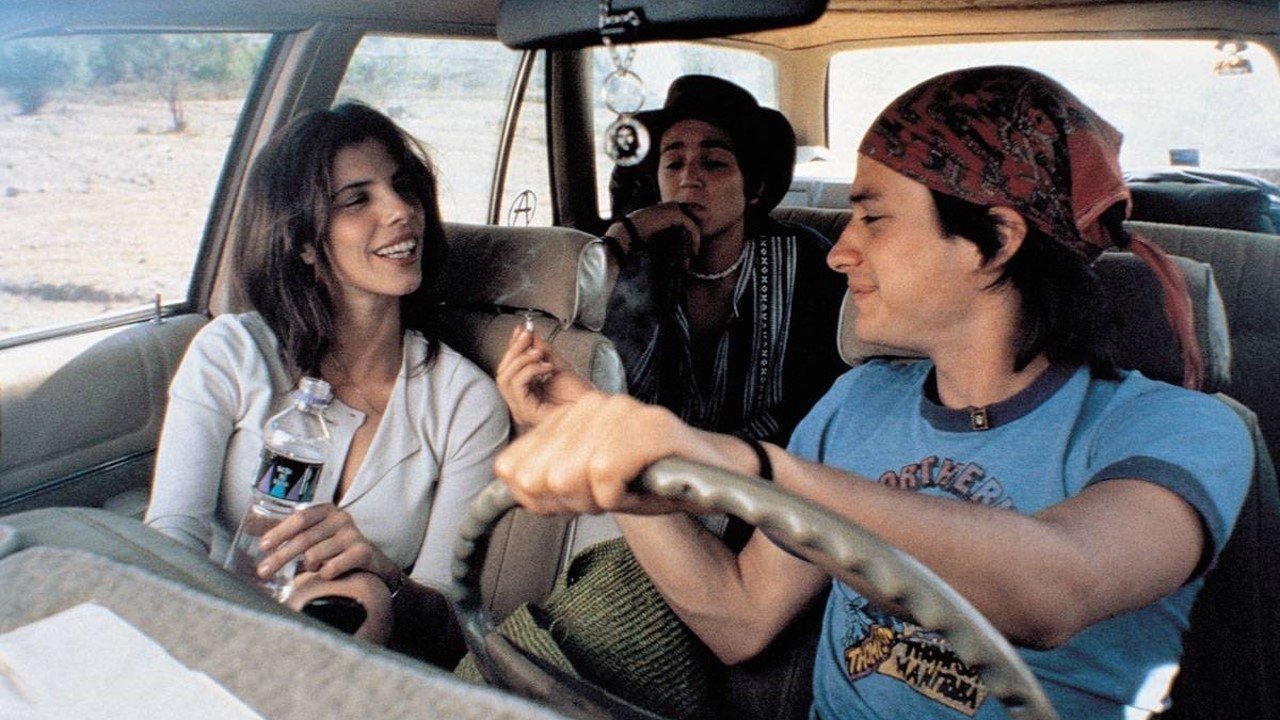
That makes the comedy more convincing than a screenplay built around polished punchlines would have been. Julio and Tenoch are funny because they are boastful, awkward and transparent. They repeatedly reveal themselves at the exact moment they believe they are creating an impressive image. The joke is not that teenagers use crude language; it is that these particular teenagers treat crudity as proof of experience.
Loose dialogue gives the friendship its messy pulse
Cuarón and co-writer Carlos Cuarón built the screenplay around language that feels responsive to the actors rather than scrubbed into generic movie banter. Cuarón later explained that the young performers adapted scripted dialogue into their own slang, while improvisation could begin before a scripted scene and continue until the cut. In his BAFTA screenwriters’ lecture, he described a process that helps explain the movie’s unusually loose conversational rhythm.
The result is a friendship that sounds lived in without becoming shapeless. Bernal and Luna give the boys a convincing shared rhythm: they compete, perform and reinforce one another’s worst instincts, yet their ease together also communicates genuine affection. The film needs both sides. If their bond were only toxic, the eventual melancholy would feel mechanically imposed; if it were merely charming, Cuarón’s critique of their selfishness would lose its teeth.
There is, however, a legitimate limit to how much mileage a viewer may get from this behavior. Variety critic Leonardo Garcia Tsao identified the oversexed, underdeveloped male duo as the film’s principal weakness, a fair counterargument even if it does not match my final judgment. The boasting can become repetitive, and the boys are deliberately exhausting company. Viewers who do not find that repetition revealing may feel the film asks two thinly drawn adolescents to carry more dramatic weight than they can support.
For me, their narrowness is the mechanism rather than the failure. Julio and Tenoch are compelling not because they contain hidden reserves of wisdom, but because Cuarón continually exposes the gap between their confidence and their understanding. The movie allows them to dominate the conversation while refusing to let them define its meaning.

Luisa changes the emotional scale
Luisa is crucial because she is not simply a glamorous reward placed at the end of a teenage fantasy. Verdú brings an adult emotional gravity into a dynamic built on juvenile competition. The boys project desire and experience onto her, but the movie steadily establishes that she has a perspective separate from their assumptions. Her presence makes their posturing look smaller without turning her into a scolding representative of maturity.
This is where the film’s combination of warmth, sexual candor and melancholy becomes most effective. Sex initially provides comic momentum and the promise of escape, but Cuarón gradually reveals the vulnerability underneath it. The frankness is not decorative provocation. In the film’s production notes, Cuarón said the filmmakers did not want to hide sexual situations and instead aimed to portray them honestly. That intention is visible in how intimacy creates uncertainty and imbalance rather than functioning as a simple badge of liberation.
The approach also makes Y tu mamá también difficult to recommend indiscriminately. Explicit sexuality and sustained crude conversation are fundamental to its character, not brief obstacles that can be ignored. Anyone seriously uncomfortable with that material is unlikely to find the social and emotional ideas beneath it sufficient compensation. Yet sanding down the film would destroy the honesty that gives its tenderness meaning. Its warmth matters because Cuarón never pretends desire is cleaner, wiser or more considerate than the people experiencing it.
The narration sees what Julio and Tenoch miss
The movie’s masterstroke is its omniscient narration. Instead of merely explaining the trio’s feelings, the voice-over repeatedly opens the frame, drawing attention to biographies, political realities and lives that continue outside the central adventure. The road-trip surface is thereby connected to class and the broader social context of Mexico.
This device prevents the journey from becoming a sealed coming-of-age playground. Julio, Tenoch and Luisa may be consumed by the unstable relationships inside their vehicle, but the country around them is not scenery waiting to decorate their memories. Cuarón and cinematographer Emmanuel Lubezki keep the travelers embedded in a larger environment, while the narration reminds us that their attention is selective. The film sees more than its protagonists do.
That broader gaze gives the movie political weight without transforming every encounter into a lecture. Class exists inside Julio and Tenoch’s friendship as well as beyond it. Their apparent equality depends partly on what they agree not to examine, and their escape cannot make those differences disappear. Cuarón’s social vision works because it challenges the characters’ self-absorption while preserving the intimate human scale of their story.
The narration occasionally states context that the images and surrounding encounters might have been trusted to communicate by implication. Its directness can briefly make the film feel as if it is annotating its own vision. Even so, I prefer that assertive widening of perspective to a version of the story that leaves the world beyond the trio as attractive background. The voice-over is not an accessory; it is the formal expression of the movie’s argument.
Raunchiness and melancholy belong to the same film
What impresses me most is how naturally Y tu mamá también allows its tones to coexist. The early comic energy is not discarded when the journey grows more reflective. Nor does the later melancholy expose the humor as a trick. Both come from the same source: the characters’ belief that an intense experience can suspend ordinary life, and the film’s understanding that no escape remains untouched by time, class or consequence.
That balance separates the movie from a conventional sex comedy. Desire propels the story, but it does not provide immunity from embarrassment or emotional damage. Freedom is real within the film, yet it is temporary and unevenly distributed. The boys’ swagger becomes poignant because Cuarón can see the fear and impermanence underneath it without sentimentalizing their selfishness.
Criterion describes the film through a similar mixture of provocative material and emotional warmth, while the critical consensus collected by Rotten Tomatoes emphasizes its sexy, wistful reflection on the transience of youth. Those descriptions capture the register, but the film’s achievement lies in refusing to divide those qualities into separate compartments. Its crudeness, affection and sadness keep complicating one another.
Y Tu Mamá También remains an essential coming-of-age film
Y tu mamá también succeeds because it does not confuse growing older with becoming morally complete. It catches Julio and Tenoch at a moment when friendship feels permanent, desire feels urgent and the world seems arranged around their impulses. Then it quietly reveals everything that perspective cannot hold: Luisa’s interior life, social inequality, other people’s histories and the certainty that even transformative experiences become memories.
This is essential viewing for audiences who appreciate naturalistic dialogue, sexually candid drama and road movies with a social conscience. The boys’ relentless immaturity and the narration’s explanatory directness may test some viewers, but neither reservation overwhelms the film’s warmth, formal intelligence or emotional precision. Cuarón gives adolescent swagger all the room it demands, then shows us how small that swagger looks against the lives and landscapes continuing beyond it.
References
- Y Tu Mamá También (2001) directed by Alfonso Cuarón • Reviews, film + cast • Letterboxd
- Y tu mamá también | Rotten Tomatoes
- static.bafta.org
- Y Tu Mamá También Reviews – Metacritic
- Y tu mamá también : Production Notes
- Y Tu Mama Tambien (And Your Mother Too) | Reviews | Screen
- Y tu mamá también (2001) | The Criterion Collection