

The Martian succeeds because it understands that competence can be action. Ridley Scott and screenwriter Drew Goddard turn calculations, improvised repairs and difficult operational decisions into the machinery of a buoyant blockbuster. I prefer its generous optimism to manufactured bleakness, and Matt Damon is exactly the actor needed to make all that technical problem-solving feel like entertainment rather than homework. The trade-off is that Mars rarely feels quite as terrifying as it should.
Our verdict Ridley Scott turns survival engineering into buoyant blockbuster entertainment. Matt Damon’s wit, the brisk problem-solving structure and the film’s faith in collective expertise outweigh softened peril and a supporting ensemble that rarely escapes mission-control function.

The Martian (2015)
Adapted from Andy Weir’s novel, the film strands astronaut and botanist Mark Watney on Mars after his crew presumes him dead during an emergency evacuation. Watney must stretch limited supplies, solve one practical crisis after another and find a way to contact Earth, while NASA and his crewmates confront the technical and ethical complications of a possible rescue. That is enough plot for a grim ordeal. The film instead finds its identity in the pleasure of watching intelligent people work.
Matt Damon makes technical exposition feel effortless
Watney spends much of the story without another person in the room, but Damon never lets isolation flatten the performance. His sardonic communications give the character someone to play to, even when that audience is only a camera and the distant possibility of human contact. He can explain a complicated process, puncture his own confidence with a joke and then bring the urgency back without making the tonal shift feel mechanical.
That charm matters because the screenplay retains plenty of scientific vocabulary rather than translating every challenge into generic movie peril. Damon makes the terminology part of Watney’s personality: thinking aloud is how he survives, and humor is how he refuses to be psychologically defeated. The jokes occasionally arrive too quickly, but the performance gives a process-driven story a warm, resilient center.

Problem-solving becomes the film’s real action language
The film’s most satisfying rhythm is simple: identify a problem, test a solution, suffer a setback and revise the plan. Scott treats each stage as meaningful forward motion. A calculation can carry the narrative force of a chase because the consequence of getting it wrong is always waiting just outside the frame.
The parallel structure prevents the Mars material from becoming monotonous. Watney’s experiments connect cleanly with decisions made on Earth and aboard the spacecraft, so separate groups appear to participate in one enormous problem-solving chain. The story moves between practical survival, institutional responsibility and personal risk without losing sight of its central objective.
This is also where The Martian distinguishes itself from combat-driven science fiction. There is no conventional villain to defeat. The antagonists are distance, time, physics, depleted resources and the possibility of human error. Even the professional disagreements generally arise from people weighing different responsibilities rather than somebody twirling a NASA-branded moustache. For another kind of muscular, team-driven science fiction, our review of Aliens makes an instructive comparison: both movies value expertise, but The Martian turns the planning itself into the spectacle.
Ridley Scott gives Mars scale without losing the human objective
Scott presents Mars as a vast physical problem rather than merely a handsome backdrop. Watney’s smallness against the landscape makes each task feel absurdly ambitious, while the enclosed habitats and spacecraft keep the spectacle tied to human bodies and finite resources.
That coherence was built through a hybrid production process combining location photography in Jordan, sets and greenscreen work in Budapest, and extensive digital extensions. Different effects teams handled the Martian environment, space sequences and Earth-based material. Post Magazine’s production account details that workflow, but the important result on screen is consistency: the movie’s environments feel connected rather than assembled from visibly separate technical showcases.
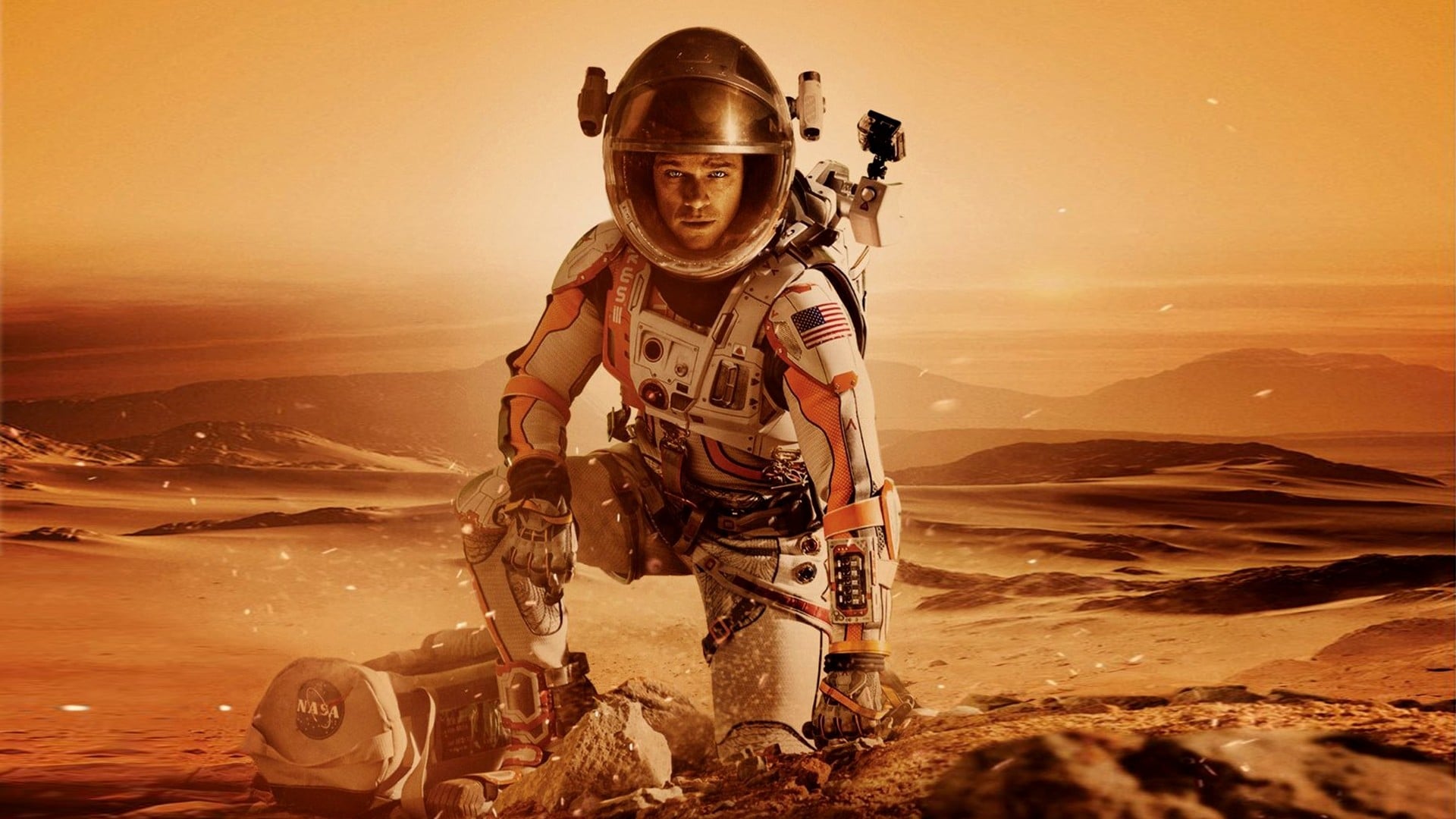
Scott rarely allows the effects to become the point of a scene. Scale matters because it clarifies the difficulty of the objective. Spacecraft, habitats and planetary vistas remain tools for telling a survival story, not expensive interruptions demanding applause.
Its optimism sometimes makes survival look too comfortable
The film’s warmth is its most appealing choice and its clearest limitation. Every joke releases a little pressure, and the crowd-pleasing trajectory makes the destination feel foreseeable well before the film reaches it. I like spending time with these capable, decent people, but there are moments when I wanted Scott to let the silence, isolation and hostile environment press harder on Watney.
The supporting ensemble has a related problem. Jessica Chastain, Chiwetel Ejiofor, Jeff Daniels, Kristen Wiig, Michael Peña, Kate Mara, Sean Bean and others give the rescue effort considerable collective presence. Yet most of their characters remain defined by a professional function or by the decision immediately in front of them. The movie believes deeply in teamwork, but Watney is the only person it explores with much individual depth.
Its scientific grounding also requires one conspicuous opening concession. Mars has an atmosphere roughly one percent as dense as Earth’s, so the forceful windstorm that initiates the plot is not physically plausible in the form depicted. Boston University’s examination of the movie’s science identifies the storm as a major dramatic liberty. It is an efficient contrivance that gets Watney stranded, but it briefly asks us to ignore the same physics the rest of the film works so hard to celebrate.
A smart blockbuster worth rooting for
The Martian is easy to recommend to viewers who like accessible science fiction, survival stories and blockbusters powered by intelligence rather than combat. Anyone seeking severe psychological isolation or sustained dread may find it overly reassuring, and its impressive supporting cast deserves richer characterization.
Those limitations do not undo the film’s central achievement. Scott makes expertise cinematic, Damon makes exposition funny, and the story treats cooperation as something more exciting than cynicism. The danger could bite harder, but few blockbusters are this entertaining while insisting that careful thought, persistence and people doing their jobs well are heroic acts.
References
- The Martian | 20th Century Studios
- The Martian review – Ridley Scott's playful sci-fi runs out of fuel before reaching home | Toronto film festival 2015 | The Guardian
- The Martian movie review & film summary
- The Martian Reviews – Metacritic
- VFX: 'The Martian' – Post Magazine
- The Martian Movie Scientific Accuracy | The Brink | Boston University