
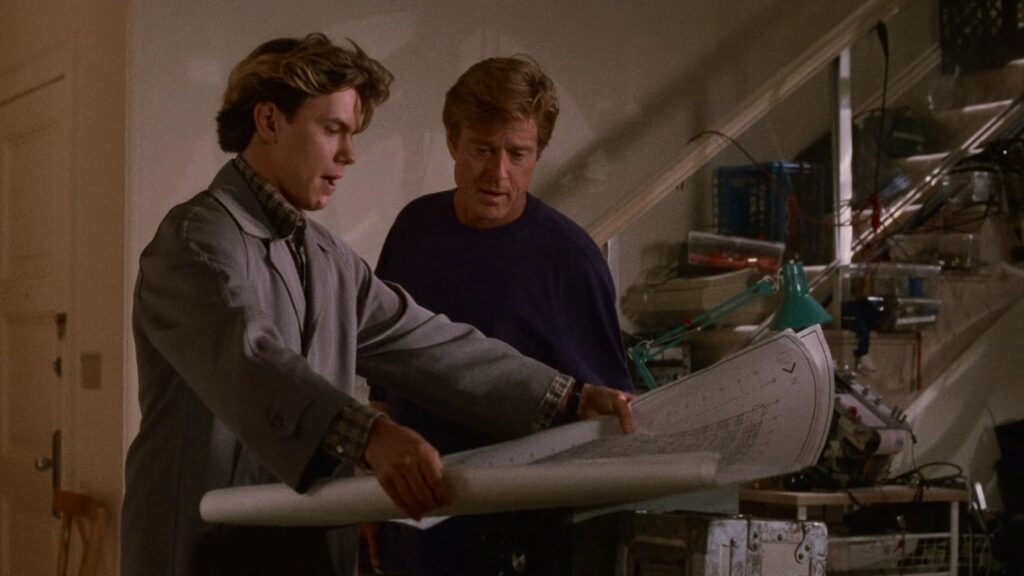
Sneakers is a conspiracy thriller in which the conspiracy is less compelling than the people trying to untangle it. Warm, witty and refreshingly interested in how skilled professionals think, Phil Alden Robinson’s 1992 caper makes expertise entertaining. Its all-powerful decryption device is pure thriller machinery; the real pleasure comes from watching a funny, complementary crew combine its knowledge under pressure.
Our verdict Sneakers turns computer-age paranoia into a warm, witty caper powered by superb ensemble chemistry and clever procedural suspense. Its characters and final action beats are conventional, but the relaxed confidence makes it an easy recommendation.

Sneakers (1992)
Robert Redford plays Martin Bishop, the leader of a San Francisco team hired to break into clients’ systems and expose their security weaknesses. When government operatives coerce the group into stealing a device capable of defeating encryption, the assignment pulls Bishop into a larger struggle connected to his past. Robinson directed and co-wrote the film with Lawrence Lasker and Walter F. Parkes, whose earlier research for WarGames helped inspire the use of “sneakers” for people paid to penetrate business security systems, according to the AFI Catalog.
The crew is the movie’s best technology
The ensemble is the film’s greatest asset because everyone contributes a distinct kind of intelligence. Redford supplies relaxed authority without swallowing the movie. Sidney Poitier brings discipline and impatience as Crease, Dan Aykroyd turns Mother’s conspiratorial worldview into a steady comic current, and David Strathairn gives Whistler a quiet precision that never needs to compete for attention. River Phoenix brings youthful energy to Carl, even though the screenplay gives him less substantial material than the stronger personalities around him.
What sells the group is not simply that each member has a specialty. It is the rhythm of colleagues who have spent enough time together to anticipate one another’s habits, tolerate each other’s eccentricities and recognize when a ridiculous idea might work. Redford acts as the ensemble’s center of gravity while leaving room for Poitier’s skepticism, Aykroyd’s comic detours and Strathairn’s understated focus.

That generosity gives Sneakers its genial personality. These are recognizable caper archetypes, but the performances make them feel like a functioning workplace rather than a collection of screenplay assignments. A team caper lives or dies on whether we enjoy occupying the room with the team. I would happily watch these people argue over a broken printer, never mind a device capable of rearranging the balance of informational power.
Listening becomes an action sequence
The clearest expression of the film’s strengths arrives after Bishop has been abducted and cannot identify where he was taken. Whistler and the others reconstruct the route from fragments Bishop remembers hearing and feeling: changing road surfaces, bridge noise and an ambiguous sound initially mistaken for a cocktail party. The crew tests possibilities, discards bad assumptions and gradually narrows the destination.
This is Sneakers at its most exciting, and hardly anybody needs to throw a punch. Careful listening becomes detective work; detective work becomes collective momentum. The scene passes information between characters, allowing every observation to modify the last. Accelerating edits and a piano-led score raise the urgency without obscuring the logic of the deduction. We understand not only that the team has reached an answer, but how its members built that answer together.
For me, that process is more gripping than the film’s conventional action. Robinson recognizes that competence can generate suspense when a movie clearly establishes the problem, the available evidence and the cost of a wrong conclusion. The sequence also proves why Whistler matters to the team. His auditory expertise is not decorative characterization; it changes what the group can know.
Old-fashioned charm meets computer-age paranoia
Sneakers balances a breezy caper tone with a premise rooted in surveillance, encryption and institutional coercion. The hardware belongs unmistakably to the early 1990s, but the underlying question has aged well: who gains power when private information stops being private? The film does not treat technology itself as the villain. Control is the danger—control of the device, control of information and control exercised by institutions willing to pressure people into serving their interests.

That distinction gives the story more bite than its easygoing style initially suggests. The complicated plot repeatedly threatens to become a lecture about access and cryptography, but the imaginative infiltration sequences return those ideas to physical spaces, human mistakes and practical obstacles. A contemporary Christian Science Monitor assessment described the film as technologically current but old-fashioned in its caper construction. That observation captures how Sneakers landed in 1992, but it also explains its durability: the technology dates while the pleasure of watching a well-matched crew solve problems does not.
Robinson’s relaxed confidence prevents the conspiracy from overwhelming the fun. At roughly two hours and five minutes, the film has enough plot to require conspicuous explanation, yet it keeps recovering whenever the crew encounters another security problem. The humor makes its paranoia easier to absorb, although that warmth comes with a tradeoff. Viewers seeking a grim, nerve-shredding cybersecurity thriller may find Sneakers more charming than frightening.
The conventional thriller is less interesting than the caper
The sharply divided specialties that make the team readable also limit some of its members. Several remain appealing types rather than fully developed people, and Carl is the clearest casualty. Phoenix has an energetic presence, but the screenplay rarely lets his character compete with the better-defined personalities surrounding him. The cast is strong enough to make that missing depth noticeable.
The movie also becomes less distinctive whenever its cerebral security games give way to familiar violence and stunt-driven escalation. Those scenes are competently handled, but they cannot match the wit of watching specialists solve a problem together. Sneakers is at its best when a locked room, an overheard sound or a flawed assumption becomes the obstacle. Once physical force takes over, it starts to resemble the more ordinary thriller it had previously been clever enough to avoid.
Even so, the film understands its greatest resource and returns to it often enough: not the miracle device, the conspiracy or the threat of force, but the crew. Its members make technical knowledge social, funny and cinematic. That chemistry turns a potentially cold story about encryption into an unusually warm thriller about trust and complementary skills.
Sneakers remains an easy recommendation
Sneakers is ideal for viewers who prefer ensemble capers, playful conspiracies and ingenious problem-solving to explosive action. Its characters could be deeper, its exposition can be conspicuous and its final action beats are more familiar than its best procedural sequences. None of that erases the relaxed confidence with which Robinson and his cast turn competence into entertainment. The technology drives the plot; the people make it worth opening. For anyone who enjoys watching a smart crew work a problem together, this remains a hugely likable caper.
References
- Sneakers | Rotten Tomatoes
- AFI|Catalog
- MOVIE REVIEW : 'Sneakers': A Caper With Lots of Twists – Los Angeles Times
- Sneakers movie review & film summary
- Transcript – Modern Technology Watches – Episode 302 – Sneakers (1992) – The Modern Technology Podcast Network
- Sneakers (1992) – The Mind Reels
- Caper-Comedy Flirts With the `Hyperreal' – CSMonitor.com