
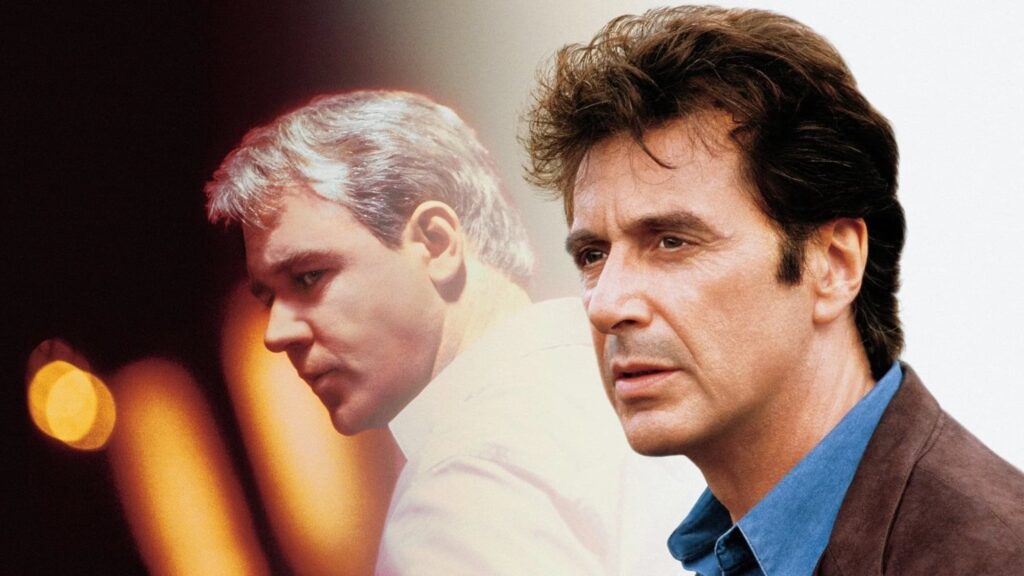
Michael Mann’s The Insider is a procedural drama with the pulse of a paranoid thriller. It has no car chases, shootouts or ticking bombs, yet a phone call can feel like an ambush and a meeting about corporate liability can tighten the chest. Mann understands that information becomes dangerous when powerful people need it contained. He turns that idea into nearly three hours of riveting, morally furious cinema.
Our verdict Michael Mann turns legal language, newsroom politics and corporate intimidation into electrifying suspense. Russell Crowe and Al Pacino give the procedural its bruised human core, while the patient accumulation of pressure makes nearly every conversation feel dangerous.

The Insider (1999)
The movie follows former Brown & Williamson executive Jeffrey Wigand and 60 Minutes producer Lowell Bergman as they pursue an interview about the tobacco industry through contracts, litigation fears, threats and resistance inside CBS. Russell Crowe plays Wigand, Al Pacino plays Bergman and Christopher Plummer takes the role of Mike Wallace, with Mann directing from a screenplay he co-wrote with Eric Roth. That sounds like the machinery of a respectable prestige drama. Mann treats it like a siege.
For me, its greatest achievement is making the fight to put Wigand’s testimony on television feel as urgent as any physical rescue. Bergman is trying to move information from one frightened person to the public without allowing lawyers, employers, executives or his own network to intercept it. The interview itself matters, but The Insider is really about the chain of responsibility surrounding it: who asks someone to speak, who promises protection, who gets frightened and who ultimately decides that the truth has become too expensive.
A corporate conversation becomes an action scene
The defining confrontations in The Insider happen across tables and telephone lines. One of the best comes when CBS executives discuss whether broadcasting Wigand’s interview could expose the network to a claim of tortious interference. The vocabulary is dry enough to make normal human eyes glaze over. Mann makes it terrifying.

The scene works because nobody needs to announce that censorship is taking place. The pressure arrives dressed as prudent legal advice. A potential lawsuit becomes a threat to corporate value, and the journalistic question—whether the report is accurate and important—is quietly displaced by a financial one. Every person in the room can pretend to be acting reasonably while the interview is pushed closer to oblivion. That is far more disturbing than a moustache-twirling executive ordering everyone to bury the truth.
Mann shoots and cuts these conversations as conflicts over territory. Faces are isolated within offices, bodies are divided by glass and institutional space, and reactions arrive with the force of counterpunches. Dante Spinotti’s cinematography uses moody lighting and constricted compositions, while the editing grows more urgent as pressure accumulates around Bergman and Wigand. The New Yorker’s contemporary analysis similarly noted the film’s expressive use of color around Wigand and the increasing intensity of its crosscutting.
The result is a film in which language has physical weight. A contractual phrase can close a door. A lawyer’s interpretation can erase months of reporting. A carefully qualified sentence can tell Bergman that his colleagues have already surrendered without requiring anyone to say so plainly. Mann’s camera catches the instant when professional caution becomes moral cowardice, and he refuses to let the distinction feel abstract.
Crowe and Pacino give the procedure a bruised human core
The Insider would still be intelligent without Russell Crowe and Al Pacino, but it would not hurt nearly as much. Their performances pull in opposite directions. Crowe turns inward, allowing Wigand’s fear, anger and pride to gather behind a stiff posture and wary expression. Pacino’s Bergman pushes outward, attacking obstruction with words, movement and sheer offended energy.
Crowe does not play Wigand as an uncomplicated saint. He can be defensive, abrasive and difficult to read. His courage exists alongside wounded pride and personal anger, which makes the decision to speak feel more credible rather than less. The film may sympathize deeply with him, but Crowe resists smoothing away every rough edge. Contemporary discussion of the performance likewise emphasized this “warts and all” quality, even while noting that the underlying reporting was harder on aspects of the real Wigand’s behavior. The Washington Post’s contemporary assessment provides useful context for that distinction.

Pacino, meanwhile, finds an ideal outlet for his intensity. Bergman is loud because the institutions around him prefer quiet accommodation. His anger is not random theatrical weather; it comes from discovering that standards treated as sacred can become negotiable the moment they threaten the company signing the paychecks. Pacino makes indignation look like a professional skill until Bergman realizes that conviction alone may not be enough.
Their pressured trust becomes the movie’s emotional center. Bergman needs Wigand to talk, but persuading him creates an obligation that does not end when the cameras stop. Wigand needs Bergman, yet every new setback gives him reason to wonder whether a television producer can protect him or merely needs him. Their calls function like lifelines across a hostile system; The New Yorker memorably described those exchanges as “oxygen lines.” Mann keeps asking whether journalism can demand extraordinary personal risk from a source and then retreat behind procedure when that risk becomes inconvenient.
Christopher Plummer adds another layer as Mike Wallace. His authority, vanity and professional confidence make him more interesting than a simple ally or obstacle. The film understands that institutions survive partly because intelligent, accomplished people become accustomed to their own importance within them. Wallace can recognize the stakes and still hesitate when resistance carries consequences for him. That tension gives the newsroom struggle its sting.
The long buildup earns its running time
At roughly 158 minutes, The Insider asks for patience. It also knows what to do with that patience. The length creates accumulation: contractual restrictions, family strain, legal maneuvering, reputational attacks, professional jeopardy and resistance inside CBS do not arrive as one neat conspiracy. They gather from different directions until Wigand and Bergman appear trapped inside a system with no visible center.
That structure matters. A shorter, tidier version might reduce the story to a brave whistleblower, a determined producer and one corrupt corporation. Mann is after something more complicated. Wigand faces the personal cost of disclosure. Bergman confronts his responsibility to the person he persuaded to disclose. CBS must decide whether journalism remains its priority when the report threatens wider corporate interests. The film shifts its weight among those perspectives rather than treating one man as the sole engine of the story. One of its editors described the structure as roughly a third Wigand’s perspective, a third Bergman’s and a third shared between them. CineMontage’s account of the film’s post-production helps explain why the expansive structure still feels deliberately shaped.
The density occasionally becomes a burden. There are stretches where legal and technical detail slows an already deliberate movie, and viewers who need rapid plot movement may feel the machinery grinding before its separate pressures converge. The patient construction is not effortless viewing. It requires attention to who controls which information, what each agreement prevents and why one corporate decision changes everything.
Yet cutting too much would undermine the point. Institutional obstruction rarely looks like a single slammed door. It looks like delay, qualification, revised language, private meetings and responsibility passed from one office to another. The runtime lets that process become exhausting because it is exhausting. By the time the broadcast itself becomes the objective, publication carries the emotional force of an action-movie climax.
Mann’s heightened style makes professional pressure feel physical
The Insider is not restrained in the conventional sense. Mann’s mobile camera, ominous music and polished images repeatedly signal that danger is closing in. Offices feel claustrophobic; exposed outdoor spaces can make Wigand appear even more isolated. Lisa Gerrard and Pieter Bourke’s music gives the story a mournful, almost mythic weight, while the editing connects personal collapse, corporate maneuvering and journalistic urgency into one tightening circuit.
There are moments when this emphasis risks becoming too insistent. The score can tell us to feel menace before the conversation has fully generated it, and the visual polish sometimes pushes sober reporting toward operatic paranoia. Contemporary responses included complaints that the movie was “too polished” or “pumped-up,” objections I can understand even though I do not share the final verdict.
For me, the heightened style is exactly why the procedural material becomes cinema rather than an illustrated case file. Mann is not claiming that a conference room literally resembles a battlefield. He is showing that professional and personal destruction can be initiated there with a few calm sentences. His style translates invisible power into light, rhythm, sound and space. The threat becomes visible even when nobody raises a hand.
A powerful drama rather than a literal historical record
The Insider’s dramatic authority should not be confused with documentary precision. Mann and Roth reorganized events and took dramatic license, while Mike Wallace and CBS News disputed elements of their portrayal. Contemporary reporting also identified invented material, including an apparent Wigand-suicide sequence. The movie is best approached as a fictionalized account of a real controversy, not a scene-by-scene historical record.
That qualification does not erase its insight. The underlying case involved threats reported by Wigand, litigation fears inside CBS and a 60 Minutes interview that eventually aired in February 1996 after parts of the story had reached the public through other reporting and tobacco litigation. Marie Brenner’s reporting on Jeffrey Wigand documents the stakes surrounding the real conflict. Mann’s film compresses and dramatizes that history into an argument about what happens when the institutions responsible for exposing power are themselves vulnerable to it.
Its most unsettling idea is that truth does not automatically win by being true. It needs a witness willing to speak, a journalist willing to listen, editors willing to publish and an organization willing to absorb the consequences. Remove any link from that chain and accurate information can remain publicly useless.
The verdict
The Insider is essential viewing for anyone who likes serious journalism dramas, morally complicated performances and thrillers built from words rather than gunfire. Its procedural density and imposing length demand concentration, while Mann’s emphatic style will be too forceful for viewers who prefer this material presented with documentary restraint.
I find its patience completely justified. Mann turns the movement of information into suspense, Crowe and Pacino make institutional conflict painfully personal, and the newsroom battle gives professional compromise the weight of moral catastrophe. Few films have made getting an interview onto television feel so dangerous—or so heroic. The Insider does not merely argue that the truth matters. It shows how many people must decide that it matters before the public is ever allowed to hear it.
References
- The Insider 1999, directed by Michael Mann | Film review
- The Insider Reviews – Metacritic
- The Odd Couple | The New Yorker
- `The Insider': Through a TV Screen Darkly – The Washington Post
- The Insider (1999) directed by Michael Mann • Reviews, film + cast • Letterboxd
- Delving Inside The Post-Production Of ‘THE INSIDER’ – CineMontage: A Journal of the Motion Pictures Editors Guild
- tollbit.time.com
- Jeffrey Wigand: The Man Who Knew Too Much | Vanity Fair