
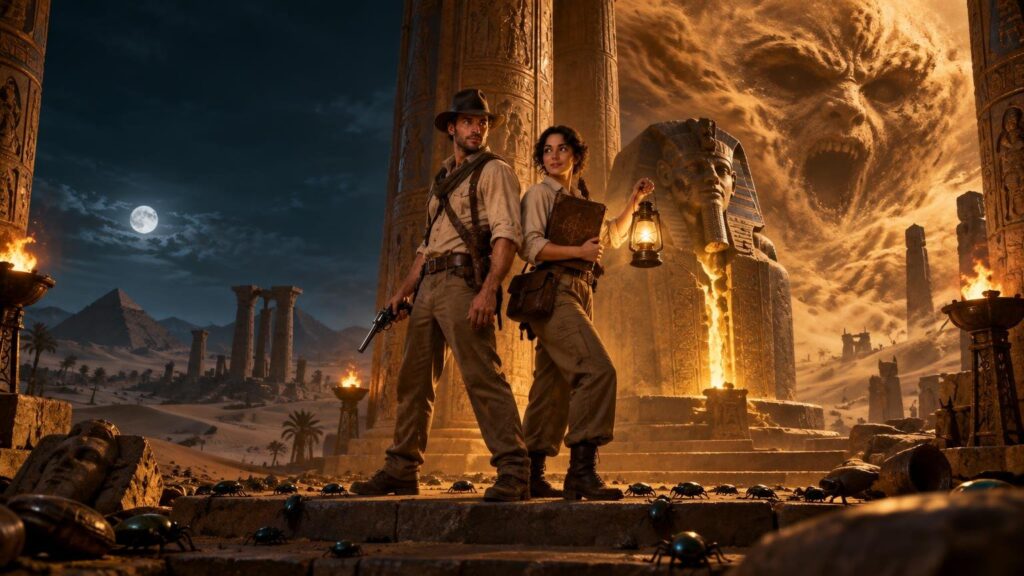
TLDR: If you are looking for a The Mummy 1999 review why it still holds up explanation, the answer is not that every effect has aged perfectly. Stephen Sommers’s blockbuster endures because it commits equally to adventure, horror, comedy and romance, then uses an exceptionally charming cast to hold those competing tones together. It is fast without becoming empty, funny without making its monster harmless and romantic without stopping the story for manufactured melodrama.
Released in the United States on May 7, 1999, The Mummy runs roughly 125 minutes and was rated PG-13. That sounds surprisingly long for a movie remembered as breezy, but its momentum rarely collapses because nearly every sequence introduces a discovery, reversal, threat or character complication. Directed by Stephen Sommers, it stars Brendan Fraser, Rachel Weisz, John Hannah and Arnold Vosloo. The result is an imperfect but enormously likable pulp adventure that still knows exactly what sort of fun it wants to provide.
The Mummy’s difficult tonal blend is its greatest strength
The Mummy is frequently described as an adventure movie with horror and comedy added, but that undersells how completely those ingredients are mixed. The horror creates urgency, the comedy makes the characters enjoyable company, the romance gives the chaos an emotional center, and the action keeps all three from sitting in separate compartments. Contemporary reviews disagreed about the film’s overall quality, yet repeatedly recognized its rapid mixture of adventure, romance, comedy, shocks and effects spectacle.
The crucial choice is that the comedy usually comes from personality rather than from mocking the premise. Rick O’Connell is funny because he remains practical in absurd situations. Evelyn Carnahan is funny because her intelligence, confidence and physical coordination do not always arrive at the same time. Jonathan turns self-preservation into an art form. Their reactions release tension, but the movie still treats curses, scarabs and resurrected corpses as real dangers.
That distinction matters. A weaker version would pause after every supernatural event so somebody could announce how ridiculous it is. The Mummy accepts that an ancient priest can return as a regenerating monster and immediately asks what its characters will do about it. The jokes do not give the audience permission to stop caring. They make the danger more enjoyable by giving us people worth following through it.
Rick and Evelyn make the spectacle matter
Brendan Fraser’s Rick could have been a generic square-jawed adventurer. Instead, Fraser plays him as capable, exasperated and just vain enough to be entertaining. He can win a fight, but he is not presented as the only intelligent person in the room. His confidence often depends on keeping the group moving before anyone has time to question how incomplete his plan might be.
Rachel Weisz gives Evelyn a complementary energy. Her knowledge is indispensable, yet the screenplay lets curiosity become both her strength and her liability. She does not merely accompany Rick into danger or wait to be rescued from it. Her decisions repeatedly change the story, sometimes for the better and sometimes catastrophically. She and Rick therefore need each other for reasons built into the adventure: he understands survival, while she understands the history and language driving the threat.
Their romance works because it grows through contrasting skills, mutual irritation and accumulating respect. Rick is attracted to Evelyn before he fully appreciates her, but the movie gradually makes her competence impossible to ignore. Evelyn, meanwhile, discovers that Rick’s rough edges conceal loyalty rather than stupidity. The relationship develops while they solve immediate problems, allowing the romantic momentum to strengthen the plot instead of interrupting it.
John Hannah’s Jonathan is equally important to the balance. He is greedy, cowardly and frequently useful despite himself, but the performance keeps him on the right side of irritating. Arnold Vosloo gives Imhotep enough physical gravity to prevent the villain from becoming a digital-effects delivery system. Oded Fehr’s Ardeth Bay adds a more serious register, helping the movie establish that its supernatural threat existed before the heroes stumbled into it.
Adventure pacing built from constant change
Calling The Mummy fast-moving is accurate but incomplete. Speed alone can become exhausting. Sommers maintains momentum by changing the kind of entertainment on offer. A military clash gives way to academic comedy, a prison negotiation, a river journey, archaeological competition, supernatural horror, pursuit and large-scale action. The movie keeps moving, but it does not keep repeating the same chase with different scenery.
Its goals are also unusually clear. Characters want to reach a place, find an object, decipher a text, escape a threat or prevent the next stage of a curse. Exposition tends to arrive beside a practical problem, so even the mythology feels connected to action. The audience is rarely left wondering what the heroes are attempting, which gives the film room to become visually chaotic without becoming narratively confusing.
That clarity links The Mummy to the best entries on our list of 1990s action movies that still deliver. Its set pieces have beginnings, escalating complications and readable objectives. Movement has direction. When characters run, ride or fight, the movie usually makes their destination and obstacle legible. Spectacle feels physical because the people inside it appear to be making decisions rather than waiting for the next visual effect.
The horror remains nasty without swallowing the fun
For a mainstream adventure, The Mummy has a healthy interest in gruesome imagery. Imhotep’s decayed body, the flesh-crawling threat of scarabs, stolen organs, desiccated victims and looming supernatural shadows all push the film beyond a harmless treasure hunt. Its PG-13 framework limits the explicit detail, but implication does plenty of work.
The horror succeeds because it attacks the body. Imhotep is not simply a powerful sorcerer firing anonymous energy into the sky. His return involves decay, consumption and reconstruction. The threat feels intimate even when the effects become enormous. Jerry Goldsmith’s forceful score further helps the movie pivot from romantic sweep to menace without making either mood feel accidental.
Just as importantly, the film knows when to stop pressing. It offers a disturbing image, lets the danger register and then returns to escape or adventure. That rhythm keeps it suitable for viewers who want spooky blockbuster entertainment rather than sustained terror. Horror fans may find it mild, but the macabre streak gives the action consequences and personality.
The effects have aged, but the filmmaking around them has not
Universal’s contemporary publicity presented Industrial Light & Magic’s work as a major visual-effects showcase. Some of that late-1990s digital imagery now shows its age. Fully computer-generated creatures can appear light, facial animation sometimes lacks subtlety, and a few composites are easier to spot on modern displays. The movie cannot claim the timeless visual seamlessness that nostalgia occasionally grants it.
Fortunately, its effects are doing more than asking to be admired as technology. Imhotep’s incomplete forms express his gradual restoration. Sand and shadow give his power a recognizable visual language. Crowds of creatures create immediate spatial problems for the heroes. Even when an individual shot looks dated, the idea behind it remains clear and dramatically useful.
The surrounding craft carries considerable weight. The AFI Catalog record credits Adrian Biddle as cinematographer, Allan Cameron as production designer, Bob Ducsay and Kelly Matsumoto as editors, and Jerry Goldsmith as composer. Warm desert vistas, cavernous ruins, torchlit interiors and a muscular orchestral score provide texture that no single digital creature has to supply alone. The editing keeps attention on pursuit, reaction and consequence, limiting the amount of time weaker effects must stand unsupported.
Pulp sincerity beats franchise homework
The Mummy believes in its own outlandish premise. That does not mean it becomes solemn. It means the filmmakers understand that a joke works better when there is a real adventure beneath it. The characters may complain about their circumstances, but the movie never seems embarrassed by lost cities, ancient curses, mystical books or undead priests.
Many would-be adventure spectacles lose this balance by treating mythology as homework, using jokes to apologize for fantasy or postponing satisfaction in favor of future installments. The Mummy is structured as a complete meal. It establishes its supernatural rules, forms its central relationships, unleashes its monster and delivers a climax shaped by what the characters have learned. Franchise potential may be visible, but it does not replace the responsibility to finish this story.
Its sincerity also lets romance and heroism survive without quotation marks. Rick can be dashing. Evelyn can be brilliant and glamorous. Imhotep can be both tragic in motivation and monstrous in action. The film understands archetypes as foundations to animate, not clichés that automatically become clever when mocked.
What has not aged well
Affection should not turn the film’s limitations invisible. Its fantasy of Egypt depends heavily on exoticism, using the country as a storehouse of curses, danger and spectacle for a largely Western-led adventure. Arab characters receive uneven treatment: some have dignity and narrative importance, while others are reduced to disposable opponents, suspicious opportunists or broad comic types. Contemporary criticism also identified problems in its handling of Arab and other nonwhite characters.
These choices are not erased by calling the movie pulp. Pulp traditions carried their own prejudices, and reproducing those conventions still has consequences. Ardeth Bay provides a welcome counterweight because he is capable, informed and committed to protecting others, but one substantial character cannot repair every stereotype surrounding him.
The most useful way to revisit The Mummy is neither to excuse this material nor pretend it makes every other quality irrelevant. The film can be a superbly constructed adventure and still reveal the representational blind spots of the tradition it enthusiastically revives. Its durability is easier to defend when that contradiction is acknowledged directly.
Final verdict: The Mummy still earns the rewatch
The Mummy remains easy to recommend to viewers who want an adventure with genuine monsters, a romance with actual chemistry and comedy rooted in character. Some digital effects are visibly products of 1999, and its treatment of culture and ethnicity deserves criticism rather than nostalgic hand-waving. Neither weakness should be ignored.
What survives is the harder achievement: tonal control. The movie moves quickly without becoming weightless because its objectives are clear and its characters remain active. Its humor makes the company better without dissolving the danger. Its horror gives the spectacle bite, while its romance gives the escape from that horror emotional shape.
That is why The Mummy still holds up. It commits to adventure, horror, romance and comedy at the same time, trusting Rick, Evelyn and the ensemble to make the mixture coherent. Plenty of effects-heavy movies have newer technology. Far fewer understand that charm, clarity and sincerity are the special effects audiences actually return for.