
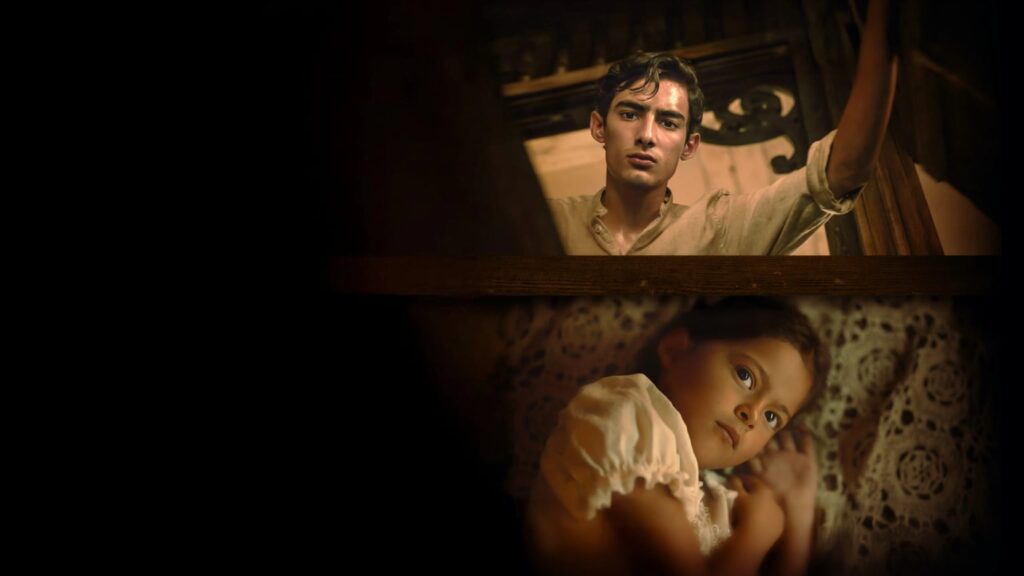
Without Blood approaches revenge, guilt and healing with unwavering seriousness, but seriousness is not the same thing as insight. Angelina Jolie’s restrained chamber drama gives Salma Hayek Pinault and Demián Bichir enough silence to suggest a lifetime of damage, then surrounds them with dialogue that keeps naming profound moral questions without pushing either character deeply enough into them. This Without Blood review comes down to a frustrating contradiction: the performances imply a richer, more painful film than the screenplay can deliver.
Our verdict Without Blood has two committed leads and a suitably grave atmosphere, but its static, overly abstract confrontation turns urgent questions about revenge, guilt and healing into underdeveloped talking points.
Without Blood (2024)
Adapted from Alessandro Baricco’s novella, the 91-minute film was written, directed and produced by Jolie. Hayek Pinault plays Nina, while Bichir plays Tito, two people connected by an act of wartime violence that continues to shape their lives long after the immediate conflict has passed. That is all the setup the film needs, and all viewers should know before watching. What follows is not a conventional revenge thriller or war movie, but a compact confrontation about memory, responsibility and whether surviving violence creates any path beyond repeating it.
Without Blood review: A chamber drama that cannot tighten the screws
The film’s mostly one-room, dialogue-led structure should be ideal for this material. Flashbacks establish the violence connecting Nina and Tito, but the present-day encounter carries the dramatic burden. Jolie removes the escape routes available to a more conventional war drama: there are no large campaigns to stage, no action sequences to hide behind and no sprawling historical timeline to create artificial importance. The movie must live or die through two faces, the changing balance of power between them and the accumulating pressure of what remains unsaid.
For a while, that restraint creates genuine tension. Nina’s purpose is not immediately reducible to a simple threat, and Tito cannot be certain whether conversation offers reconciliation, judgment or merely a more elaborate form of punishment. Jolie understands that politeness can become unnerving when both people know it is covering an abyss. A pause before an answer carries the possibility that the entire encounter is about to change shape.
Yet the screws never tighten as forcefully as they should. Revelations emerge, receive an appropriately grave silence and then make way for the next philosophical issue. Instead of allowing new information to destabilize the conversation, the screenplay tends to arrange its ideas in sequence: revenge, justice, guilt, memory, healing. The structure resembles a carefully moderated debate when it should feel like two people losing control of stories they have told themselves for years.
That distinction matters. A static film is not automatically an inert one; a room can become a battlefield when each line changes what the characters want or fear. Here, too many exchanges circle the moral stakes without materially changing the emotional stakes. Without Blood is compact, but it still feels dramatically stretched because its movement is conceptual rather than psychological.
Hayek Pinault and Bichir find the pain between the lines
The two leads understand that understatement is their best weapon. Hayek Pinault does not play Nina as a blunt instrument of vengeance. Her composure has an unstable quality, suggesting that control is something Nina must keep actively rebuilding. The performance leaves room for anger, grief and calculation to exist simultaneously, which is more complex than the screenplay’s tendency to assign each emotion its own solemn exchange.
Bichir is equally effective at showing a man trying to determine which version of himself has entered the room. Tito can appear ordinary, frightened, remorseful or evasive without any of those qualities completely canceling the others. His restraint gives the film some of its most haunting moments because it raises a question the dialogue cannot neatly answer: is his stillness evidence of guilt, acceptance, self-protection or exhaustion?
Together, the actors create a guarded rhythm that occasionally makes the movie’s abstraction feel purposeful. They watch each other closely, treating every shift in tone as a possible trap. Their performances suggest that memory is not a stable record but a negotiation—between what happened, what can be admitted and what each person needs the past to mean now.
Unfortunately, Nina and Tito remain more convincing as embodiments of competing responses to violence than as fully developed people. The actors provide texture, but there is only so much psychology they can supply around dialogue designed to carry themes. I kept wanting the film to become messier: for resentment to contradict empathy, for self-knowledge to collapse under pressure, or for an apparently settled memory to acquire a more personal and damaging meaning. The performances reach for those complications, but the writing keeps returning them to the parable.
The controlled atmosphere is stronger than the moral argument
Without Blood had its world premiere at the Toronto International Film Festival in September 2024, and TIFF’s programme materials identify Rome’s Cinecittà Studios as a filming location. That controlled environment suits Jolie’s sealed-off approach. The surroundings feel suspended from ordinary time, as though Nina and Tito have entered a space built solely for unfinished history to catch up with them.
For me, this atmosphere is the film’s strongest element. The unspecified setting allows wartime violence to hang over the drama without turning the story into a reconstruction of one named conflict. The compact staging, subdued imagery and deliberate pace create the sensation that the past has never actually ended. War may be absent from the room in a literal sense, but it remains present in posture, hesitation and the characters’ awareness that one decision made years ago can govern an entire life.
There is a useful contrast here with war films that establish horror through scale. MovieBunker’s review of All Quiet on the Western Front considers a story built around the machinery and devastation of combat; Without Blood is interested in what remains when that machinery is no longer visible. Its refusal to turn trauma into action spectacle is sincere and, in principle, refreshing. A smaller drama can make violence feel more personal by concentrating on the people forced to carry its consequences.
But the lack of historical specificity also creates a problem. Universality must be earned through exact human behavior, not achieved merely by removing names, dates and places. Without Blood strips away context while leaving Nina and Tito too schematic to fill the resulting space. Rather than making their conflict feel applicable to every war, the vagueness sometimes makes it feel detached from any lived reality. The movie wants the force of myth without giving its figures enough particularity to become mythic.
The flashbacks show violence without deepening its aftermath
The flashbacks provide contrast with the controlled present-day encounter. They establish that the film’s moral discussion originates in physical terror rather than in an abstract thought experiment, and they allow Jolie to make past violence visible without transforming the picture into an action movie. That is the right instinct: the story is about consequences, not combat choreography.
Even so, these returns to the past do not generate enough dramatic momentum. They supply information, but information alone is not escalation. Each glimpse should alter how we understand the present conversation, forcing us to reconsider a gesture, a claim or the apparent balance of responsibility. Instead, the flashbacks too often illustrate trauma that the film has already announced. They confirm the gravity of the situation without finding a new dramatic language for it.
A quieter approach can be devastating when implication makes viewers active participants in the tension, as discussed in MovieBunker’s review of The Forger. Without Blood has the appropriate restraint, but not the same accumulating pressure. It repeatedly invokes wounds that cannot be repaired, while its rigid structure prevents those wounds from opening in surprising or emotionally transformative ways.
A sincere anti-war drama trapped inside its own importance
There is no doubting the film’s sincerity. Jolie is clearly interested in the emotional residue of violence: the way revenge can imitate justice, the way guilt can become self-serving and the way forgiveness may be demanded from people who owe it to no one. Those are urgent questions, and the refusal to provide an easy cathartic answer is one of the film’s better decisions.
The trouble is that Without Blood treats the presence of difficult questions as though it were equivalent to examining them. It assembles the language of moral complexity—long silences, controlled framing, grave declarations and haunted performances—but rarely permits the confrontation to become unpredictable enough to test its own ideas. Solemnity becomes a protective layer. Every moment arrives already labeled as important, leaving little room for importance to emerge naturally from character.
Hayek Pinault and Bichir make the film watchable, and viewers who enjoy restrained, talk-heavy chamber dramas may respond to the disciplined atmosphere more warmly than I did. Anyone expecting a tense revenge thriller, sustained action or a richly developed psychological study should adjust expectations. This is a film of faces, pauses and philosophical positions.
I admire the decision to focus on war’s emotional aftermath rather than its spectacle, but the execution remains too abstract and dramatically static to make that aftermath feel newly understood. Without Blood asks whether people marked by violence can stop living according to its logic. Its actors make that question ache. The screenplay merely places it on the table, regards it solemnly and moves on.