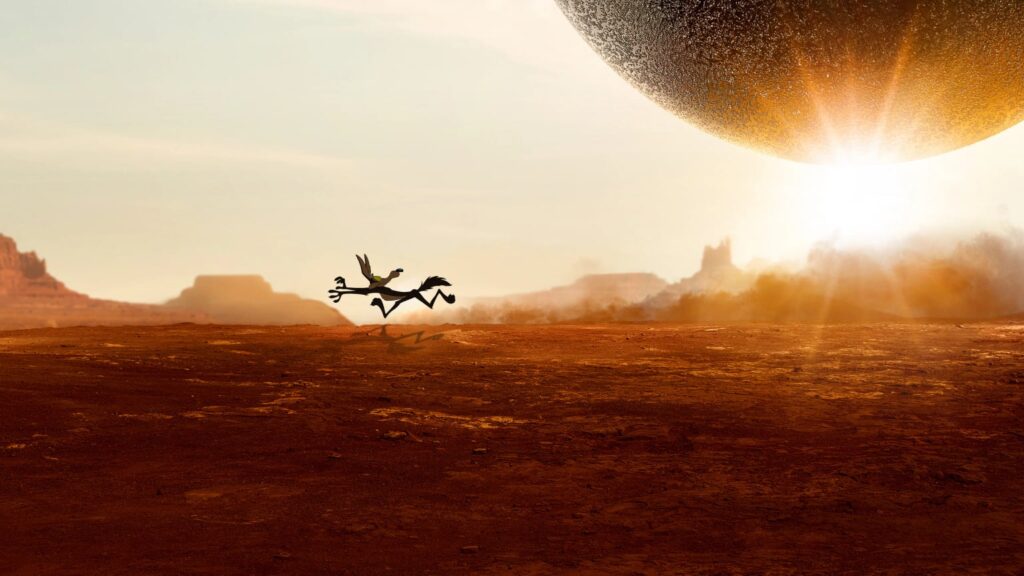
Coyote vs. Acme pulls off the trick that matters most: it gives Wile E. Coyote a reason to exist beyond the next falling anvil without turning him into a cuddly motivational mascot. This is a funny, unexpectedly heartfelt courtroom comedy built around corporate liability, but its smartest joke remains the simplest one. No matter how sympathetic the Coyote becomes, the universe is still waiting to drop something extremely heavy on his head.
Our verdict Coyote vs. Acme successfully turns cartoon punishment into a funny, unexpectedly heartfelt fight for corporate accountability. Its busy feature plotting sometimes blunts the Road Runner shorts’ ruthless velocity, but the inspired premise and committed comic energy earn a strong recommendation.
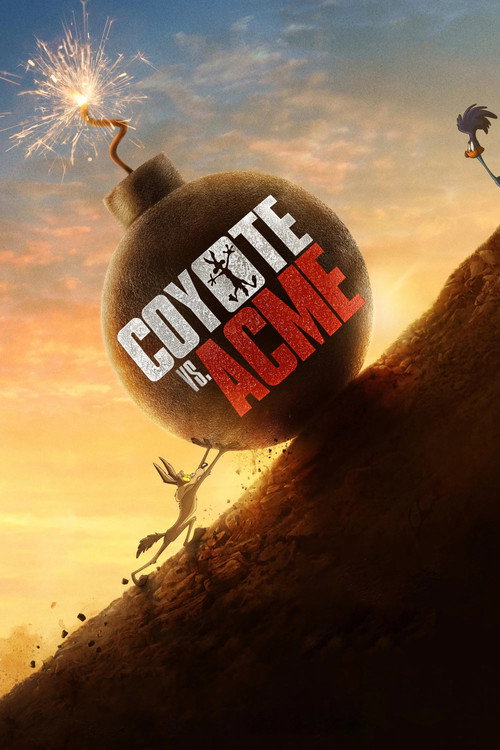
Coyote vs. Acme (2026)
That balance is what makes this Coyote vs. Acme review a strong recommendation rather than a nostalgic shrug. Director Dave Green and screenwriter Samy Burch expand the Road Runner formula into a live-action and animation hybrid about a struggling lawyer representing Wile E. in a case against the company whose catastrophically unreliable products have powered his failures for years. Burch shares story credit with Jeremy Slater and James Gunn. The resulting movie is busier than the classic shorts and not always improved by that extra machinery, but its legal hook is inspired, its comic energy is committed and its affection for the character never becomes sentimental mush.
The lawsuit gives Wile E. Coyote agency without explaining him away
The premise sounds like the kind of joke that could exhaust itself in a trailer: Wile E. Coyote hires down-on-his-luck attorney Kevin Avery after years of defective Acme contraptions fail during his pursuit of the Road Runner. Yet the liability case proves surprisingly durable because it changes the meaning of a familiar pattern. All those rockets, catapults and elaborate traps are no longer just props in an eternal chase. They are evidence.
That reframing gives Wile E. something he has rarely possessed: leverage. He remains the architect of many of his own disasters, obviously, and the film would be unbearable if it pretended otherwise. But there is a satisfying comic logic in asking why Acme keeps selling dangerous equipment to its most loyal customer while avoiding responsibility for the smoking crater that follows. The perennial loser finally gets to direct his ingenuity toward the system profiting from his pain.
Crucially, the film does not need Wile E. to become chatty or psychologically ordinary. His persistence, wounded pride and capacity for elaborate self-sabotage already constitute a personality. The courtroom structure translates those qualities into dramatic agency while preserving his essential strangeness. He can pursue justice, but he still communicates most naturally through signs, expressions and an appalling tolerance for blunt-force humiliation.
That is the movie’s central achievement. It finds warmth in Wile E. without curing him of being Wile E. Coyote. A lesser version would turn his pursuit of the Road Runner into a tidy lesson about letting go. This one understands that the pursuit is not a problem to be solved. It is the engine of the character, as permanent and irrational as gravity.
Will Forte gives the cartoon chaos a human pulse
Will Forte is exactly the right actor to place beside a silent animated obsessive. As Kevin Avery, he brings the weary, hangdog quality of a man who looks as though life has already dropped its own metaphorical piano on him. Forte does not compete with Wile E.’s elastic physicality. He absorbs it, reacts to it and supplies the bruised human rhythm that lets the movie slow down without becoming inert.
Kevin and his client work because they are complementary underdogs rather than emotional duplicates. Wile E. attacks impossible problems with insane confidence; Kevin has to recover enough confidence to attack anything at all. Their partnership gives the movie genuine feeling, but the screenplay mostly resists forcing the Coyote into conventional speeches or therapeutic revelations. Forte carries the verbal and emotional load, leaving his co-star free to remain gloriously, dangerously himself.
The wider cast, which includes Lana Condor, John Cena, Tone Bell, Martha Kelly, Luis Guzmán, P.J. Byrne, John Early and Kenneth Choi, commits to the heightened reality rather than treating the animated characters as interruptions. Eric Bauza, Candi Milo and Jim Cummings are among the credited voice performers. That commitment matters in a hybrid comedy. The live-action actors must believe in the stakes just enough for the cartoon violations of reality to feel funny instead of weightless.
There are moments when the human story threatens to become more important than the character whose name is in the title. Even then, Forte’s performance prevents Kevin from becoming a mere exposition machine. His exhausted decency provides a stable center, and the movie’s affection grows from the recognition that both lawyer and client have spent a long time being treated as disposable.
The best slapstick obeys the old rules of cartoon cruelty
For me, the atmosphere is strongest whenever the film remembers that Coyote comedy depends on cruelty delivered with mathematical precision. The joke is not simply that a gadget fails. It is that Wile E. plans with absurd sophistication, enjoys one tiny instant of confidence and then has enough time to recognize the approaching catastrophe before it flattens him.
Green has discussed following Chuck Jones-style principles, including keeping the Road Runner on the road and treating Wile E. as a figure of humiliation rather than realistic injury. That distinction governs the film’s most successful physical comedy. Coyote can be crushed, blasted or hurled through space, but the violence never asks us to fear for his life. The consequence is embarrassment, not trauma. Physics exists primarily to punish arrogance with impeccable timing.
Preserving that logic inside live action is difficult. A real environment can make cartoon violence feel either unpleasantly concrete or digitally detached. Coyote vs. Acme usually finds the right middle ground. The human world offers surfaces, objects and corporate structures that appear solid, while Wile E. remains subject to a more vindictive set of natural laws. He belongs in the frame without becoming bound by it.
The visual collision also supports the satire. Acme’s institutional confidence looks ridiculous when confronted with the physical consequences of its products, especially when those consequences arrive in the form of a soot-blackened Coyote holding a small sign. Corporate language can evade responsibility; cartoon imagery makes the damage impossible to disguise.
Feature plotting sometimes slows a character built for velocity
The film’s weakness is not that it expands a short cartoon into a feature. It is that it occasionally tries to justify that expansion with too many different kinds of movie. The clean courtroom hook must share space with corporate satire, detective mechanics, emotional recovery and the obligations of a broader Looney Tunes showcase. Each addition is understandable. Together, they sometimes clog a machine that should move like a rocket with a dangerously short fuse.
The original Road Runner shorts were mercilessly efficient. Setup, anticipation, impact, silence, repeat. Their escalating failures needed little explanation because character and structure were identical: Wile E. makes plans, the plans fail and his belief that the next plan will work becomes funnier every time. A feature requires variation, but variation also softens that deadpan ferocity. Dialogue occupies time that might otherwise be spent watching one terrible decision produce an even worse result.
The legal material survives this expansion better than the surrounding plot machinery because it grows directly from the cartoons. Acme products have always failed. Wile E. has always endured the consequences. A lawsuit is an absurd but coherent continuation of that relationship. The further the screenplay travels from that central idea, the more it resembles a conventional family adventure wearing Looney Tunes accessories.
A dissenting Associated Press review argued that the courtroom drama wastes the cartoon icons, and I understand the complaint. There are stretches when the movie appears to be containing Wile E. rather than unleashing him. But I do not think the legal structure is the problem. The courtroom gives his suffering a new comic context; it is the extra plot layered around that structure that occasionally blunts the momentum. I like the clean case against Acme more than the expanding machinery required to turn it into a full-scale adventure.
Its release history makes the satire sharper, not automatically better
It is impossible to watch a story about disposable labor confronting a powerful corporation without thinking about the movie’s own history. Warner Bros. shelved the completed film in 2023 before Ketchup Entertainment acquired it and gave it a U.S. theatrical release on August 28, 2026. The Associated Press account of the film’s shelving and eventual release gives that history an irony no marketing department could manufacture.
That context does not prove the movie is good. A rescued film can still be a bad film, and institutional mistreatment is not a substitute for comic timing. But here the parallel genuinely intensifies material that already works. A character treated as an endlessly renewable object demands recognition from the company that benefited from his punishment. Meanwhile, the completed work telling that story had itself been treated as something that could disappear into a corporate drawer.
The satire is not especially subtle, nor should it be. Looney Tunes has never needed a scalpel when dynamite is available. What matters is that the accountability theme emerges from the character’s history instead of being pasted onto him. Wile E. has spent decades paying for Acme’s failures with his body. Letting him submit the invoice is both an effective joke and a satisfying act of narrative revenge.
A worthy expansion, even when it overbuilds the trap
Coyote vs. Acme works best as an underdog comedy with a cartoon fuse. Its courtroom premise transforms repetition into accumulated injustice, Will Forte gives the hybrid chaos an appealing human counterweight, and Dave Green preserves enough of the chase’s cruel physical logic to keep Wile E. recognizably absurd. The movie finds an emotional connection without insisting that its silent plaintiff become a conventional hero.
The feature-length plotting does cost it some of the classic shorts’ ruthless speed. Viewers who want nothing more than Road Runner, desert and escalating catastrophe may find the legal and investigative machinery overbuilt. Families comfortable with cartoon violence, Looney Tunes fans and anyone receptive to a high-concept comedy with actual affection beneath the explosions should have a much better time.
Most importantly, the film understands that Wile E. Coyote does not need to win in order to matter. He needs another plan, another impossible device and one more second of confidence before gravity notices him. Coyote vs. Acme gives him his day in court without taking away the cliff beneath his feet. That is more than enough reason to recommend it.
References
- Coyote vs. Acme | Rotten Tomatoes
- Coyote vs. Acme (2026) directed by Dave Green • Reviews, film + cast • Letterboxd
- Comic-Con 2025: 'Peacemaker,' 'Coyote v. Acme' | AP News
- 'Coyote vs. Acme' review: Courtroom drama wastes cartoon icons | AP News
- 'Coyote vs. Acme' was canned by Warner Bros. But that's not all folks | AP News