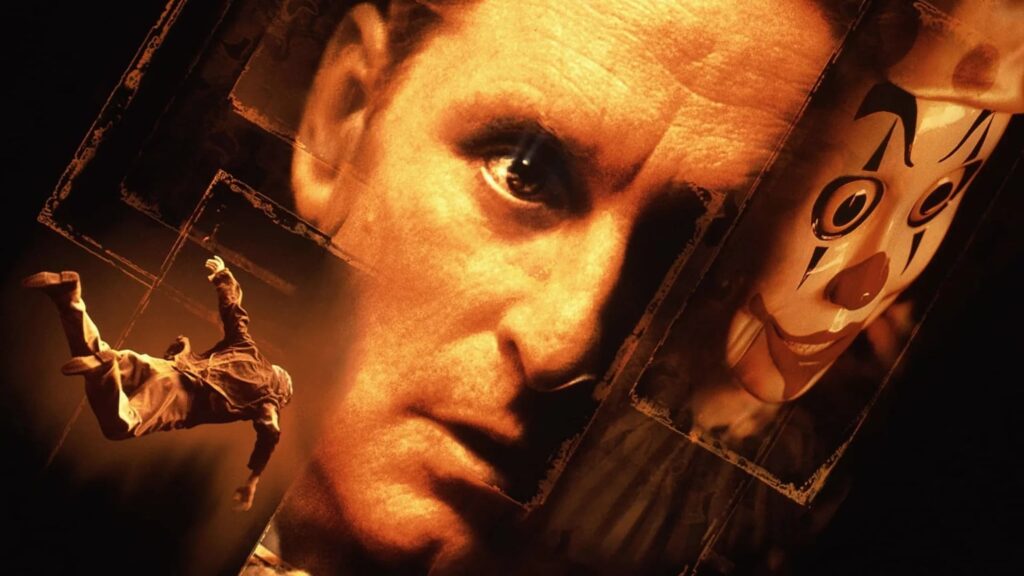
The short version of this The Game 1997 review is simple: David Fincher’s exquisitely controlled paranoia thriller remains essential viewing. Its elaborate final construction strains credibility, but Michael Douglas, Harris Savides’ shadowy photography and Fincher’s merciless command of escalation make the experience far more powerful than its explanation. The mystery matters; the terrifying destruction of one man’s certainty matters more.
Our verdict Fincher’s exquisitely controlled paranoia thriller turns wealth and certainty into traps. Michael Douglas anchors its cold, escalating nightmare, and although the final construction strains credibility, the atmosphere and momentum make it essential viewing.
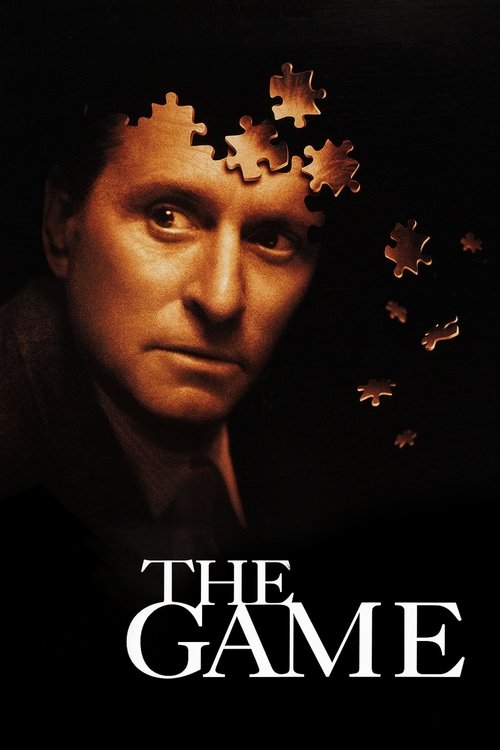
The Game (1997)
Directed by Fincher and written by John Brancato and Michael Ferris, The Game follows Nicholas Van Orton, an affluent and profoundly isolated banker whose entry into a personalized game begins to erase the boundary between performance and reality. For me, the film works because it identifies control as Nicholas’s most treasured possession and then takes it away piece by piece. His money, status and ability to intimidate other people cannot help him once he stops trusting the institutions, rooms and relationships around him.
The Game turns privilege into a psychological trap
Nicholas is not designed as an immediately lovable protagonist, and softening him would ruin the movie. He is remote, severe and so accustomed to getting his way that ordinary human interaction often feels like an irritating administrative task. His wealth gives him extraordinary freedom, but it has also become a system for avoiding vulnerability. Fincher does not treat the mansion, tailored clothes and private offices as simple fantasies of success. They are expensive layers of insulation.
That makes Michael Douglas ideal casting. He can project authority without raising his voice, then turn the smallest reply into a blade. Roger Ebert noted the dialogue’s “wicked wit” and the cruelty of Nicholas’s sarcastic responses, and that defensive sharpness is central to the performance. Douglas allows panic to emerge gradually from beneath the character’s abrasive restraint. Nicholas does not instantly become a different man when the pressure starts; he tries to manage terror with the same chilly impatience he uses to manage everything else.
The performance gives the escalating conspiracy a human shape. A lesser version of The Game might have made Nicholas an ordinary audience surrogate and relied entirely on questions about who is watching him or which disruption is real. Douglas instead makes every new violation an attack on a specific personality. We are watching a difficult man discover that his usual weapons—money, access, sarcasm and institutional confidence—have stopped working.
That is also why Nicholas remains compelling even when he is not especially sympathetic. The film does not require us to approve of him before making his fear contagious. His arrogance creates dramatic friction, while the gradual collapse of that arrogance supplies the emotional movement. Fincher turns privilege into a vulnerability: Nicholas has constructed such a controlled life that uncertainty feels like an existential assault.
San Francisco becomes an elegant surveillance maze
The atmosphere is the film’s strongest achievement. Cinematographer Harris Savides turns offices, mansions and city streets into parts of the same elegant trap. The images are dark without feeling generically grim, and the city retains enough physical specificity to prevent the story from dissolving into an abstract puzzle. Nicholas may be losing his grip on reality, but the architecture surrounding him remains oppressively solid.
That visual precision was rooted in the production. The film was shot almost entirely on location in San Francisco and Mexicali, with additional stage work in Los Angeles. The production also used blacked-out Panavision cameras to reduce reflections in windows—a wonderfully exacting solution for a movie in which glass, visibility and the suspicion of observation carry so much weight. American Cinematographer’s production account describes Savides’ imagery as a “shadow-filled milieu of intrigue” and identifies 1970s paranoid thrillers as a key point of reference.
Fincher makes those shadows psychologically useful. Darkness is not just decoration pasted onto a thriller plot; it changes how Nicholas and the audience read familiar spaces. Rooms that should signify security begin to suggest exposure. Polished surfaces no longer reassure. The city appears orderly, expensive and professional, yet every part of it seems capable of concealing another mechanism in the game.

The cold visual control also gives Fincher something to dismantle. His later work would return repeatedly to obsessive people attempting to impose systems on an uncooperative world, a tendency visible in MovieBunker’s review of The Killer and its icy world of precision. In The Game, however, the system belongs to somebody else. Nicholas is not pursuing mastery; he is discovering how easily the appearance of mastery can be manufactured.
Intrigue is more gripping than conventional action
Fincher characterized The Game as an intrigue movie rather than a large-scale action film and identified loss of control as one of its central concerns. That distinction explains why its best passages do not depend on one spectacular set piece. The tension comes from invasive disruptions, unstable loyalties and the sense that every attempt to obtain a clear answer only opens another trapdoor.
I like that controlled escalation more than I would a louder series of chases and confrontations. Fincher understands that uncertainty needs rhythm. The movie repeatedly gives Nicholas just enough information to form a theory, then makes that theory unsafe. Trust becomes provisional. Explanations arrive contaminated by the possibility that they are themselves part of the performance.
The result is propulsive without becoming frantic. At about 129 minutes—the supplied runtime listings vary slightly—the film has room to tighten its grip rather than sprint immediately into chaos. Fincher lets Nicholas’s confidence erode in stages, making the nightmare feel cumulative. Like the suffocating uncertainty examined in our Sicario review, the tension comes from watching a protagonist realize that the apparent rules offer no protection.
The dry dialogue helps prevent all this control from becoming humorless. Nicholas’s cutting manner gives the early material a nasty comic edge, and that wit makes his later inability to command events even more satisfying. The movie is never a broad takedown of a rich man, but it understands the grim pleasure of watching absolute confidence encounter a situation it cannot buy, fire or insult into submission.
The ending works emotionally better than mechanically
The ending is the obvious reservation, and discussing its weakness does not require spoiling its mechanics. The Game eventually asks the audience to accept a degree of planning and precision that becomes increasingly fragile when examined afterward. The immediate rush survives because Fincher has established such persuasive nightmare logic, but the mystery loses some retrospective coherence once the visible contrivances begin piling up.
This tension divided contemporary responses in revealing ways. Ebert praised the film’s technical execution and nightmare-like escalation while acknowledging that individual logistics could strain plausibility. The Washington Post took a harsher position, arguing that the film abandons its strongest premise at the decisive point, while a Newsweek excerpt preserved by Metacritic identified “gaping holes of logic.” I land between those views: the machinery does not withstand every practical question, but its emotional purpose remains clear enough to preserve the experience.
The more troubling issue is moral rather than logistical. The game functions as a forced reckoning with Nicholas’s isolation, but its methods are coercive and psychologically punishing. The Washington Post compared the broad redemptive framework to It’s a Wonderful Life while objecting to what this film does with that setup. That comparison exposes the discomfort at the heart of The Game: personal awakening is presented through cruelty so extreme that redemption cannot feel clean.
I do not think that unease destroys the movie. If anything, it keeps the conclusion from becoming simple reassurance. Nicholas’s insulated existence clearly needs to be challenged, but the film never fully reconciles the value of that awakening with the brutality used to produce it. The ending wants release after two hours of sustained violation, and the transition is more emotionally complicated than the movie can comfortably admit.
The Game remains an essential Fincher nightmare
The Game is best approached as a psychological nightmare rather than an engineering diagram. Viewers who need every logistical detail to lock perfectly into place may leave frustrated, because the explanation cannot match the immaculate control of the build-up. But anyone who enjoys dark, intricately plotted thrillers should find plenty to admire in the way Fincher turns wealth, professionalism and urban sophistication into sources of dread.
Douglas holds the entire construction together. His performance makes Nicholas’s collapse feel like more than a chain of clever reversals, while Savides gives that collapse one of the most seductive visual environments in 1990s American thrillers. Even when the plot strains, the atmosphere never loses its grip.
For me, that grip is decisive. The Game does not need an airtight solution to make its central idea land: control is partly a story people tell themselves because the alternative is terrifying. Fincher dismantles that story with ruthless precision, leaving behind a cold, propulsive and morally uneasy thriller that deserves to be seen—even if the argument after the credits inevitably becomes another game.