
Fatal Attraction remains gripping because it takes a moment of reckless desire and tightens it into a domestic nightmare with ruthless patience. Adrian Lyne’s thriller is sleek without feeling empty, lurid without immediately surrendering to camp, and powered by a Glenn Close performance that resists the screenplay’s eventual demand that Alex Forrest become a straightforward monster. Its final turn is blunter and less psychologically persuasive than everything leading to it, but the film still gets under the skin.
Our verdict A sleek, gripping domestic nightmare powered by Glenn Close’s volatile performance and Adrian Lyne’s carefully controlled erotic tension. Its blunt final turn sacrifices some psychological complexity, but the film remains uncomfortably effective.
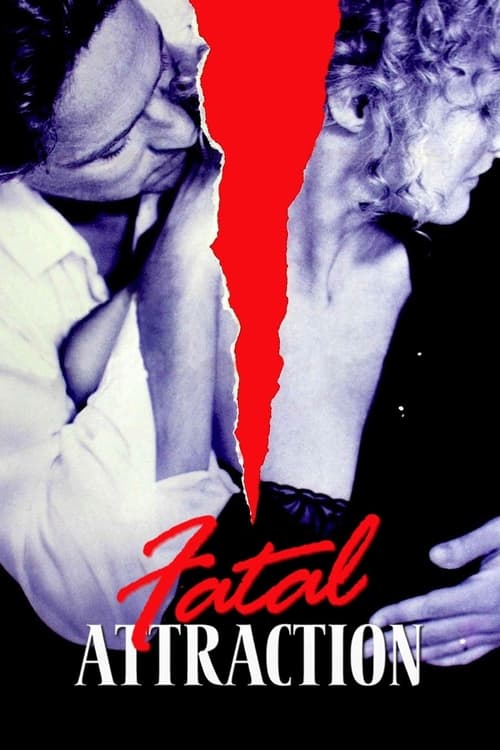
Fatal Attraction (1987)
The central argument of this Fatal Attraction 1987 review is that the movie works best while attraction, guilt and fear remain tangled together. Lyne understands that the affair itself is not enough; the real suspense comes from watching Dan Gallagher’s attempt to compartmentalize it fail. Desire crosses into professional life, then marriage and finally the supposedly protected family home. By the time the movie becomes a more conventional horror-thriller, it has already built an impressively uncomfortable trap.
Fatal Attraction turns polished desire into domestic dread
The premise is brutally efficient. Dan, a married New York attorney played by Michael Douglas, begins a brief affair with book editor Alex Forrest, played by Close. When he treats the encounter as finished, she refuses to accept his terms, and the consequences spread toward his wife Beth, played by Anne Archer, and their daughter. The setup could have produced little more than a cautionary exploitation thriller. Lyne instead gives the escalation enough room to become psychological pressure.
That deliberate pace is crucial. Fatal Attraction does not need to behave like an action movie because its most effective weapon is anticipation. Dan’s mistake hangs over the film before every consequence arrives, and the measured build allows erotic excitement to sour gradually into unease. Howard Atherton’s sensual imagery and the deliberate pacing were already central to discussion of the film’s erotic atmosphere in 1987. They remain central to why it works: the polished appearance is not decorative 1980s gloss but part of the danger. Everything looks controlled until control becomes the story’s central illusion.
Atherton’s cinematography, Maurice Jarre’s music and the editing credited to Michael Kahn and Peter E. Berger all contribute to Lyne’s steady tightening of the screws. The movie understands that erotic thrillers require more than sex and menace. They need a convincing transition between the two. Attraction has to retain enough charge that the later fear feels like a consequence rather than a genre change imposed from outside.
The locations reinforce that progression. Production moved through New York City and Westchester County, including Wall Street, Greenwich Village and suburban homes. The AFI Catalog’s production history documents that geography, which gives the thriller a persuasive dramatic shape: the risk begins in an urban world of work and private appetite, then advances into the domestic space Dan imagined he could keep separate. The movement makes the affair feel invasive without pretending Dan is merely an innocent homeowner selected at random.
Glenn Close keeps Alex human longer than the screenplay does
Close is the reason Fatal Attraction remains more troubling than its most sensational elements. Alex can be frightening, but Close does not reduce her to a collection of ominous gestures. She keeps vulnerability, humiliation, fury and need in unstable proximity. Even when the plot pushes Alex toward excess, Close preserves the sense of a person being distorted into a threat rather than a threat who was conveniently waiting to reveal herself.
That distinction matters because the movie’s politics become harder to defend as it proceeds. Alex’s refusal to let go is dangerous, but Dan’s desire to define the affair entirely on his terms is also morally active. He expects the encounter to fit inside a sealed compartment: temporary pleasure, no lasting obligation and no disruption to the life he values. The thriller is strongest when it recognizes the arrogance in that expectation.
Douglas is well cast for the movie’s shifting sympathies. Dan must be recognizable enough for the audience to understand his panic without becoming so sympathetic that his decisions disappear from the moral equation. The film sometimes lets him retreat too comfortably into the role of besieged family man, but Douglas makes that retreat dramatically effective. Dan wants normality restored so badly that his fear can begin to look like innocence.
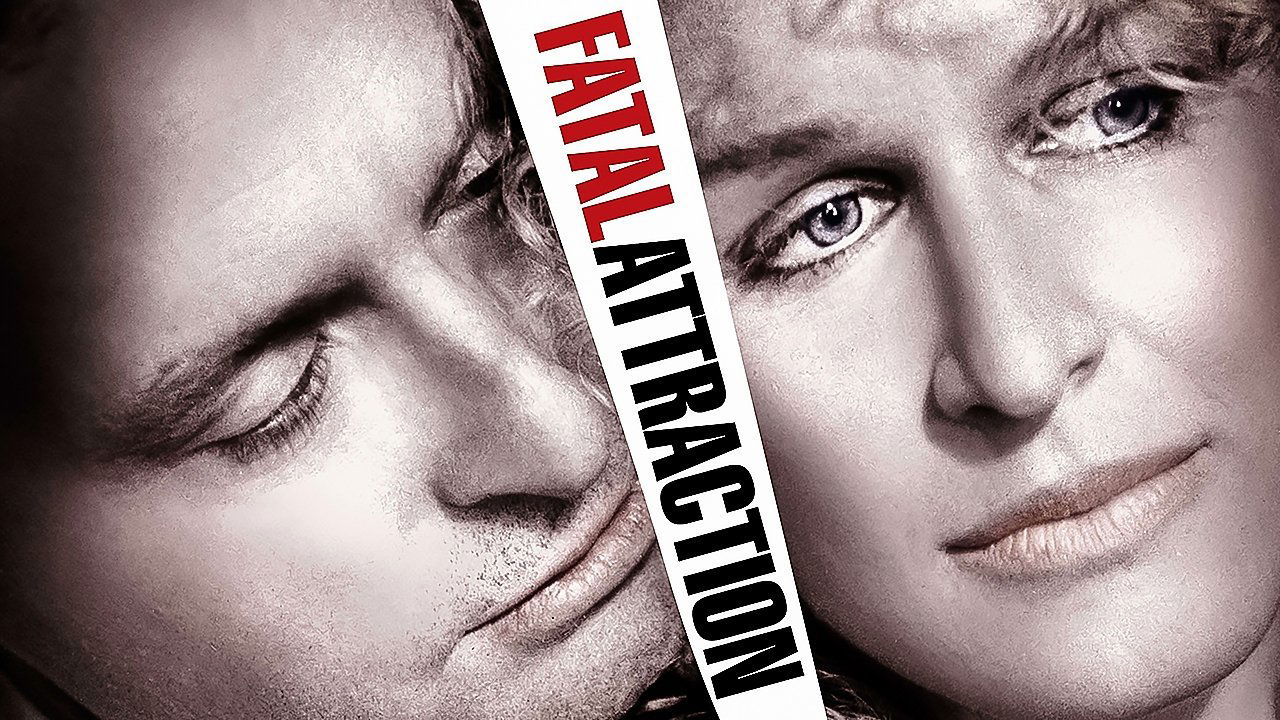
Close never permits the same easy simplification. Her performance keeps asking what the movie would prefer to stop asking: whether Alex’s pain deserves recognition even when her conduct becomes indefensible. The pathos in Close’s performance and Lyne’s moments of empathy for Alex were also recognized in contemporary critical responses. For me, that emotional contradiction is the film’s greatest strength. Alex is most compelling when she is neither an innocent victim nor a ready-made villain.
The family-under-siege framing makes the morality too comfortable
Fatal Attraction becomes less persuasive when Dan’s culpability recedes behind the image of his household under attack. The affair remains his decision, yet the structure increasingly treats the restoration of his family as the obvious moral destination. That turns a messy story about infidelity, agency and consequence into a cleaner conflict between domestic order and an intruder.
The simplification is dramatically useful. It gives the suspense a clear direction and allows the movie to intensify without pausing for a seminar on marital ethics. It also exposes the limitation of its viewpoint. Dan’s panic receives narrative momentum, while Alex’s interior life is increasingly converted into evidence against her. Close keeps fighting that narrowing process, which is why the performance grows more interesting even as the screenplay grows less so.
This tension is part of what separates Fatal Attraction from a purely mechanical stalker thriller. Viewers interested in another classic about obsession and the stories people impose upon others may find a useful comparison in MovieBunker’s review of Alfred Hitchcock’s Vertigo. Lyne’s film is far more direct, but both movies become uncomfortable when desire starts treating another person as a role rather than a full human being.
A controlled thriller gives way to blunt catharsis
The final movement delivers undeniable force, but it does so by exchanging some of the film’s psychological tension for conventional horror-thriller machinery. The earlier sections are frightening because motives, shame and desire remain entangled. The climax is frightening in a simpler way: immediate danger demands immediate resolution.
That transition is effective enough to explain the movie’s staying power, yet it feels like its safest creative choice. In his original review, Roger Ebert praised the early material as spellbinding but argued that the closing minutes abandoned character and plausibility for a standard horror payoff. Ebert’s contemporary review identifies the fracture precisely, although I find the ending more effective as visceral cinema than his criticism allows. The finale does excite. The problem is that excitement replaces the more difficult movie Fatal Attraction had been making.
Compared with a modern chamber thriller such as Heretic, which also depends heavily on escalating psychological control, Fatal Attraction is more willing to cash ambiguity in for release. That makes it accessible and immediately satisfying, but less haunting than the morally unresolved version of the story suggested by its strongest passages.
Spoilers Ahead: The reshot ending reveals the film’s priorities
The released ending was not the original conception. The earlier screenplay had Alex frame Dan for her death, while the theatrical resolution emerged from reshoots. AFI records Lyne’s view that the initial ending did not fit the emotional drama, as well as reports that test audiences were dissatisfied with it. The change clarifies exactly what the finished film wants: punishment, physical catharsis and restoration of the family unit.
As crowd-pleasing machinery, the decision works. The final confrontation provides a direct outlet for tension accumulated across the movie, and Beth’s intervention decisively reasserts the threatened household. But the resolution also converts Alex from a psychologically complicated antagonist into a target to be eliminated. Dan’s betrayal becomes background information while the family’s survival becomes the only urgent moral fact.
The earlier ending would not automatically have solved every problem. Its darker ambiguity might have created different plausibility issues, and an unused idea is not inherently better simply because it is less conventional. What matters is what the theatrical choice reveals. Fatal Attraction ultimately prefers retribution to uncertainty. It wants the audience to leave relieved rather than implicated.
Fatal Attraction remains an uncomfortably effective thriller
Despite that retreat into conventional punishment, Fatal Attraction remains a sleek and impressively controlled piece of domestic suspense. Lyne understands how to make privilege, professional confidence and suburban security feel fragile. Atherton’s sensual imagery gives the danger an alluring surface, while the pacing turns one selfish decision into sustained pressure rather than a rapid series of shocks.
Close elevates the entire film. She supplies the ambiguity the screenplay gradually strips away, keeping Alex emotionally legible even at her most extreme. That does not excuse the character’s actions; it prevents the movie from becoming as morally simple as its ending wants to be. Her performance leaves a residue of discomfort after the thriller has tried to tidy everything up.
I recommend Fatal Attraction to viewers who like slow-building psychological thrillers, erotic tension and performances that complicate familiar genre roles. Its gender politics and family-under-siege framing deserve skepticism, and the final stretch is more bluntly satisfying than psychologically convincing. Even so, the deliberate escalation and Close’s volatile, wounded performance make it difficult to dismiss. It works best before it settles for retribution, but during that long tightening of the trap, it is very hard to look away.