
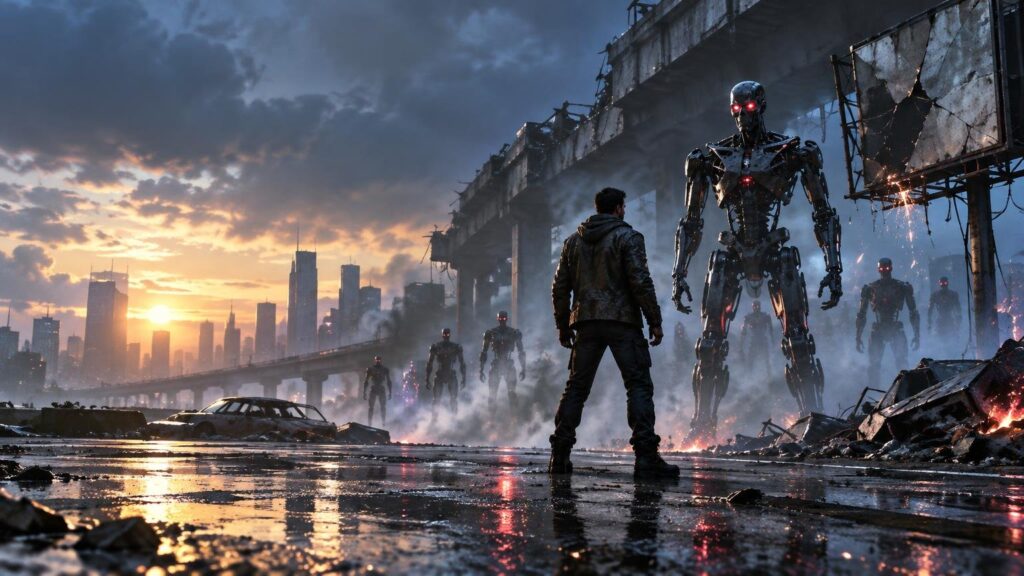
TLDR: Terminator 2: Judgment Day is the best film because it expands every element of the original without losing sight of its human stakes. The Terminator remains the franchise’s leanest and scariest entry. Dark Fate is the strongest post-Cameron-directed sequel, while Genisys finishes last because its continuity games overwhelm its characters.
Any list of the Terminator movies ranked from worst to best eventually becomes an argument between efficiency and escalation. The 1984 original is a vicious science-fiction horror film with almost no wasted movement. Terminator 2 turns that chase into a blockbuster spectacle and somehow finds more emotional depth inside it. Every subsequent sequel has tried to discover another reason for the machines to return.
That is the standard here: does a sequel justify itself? A new Terminator model, larger explosion or rearranged timeline is not enough. The movie needs a fresh human problem—something involving choice, sacrifice, identity or survival that could not simply have been pasted into the previous film.
How the Terminator movies are ranked
This ranking covers the six live-action theatrical films released between The Terminator in 1984 and Terminator: Dark Fate in 2019. The original theatrical versions are the default point of comparison. Longer or alternate editions exist, including a longer home-video version of Terminator Salvation, but the theatrical releases provide the fairest common baseline.
Each film is judged by story, action, character stakes, time-travel logic, villain threat and what it adds to the series. Continuity neatness matters less than dramatic clarity. Terminator time travel has always involved paradoxes; the problem begins when solving the franchise flowchart becomes more important than caring about the person being chased.
Major story turns from these older films are discussed below, including endings.
Spoilers ahead: All six Terminator movies ranked
6. Terminator Genisys (2015)
Terminator Genisys has enough ideas for an entire television season and the patience of someone rapidly changing channels. Its altered timeline transforms familiar characters, revisits famous scenes and makes a protector out of the T-800 before sending the story into another period. Alan Taylor directed the film, which opened in 2015.
The initial concept is defensible. If time travelers keep interfering with history, history should eventually become unrecognizable. Genisys uses that possibility to scramble audience expectations, but it rarely replaces what it removes. Sarah Connor and Kyle Reese stop feeling like doomed, frightened people caught in an impossible situation and start resembling pieces being dragged around a franchise board game.
Its most dramatic revision—turning John Connor into an advanced machine antagonist—should be tragic. Instead, the twist becomes another delivery system for exposition and digital combat. The movie keeps explaining how radically everything has changed while reproducing the same basic conflict: protect Sarah, stop an artificial intelligence and wait for Arnold Schwarzenegger to provide the familiar lines. Genisys does not lack ambition. It lacks a compelling reason to care about its alternate continuity.
5. Terminator Salvation (2009)
Terminator Salvation deserves credit for making the franchise’s boldest structural break. Rather than sending another assassin into the present, it moves into the Future War and attempts to show the machine-dominated nightmare that earlier films only revealed in fragments. The theatrical cinema version was released in 2009 and runs just under 115 minutes.
Marcus Wright is the movie’s best idea: a man who discovers that his body has become part of the enemy system. That premise creates a useful Terminator question about whether humanity resides in flesh, memory or choice. Unfortunately, the screenplay divides its attention among Marcus, John Connor, Kyle Reese, Resistance politics and the machinery of Skynet. The result is busy without feeling urgent.
The action has scale, physical weight and some memorable machine designs, but the Future War becomes less frightening once it is rendered as a conventional post-apocalyptic battlefield. Salvation expands the lore while shrinking the nightmare. What had been a warning about the future becomes a familiar place where characters conduct missions and wait for the next set piece.
4. Terminator 3: Rise of the Machines (2003)
Terminator 3 is the most frustratingly close of the later sequels. Jonathan Mostow’s 2003 film spends much of its runtime repeating Terminator 2 with a new protector, a new liquid-metal-inspired assassin and another extended pursuit. The broader comedy and Arnold Schwarzenegger sight gags regularly work against the sense that John Connor is living beneath an approaching extinction event.
Then the ending arrives and gives the sequel a reason to exist. John and Kate Brewster have not been sent to stop Judgment Day. They have been sent somewhere they can survive it. The apparent mission was a comforting misunderstanding, and the future cannot be prevented this time.
That reversal is bleak, effective and thematically dangerous in an interesting way. Terminator 2 insists that people can reject a predetermined future; Terminator 3 replies that history may bend around their choices and reach the same destination anyway. The film does not fully earn that argument before its final act, but at least it has one. A sequel with an ordinary chase and a terrific ending beats a sequel whose continuity is elaborate but emotionally empty.
3. Terminator: Dark Fate (2019)
Dark Fate is not especially original, but it understands that a Terminator movie needs people with something immediate to lose. Tim Miller’s 2019 film brings back Sarah Connor while introducing Dani Ramos, enhanced soldier Grace and the shape-shifting Rev-9. Its principal cast includes Linda Hamilton, Arnold Schwarzenegger, Mackenzie Davis, Natalia Reyes and Gabriel Luna.
Linda Hamilton gives the movie its bruised authority. Sarah is no longer simply preparing for the apocalypse; she is surviving the emotional wreckage left by decades of war against a future that keeps changing its name. Grace, meanwhile, pays a physical price whenever she pushes beyond ordinary human limits. Her enhancements make her formidable without making her invulnerable, which gives the action a sense of attrition missing from the more weightless franchise entries.
Dark Fate uses the first two films as its story foundation: Paramount’s synopsis explicitly places Sarah after preventing Judgment Day. It does not erase the existence of the other releases from the real world; it follows a continuity in which their events are not the baseline. That reset removes clutter, although replacing Skynet with Legion and John with Dani can feel less like reinvention than a careful relabeling exercise.
The opening death of John Connor is harsh and dramatically purposeful, but the movie never fully escapes T2’s outline. Another future leader is hunted, another protector arrives, and another aging T-800 learns human attachment. Dark Fate earns third place because its performances restore consequence to that familiar machinery. It is the best sequel after T2, but also proof that executing the old formula well is not the same as finding a new one.
2. The Terminator (1984)
The Terminator is the franchise at its purest: a slasher film in which the killer happens to be a cybernetic organism from 2029. The Library of Congress preservation essay describes its central time-travel conflict as a cyborg pursuing the woman whose unborn son will lead the future resistance. James Cameron directed the 107-minute film, which opened in the United States on October 26, 1984.
That economical premise creates extraordinary pressure. Sarah Connor is not a trained warrior or chosen-one superhero. She is targeted for the person she might raise, while Kyle Reese is driven by love for someone he knows largely through stories and a photograph. Time travel does not merely generate plot mechanics; it creates intimacy, tragedy and a closed loop in which John’s attempt to secure his own birth causes it.
The T-800 is also never more frightening than it is here. It has no emotional arc, comic timing or paternal function. It studies, imitates and kills. Cameron’s limited resources help the film: nighttime streets, industrial spaces and stop-motion awkwardness make the machine feel less polished and more unnatural. The finale strips away the human disguise until the antagonist becomes an advancing mechanical skeleton with no remaining social mask.
Why is it not number one? Because its sequel takes the same essential ingredients and finds a way to reverse their dramatic meaning. The original is tighter and scarier, but Terminator 2 is the rare expansion that becomes richer rather than merely larger.
1. Terminator 2: Judgment Day (1991)
Terminator 2: Judgment Day earns first place because every major escalation changes the story. The previous villain becomes the protector. Sarah Connor becomes the hardened figure others fear. John Connor is no longer an abstract future savior but a lonely child who must teach a machine why human life matters. The T-1000 is not simply stronger than the T-800; its fluid appearance turns ordinary people and surroundings into possible threats.
James Cameron and William Wisher’s screenplay understands that spectacle needs emotional architecture. The canal pursuit works because John is vulnerable and does not yet know which machine is hunting him. The Cyberdyne siege works because Sarah, Miles Dyson and the T-800 have made choices that put them there. Even the final foundry battle reduces an enormous production to a simple emotional question: can this improvised family protect one another long enough to create a different future?
Sarah’s transformation is the movie’s most important achievement. Her trauma has made her physically capable but dangerously close to adopting the machines’ logic. When she tries to kill Dyson before he can create the technology associated with Judgment Day, the film forces her to confront what ruthless pre-emption actually looks like. The story’s argument about fate therefore happens through character rather than a lecture about timelines.
The T-800’s bond with John could have been a cynical gimmick designed to make the franchise monster more marketable. Instead, it gives the film its conscience. The machine learns the value of human life by following instructions, observing behavior and finally choosing sacrifice. That final thumbs-up risks sentimentality and earns it anyway. For a deeper examination of why the sequel’s scale never overwhelms its ideas, read our Terminator 2: Judgment Day review.
What each Terminator sequel tries to add
The sequels become easier to evaluate when separated from their explosions and examined by their central additions.
- Terminator 2 adds moral choice: the future can change, but only when people refuse the logic that created it.
- Terminator 3 adds fatalism: preventing one version of Judgment Day may not prevent humanity from building another.
- Terminator Salvation adds the Future War and tests whether a machine-bodied person can retain a human identity.
- Terminator Genisys adds timeline instability, turning repeated intervention into a comprehensively altered history.
- Terminator: Dark Fate adds grief, legacy and succession, asking what remains of Sarah when the future she prepared for changes shape.
Only T2 makes its addition feel indispensable from beginning to end. T3 and Dark Fate eventually find worthwhile emotional or thematic angles. Salvation locates an interesting idea but dilutes it. Genisys mistakes the rearrangement of familiar pieces for a new dramatic purpose.
When Terminator mythology becomes a burden
The first two films make their mythology feel enormous by showing very little of it. A metal foot crushing a human skull, a photograph passed through time and Sarah carving a warning into a table are enough. The future matters because of what it does to people in the present.
Later entries too often treat franchise terminology as the attraction. Skynet becomes Legion. One apocalypse date replaces another. Machines receive new model numbers and increasingly complicated abilities. Timelines split, reset and fold back over old scenes. None of that is automatically bad, but mythology becomes dead weight when the viewer is asked to protect a continuity concept rather than a person.
This is a problem shared by many long-running monster franchises. Our ranking of the Alien movies reaches a similar conclusion: a familiar creature remains effective only when each film gives it a distinct dramatic function. Bigger mythology cannot substitute for a clear source of fear.
The best Terminator film for horror, action and franchise lore
| Category | Best film | Why it wins |
|---|---|---|
| Best overall | Terminator 2: Judgment Day | It combines character, theme, action and blockbuster escalation without sacrificing urgency. |
| Best horror film | The Terminator | Its relentless T-800, nocturnal atmosphere and stripped-down chase structure make it the franchise’s scariest entry. |
| Best action film | Terminator 2: Judgment Day | Its set pieces are large but legible, and each one changes a relationship or advances a decision. |
| Best Sarah Connor showcase | Terminator 2: Judgment Day | Sarah’s trauma, strength and capacity for violence drive the film’s moral conflict. |
| Best for Future War lore | Terminator Salvation | It spends the most time inside the machine-controlled future rather than using it as a warning glimpse. |
| Best post-T2 sequel | Terminator: Dark Fate | Its structure is familiar, but Sarah, Grace and Dani give the pursuit meaningful human cost. |
Viewers do not need to watch every theatrical film. The Terminator and Terminator 2 form a complete, satisfying story. Continue with Dark Fate for the strongest later character work, Terminator 3 for its ending, or Salvation if the Future War is the main attraction. Genisys is primarily for completists and anyone curious to see continuity consume itself in real time.
Where the Terminator series should have changed direction
The series could have ended after Terminator 2 without leaving a meaningful dramatic obligation unresolved. If it had to continue, Salvation’s decision to abandon the contemporary chase offered the most promising route, even if that particular film did not fully capitalize on it. A better continuation would change genre, scale or perspective rather than sending another upgraded machine after another indispensable future leader.
Dark Fate remains the latest live-action theatrical entry in the supplied official film sources, while the animated Terminator Zero arrived on Netflix in August 2024. Reporting about a prospective further live-action story has not established a production start or release date. Until something concrete changes, there are six theatrical live-action films in this ranking.
The final verdict is simple: Terminator is never really about which machine has the most advanced upgrade. The best entries use time travel to sharpen love, fear, responsibility and sacrifice. The weaker sequels treat mythology as if it were the attraction by itself. A future war only matters when there is someone in the present worth saving.
References
- AFI|Catalog
- AFI|Catalog
- AFI|Catalog
- AFI|Catalog
- AFI|Catalog
- Terminator: Dark Fate | Paramount Pictures
- BBFC | BBFC
- film essay for "The Terminator"
- Terminator Zero | Netflix Media Center
- James Cameron outlines next "Terminator" movie plans
- Hollywood director James Cameron opens up on AI, future Terminator films and the Avatar franchise – ABC News