
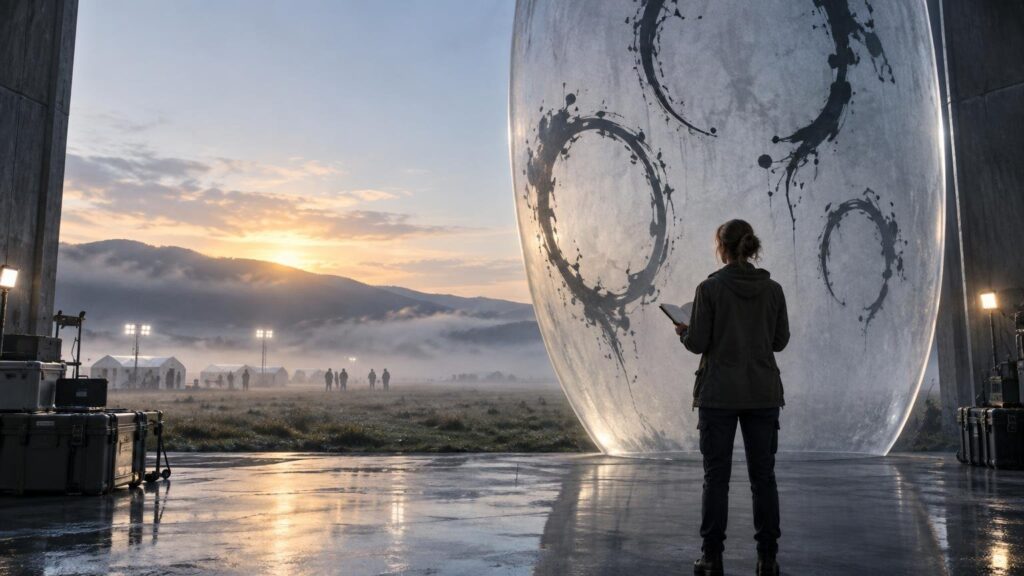
Arrival understands that trying to comprehend another mind can be more suspenseful than shooting at it. Denis Villeneuve’s first-contact drama takes an intricate speculative premise and turns it into an intimate act of empathy, with every tentative symbol carrying the threat of catastrophic misunderstanding. This Arrival movie review comes down firmly on the side of its patience: the careful accumulation of meaning is not a delay before the action. It is the action.
Our verdict Arrival turns translation into gripping suspense, with Amy Adams grounding its grand ideas in quiet emotional conviction. Its geopolitical machinery is less nuanced, but Denis Villeneuve’s patient, uncanny first-contact drama remains exceptional science fiction.
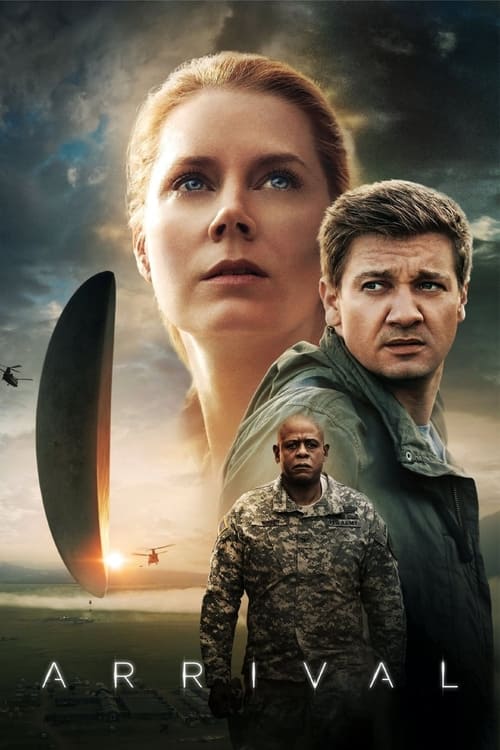
Arrival (2016)
After 12 mysterious spacecraft appear around the world, linguistics professor Louise Banks is recruited to establish communication with the visitors while governments struggle with fear, incomplete information and growing international distrust. Amy Adams plays Louise, Jeremy Renner is physicist Ian Donnelly, and Forest Whitaker appears as Colonel Weber in Eric Heisserer’s adaptation of Ted Chiang’s short story “Story of Your Life.” That setup could easily have produced another countdown-driven invasion movie. Instead, Arrival becomes exceptional science fiction by asking whether curiosity can survive long enough to prevent panic from making the first move.
Amy Adams makes thought visible
Adams is the film’s essential translator in more ways than one. Louise spends much of the story observing, listening and processing information, which leaves the performance without many of the obvious tools actors receive in louder blockbusters. There are no heroic speeches designed to announce her intelligence. Adams makes concentration itself dramatic. A pause before she answers, a slight change in her breathing or a wary step forward communicates the mental work happening beneath Louise’s controlled exterior.
That restraint gives the film its human pulse. Arrival deals in enormous questions about language, knowledge, memory and choice, but Adams never allows Louise to become a delivery system for a clever screenplay. She plays expertise as an active quality rather than a character description. Louise tests assumptions, recognizes when a question has been built incorrectly and understands that shared terms must exist before anyone starts demanding answers. Her intelligence is compelling because the film shows how she uses it.
Adams also holds together the movie’s emotional and conceptual layers. Villeneuve presents fragments of Louise’s private life without immediately explaining how they connect to the crisis, and a colder performance might have made those passages feel like pieces arranged for a later revelation. Adams gives them emotional reality in the moment. Even when the structure keeps us uncertain, her response feels complete. The eventual payoff works because she has already persuaded us that Louise is a person before she becomes the key to a puzzle.
Renner brings an easy warmth to Ian and works well as a less guarded counterweight, but the supporting roles are thinner by design and sometimes by convenience. Ian frequently exists to assist, explain or quietly admire, while several military and political characters embody institutional pressure rather than fully developed perspectives. Whitaker gives Weber enough weary authority to avoid caricature, yet this is unmistakably Louise’s film. That imbalance strengthens its emotional focus while limiting the surrounding human world.
Arrival turns translation into gripping action
What makes Arrival so gripping is its insistence that communication is physical, dangerous work. Louise cannot simply ask the visitors why they have come. She must establish who is speaking, what a question is, whether a symbol describes an object or an intention, and how radically different beings might organize meaning. One mistranslated term could be treated as a declaration of war. A whiteboard and marker become more consequential than a rack of weapons.
Villeneuve repeatedly resists the temptation to rush this process. Terms are tested, revised and placed into context. Information arrives in partial forms. The repetitions could frustrate viewers expecting every encounter to produce a fresh burst of conventional spectacle, but they create their own escalating rhythm. Each return to the spacecraft carries more knowledge and therefore more risk. The audience begins to understand enough to recognize how much remains uncertain.
For me, that controlled build is much more exciting than the expanding geopolitical machinery around it. Editor Joe Walker described withholding information and staging revelations gradually, while fabricated broadcast footage helped widen the atmosphere of international paranoia. The editing succeeds because it keeps those larger developments attached to Louise’s limited perspective. We receive fragments rather than an all-knowing overview, making uncertainty the film’s central condition instead of a temporary obstacle.
The structure also plays fair without becoming obvious. Images acquire new significance as Louise’s understanding changes, but Walker does not reduce the movie to a parade of cryptic clues begging to be solved. Arrival is interested in the emotional consequences of perception, not merely in congratulating the audience for recognizing a trick. Its revelations deepen what came before rather than invalidating it.
That distinction matters because puzzle-box science fiction can become emotionally sterile when every scene exists only to hide a later answer. Arrival avoids the trap. Its withheld information is not a screenwriter teasing the audience from behind a curtain; it recreates Louise’s incomplete understanding. We are not simply waiting to learn what the visitors mean. We are learning how difficult it is to ask the right question in the first place.
The spacecraft feels monumental, tactile and completely wrong
Arrival’s atmosphere is its strongest technical achievement. Bradford Young’s cinematography avoids the polished brightness of so much effects-heavy science fiction. Interiors sink into shadow, military spaces feel damp and temporary, and the landscape around the spacecraft has an overcast, almost funereal stillness. The alien object itself is monumental but not busy: a dark, smooth form whose simplicity makes it more unsettling. It does not look engineered to sell toys. It looks as though it obeys an aesthetic logic that has no interest in us.
The first entries into the craft are especially effective because Villeneuve gives them physical weight. Characters struggle with protective equipment, move through an unfamiliar gravitational transition and approach the encounter as vulnerable bodies rather than invincible explorers. Young said the spacecraft interior used for Louise’s initial entry was a fully practical set designed by production designer Patrice Vermette. Bradford Young’s discussion of the practical spacecraft interior That substantial environment registers in the actors’ cautious movement. The sequence feels less like actors visiting an effects stage and more like people discovering that the ordinary rules of space have stopped cooperating.
The practical construction does not mean Arrival rejects digital filmmaking. Walker said the finished film contained 750 visual-effects shots, with some creature imagery developed after performers worked from eyeline references on set. What matters is how quietly those effects serve the scene. The visitors have presence because their scale, environment and movement belong to the same ominous visual system. The film never stops to wave a digital creation in front of the audience and demand applause. Its spectacle supports the atmosphere instead of elbowing the story aside—a novel blockbuster concept, apparently.
Jóhann Jóhannsson’s score and the broader sound design complete that sense of entering a place beyond familiar categories. Voices, low vibrations and musical textures blur into one another, creating unease without relying on routine shock cues. The sound does not tell us precisely what to feel. It makes the contact space seem too large, too dense and too unfamiliar for ordinary human comfort. Combined with Young’s shadows and Vermette’s severe forms, it creates awe without sanding away fear.
This craft does more than make the spacecraft impressive. It supports the movie’s argument. Human spaces are cluttered with screens, equipment, uniforms and urgent voices, while the visitors’ environment is vast and severe. Louise enters carrying all the noise of human assumption into a place she cannot immediately categorize. The visual contrast makes interpretation feel like a confrontation with the limits of her own perspective.
The global crisis is effective but considerably less subtle
Arrival is at its weakest when its intimate study of interpretation widens into familiar studio-thriller urgency. Military deadlines, news montages, frightened crowds and deteriorating international cooperation all serve the theme: incomplete information becomes dangerous when governments treat uncertainty as hostility. The problem is not that these elements are irrelevant. It is that they communicate their point with far less nuance than Louise’s linguistic work.
A contemporary Time Out review argued that the ticking-clock material leaves Arrival divided between a broad studio thriller and a more intimate, eerie science-fiction drama. Time Out’s contemporary review of Arrival I agree that the seam is visible, but not that it splits the film in two. The geopolitical storyline supplies necessary pressure and prevents Louise’s work from becoming an insulated academic exercise. The threat of misinterpretation needs consequences. My reservation is narrower: the international crisis sometimes arrives through stock images and functional authority figures when the central encounter has taught us to expect greater precision.
Some of the conflict depends on people reducing complicated information to the most alarming possible interpretation. That is thematically appropriate, but the political actors remain broad enough that the crisis can feel mechanically arranged around Louise’s insight. The film is much better at dramatizing how two individuals might patiently build understanding than at representing how entire nations process uncertainty.
The supporting characters expose the same limitation on a smaller scale. Louise has such interior weight that Ian and the military figures can seem like satellites around her perception. The choice keeps the movie focused, but it means its argument for understanding is expressed through a world in which relatively few human beings are granted comparable complexity. Arrival asks us to resist simplification even as its thriller framework occasionally simplifies the people creating pressure.
The deliberate pacing will also be a dividing line. Arrival offers tension, danger and moments of immense scale, but it refuses the usual escalation from mysterious landing to increasingly destructive combat. Viewers waiting for the linguistics to end so that the invasion movie can begin may find it withholding. I find the repetitions purposeful because each encounter changes the meaning of the last. The payoff justifies the patience, even if the middle occasionally feels more managed than effortless.
Arrival chooses empathy over conquest
Villeneuve’s great achievement is making understanding feel brave. Arrival does not romanticize communication as a magical cure for conflict; it shows how slow, fragile and vulnerable the process can be. Louise must move closer to something frightening without assuming that fear has already explained it. To understand another mind, she must also risk being changed by what she learns. That idea gives the film its emotional force and separates it from stories in which contact with the unknown exists mainly to reveal humanity’s superior firepower.
It is also why the film remains moving rather than merely ingenious. Its speculative machinery is intricate, but the ultimate questions are recognizably human: What does knowledge ask of us? Does pain erase the value of what precedes it? Can choosing connection be rational when connection also creates vulnerability? Arrival lets those questions emerge through character, imagery and structure rather than flattening them into a final explanatory speech.
There is confidence in the film’s refusal to treat empathy as softness. Louise’s patience is not passive, and her restraint is not indecision. Listening becomes a form of courage because everyone around her is being pushed toward certainty before certainty is possible. Adams makes that pressure visible without turning Louise into a saint or a superhero. She is compelling because she keeps doing the difficult work of understanding while easier, louder responses gather momentum.
This is essential viewing for anyone who prefers thoughtful, emotionally sincere first-contact science fiction to laser battles. Adams delivers a beautifully attentive central performance, while Villeneuve, Young, Walker, Vermette and Jóhannsson turn language into image, rhythm and sound. The supporting characters and geopolitical plotting cannot match Louise’s depth, but those weaknesses do little to diminish the film’s central triumph. Arrival makes patience gripping, empathy cinematic and understanding feel like the most consequential action a person can take. Strongly recommended.