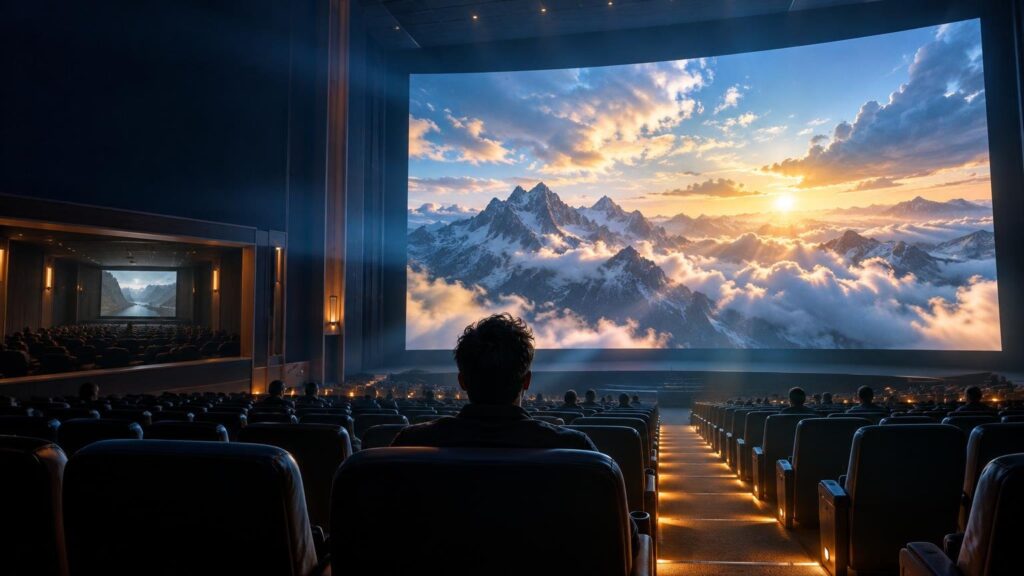
TLDR: IMAX is worth paying for when the movie has an expanded aspect ratio, an IMAX-specific sound mix or large-scale imagery—and when your local auditorium has the equipment to present those advantages properly. For an intimate drama, an ordinary conversion or a screening with terrible seats, a good standard auditorium may be the smarter purchase.
The honest answer to “is IMAX worth it for movies?” is therefore conditional. IMAX is not one identical experience installed in every theater, and the logo cannot tell you how much of a particular movie uses the format. Buy the movie-and-auditorium combination, not the label.
Is IMAX worth it for movies? The short answer by movie type
The strongest IMAX candidates are movies designed around scale: science fiction, aerial action, large-format spectacle, visually ambitious animation and films with sequences captured or specifically framed for the format. A huge screen can make landscapes feel overwhelming, place more image above and below the conventional frame, and give action room to breathe. A dedicated mix can make engines, spacecraft, weather and music physically imposing rather than merely loud.
That does not mean every blockbuster deserves the surcharge. A movie can play in IMAX without offering expanded imagery throughout, and some releases may have no expanded ratio at all. Conversely, a film does not need explosions every seven minutes to benefit. Deliberate compositions, imposing architecture and unusually detailed photography can be just as persuasive on a large screen.
A standard presentation is usually enough when the movie is visually modest, the IMAX-specific work is unclear, or the available seats would leave you staring upward from the front row. Comfort, sightlines and presentation quality matter more than format prestige. Cinema technology has accumulated enough acronyms to resemble a badly secured password, so our guide to theater-format acronyms can also help when comparing local listings.
What “IMAX” can mean at different theaters
The first trap is assuming every IMAX auditorium contains the same projector, screen and room. It does not. The network includes digital laser systems, older Xenon digital projection and a limited number of IMAX 70mm film installations. IMAX also describes “Filmed for IMAX” as a production-to-release program involving IMAX film cameras or certified digital cameras, followed by collaboration during post-production.
IMAX with Laser uses 4K laser projection and is promoted by the company as providing improved brightness, contrast, color and black levels. Its materials also describe a 12-channel sound system. Those are meaningful potential advantages, especially for dark scenes, vivid color and effects-heavy soundtracks, but the experience still depends on the specific installation and how the auditorium is maintained.
Older Xenon-equipped rooms remain part of the network. They can still provide a large screen, IMAX-remastered presentation and powerful sound, but “IMAX” on the booking page does not automatically mean the latest laser system. That distinction is worth checking when the surcharge is substantial.
IMAX 70mm is something else again: a photochemical film presentation available only at select locations and for select releases. It should not be treated as another name for laser projection. Likewise, an “IMAX with Laser” listing does not prove that the auditorium can display the towering 1.43:1 image associated with certain purpose-built screens. Official release notices identify the particular theaters offering those engagements.
Expanded aspect ratio is often the biggest visible difference
Aspect ratio describes the shape of the projected image. Many wide theatrical movies are presented around 2.39:1, producing the familiar broad, shallow frame. IMAX presentations may use 1.90:1 or, at select compatible venues, the much taller 1.43:1 ratio. When a movie has been prepared for that presentation, the expanded frame reveals additional picture vertically.
That extra height can materially change a scene. A mountain extends farther above the characters, a cockpit occupies more of your vision, or a falling body has greater vertical distance to travel. The benefit is not just “bigger objects.” It can alter composition and make the spectator feel less like they are watching action through a horizontal slot.
IMAX says a 1.90:1 presentation can provide up to 26% more image than a conventional presentation on a standard IMAX screen, while select 1.43:1 locations can show up to 67% more. Those are the company’s format-comparison figures, and “up to” matters: the actual benefit depends on the film, scene and venue.
Expanded imagery is also movie-specific. According to IMAX, most releases in its filming program use the expanded ratio for selected sequences, although some sustain it throughout the feature. IMAX’s Filmed for IMAX overview explains the program, but the title’s own official page is the better place to check exactly what a current release offers.
Do not assume that changing ratios are a defect. A film may deliberately open into a taller frame for its largest set piece and return to a wider composition afterward. When the transition follows the dramatic scale of the scene, it can be one of the format’s best tricks. When the expanded footage is brief or visually unimportant, it may not justify a large premium by itself.
Projection quality matters beyond sheer screen size
A giant screen is not automatically a great screen. The image still needs sufficient brightness, focus, contrast and uniformity. Stretching an underwhelming projection across a larger surface merely gives the problem more real estate.
Laser is generally the IMAX option to investigate first because its advertised advantages address those fundamentals. Stronger black levels and contrast can preserve depth in night scenes, while brightness and color matter for both visual impact and legibility. These are characteristics claimed for the system rather than proof that every laser auditorium will outperform every competing screen, so local experience still counts.
The key distinction is between projector technology and frame capability. Laser describes the projection system; 1.43:1 describes an image shape and the auditorium’s ability to display it. A laser venue may show only the 1.90:1 version of a movie. If a release is advertising a special 1.43:1 presentation, verify that your exact theater is included rather than inferring it from the word “Laser.”
Sound and auditorium scale can be worth the premium
Picture specifications receive most of the attention, but sound may produce the more immediate difference. IMAX says releases receive audio remastering for its system, while its laser materials describe 12-channel sound. The company’s theater package also encompasses projection, audio, screen treatment, control systems and auditorium planning rather than a projector dropped into an otherwise untouched room.
For the right film, that integration can create convincing direction and scale. An aircraft should move through the room rather than become an anonymous wall of noise. A bass-heavy score should carry force without burying dialogue. The best premium presentation makes the soundtrack feel larger while preserving the detail inside it.
Still, volume alone is not quality. Calibration, maintenance, room acoustics and seat location affect what reaches the audience. If your nearest IMAX has routinely harsh sound, distracting rattles or poor sightlines, the theoretical specification will not rescue the screening. A well-run standard theater can beat a neglected premium room.
Which movies benefit most from IMAX?
Look for confirmed format-specific work rather than trusting genre alone. The following signs make the premium easier to justify:
- The movie is officially identified as Filmed for IMAX.
- Its official listing confirms expanded 1.90:1 or 1.43:1 sequences.
- A substantial portion—or all—of the movie uses expanded framing.
- The production emphasizes large-scale environments, aerial photography, action geography or detailed visual compositions.
- The release has a sound mix tailored for IMAX presentation.
- A specifically listed IMAX 70mm engagement is available and the film was prepared for it.
- Your local venue has laser projection, good seats and a screen large enough to make the difference obvious.
The amount of format-specific material can vary dramatically. IMAX said Mission: Impossible – The Final Reckoning contained more than 45 minutes in 1.90:1, while its materials for F1 described the movie as presented entirely in 1.90:1 with a custom IMAX mix. The lesson is not that one title is automatically better; it is that checking the individual release can reveal what the premium actually buys.
When a standard theater is enough
Skip the upgrade when the sales pitch is doing more work than the movie. A dialogue-led film without confirmed picture or sound enhancements may gain little beyond a larger canvas. That can still be pleasant, but it is not necessarily worth sacrificing a better showtime, a preferred seat or a meaningful amount of money.
The same applies when the local IMAX details are vague. If you cannot identify the projection system, expanded ratio or any film-specific mastering, treat the premium as payment for a larger auditorium—not as a guaranteed leap in image quality.
Poor seat availability is another easy deal-breaker. An extreme front or side position can distort the image, force constant head movement and weaken the intended sound balance. The largest screen in town is not an upgrade if you spend two hours examining its lower-left corner like a detective searching for fingerprints.
Finally, compare IMAX with the theater’s other premium options. A venue may offer a competing large-format screen with laser projection, reclining seats or a layout you prefer. Without evidence that the film has an exclusive IMAX presentation, comfort and local presentation quality are perfectly sensible deciding factors.
How to evaluate a local IMAX showing before buying
A few minutes of checking can separate a genuine format event from a routine screening carrying a premium price.
- Open the movie’s official IMAX page or release announcement. Look for explicit language about 1.90:1, 1.43:1, selected sequences, full-feature expansion or IMAX 70mm.
- Check the exact theater listing. Identify whether the auditorium is described as IMAX with Laser, Xenon digital or IMAX 70mm.
- For a 1.43:1 presentation, confirm that both the movie and the named venue support it. Laser branding by itself is not enough.
- Compare the surcharge with the benefit. Expanded framing throughout a visually ambitious film is a stronger proposition than an unspecified remaster.
- Inspect the seating map before paying. Start near the horizontal center and around the middle to rear-middle of the room, then adjust based on the auditorium and how immersive you like the screen to feel.
- Favor what you know about the venue. Clean projection, sensible sightlines and properly managed sound outweigh impressive specifications on paper.
Official IMAX theater pages can identify a venue as IMAX with Laser, while release notices may publish participating locations for limited 70mm engagements. Because those engagements and showtimes can change, check the exact date and screening rather than relying on an old list or a theater’s general format page.
The verdict: pay for capability, not branding
IMAX is worth it when three things line up: the filmmakers created a meaningful format-specific presentation, the local auditorium can reproduce it, and you can get a seat that lets you enjoy it. Expanded framing, capable laser projection and a purpose-built sound mix can turn a major theatrical release into something that cannot be replicated by simply sitting closer to a television.
But IMAX is not an automatic quality switch. If the movie offers little special-format material, the local installation is unclear, or the remaining seats are miserable, choose the standard screening without feeling that you have missed the “real” movie. Pay extra when the movie and the room can use the format—not simply because the ticket has a premium logo.
References
- Filmed For IMAX
- IMAX with Laser
- Select IMAX Theatres with IMAX 70mm Film & IMAX with Laser Featuring 1.43:1
- For
UNITED STATES SECURITIES AND EXCHANGE COMMISSI - Mission: Impossible – The Final Reckoning (2025) Movie Tickets & Showtimes Near You | IMAX
- F1® The Movie (2026) Movie Tickets & Showtimes Near You | IMAX
- Project Hail Mary in IMAX 70mm Film
- AMC Willowbrook 24 & IMAX Movie Showtimes & Tickets | Houston | IMAX