
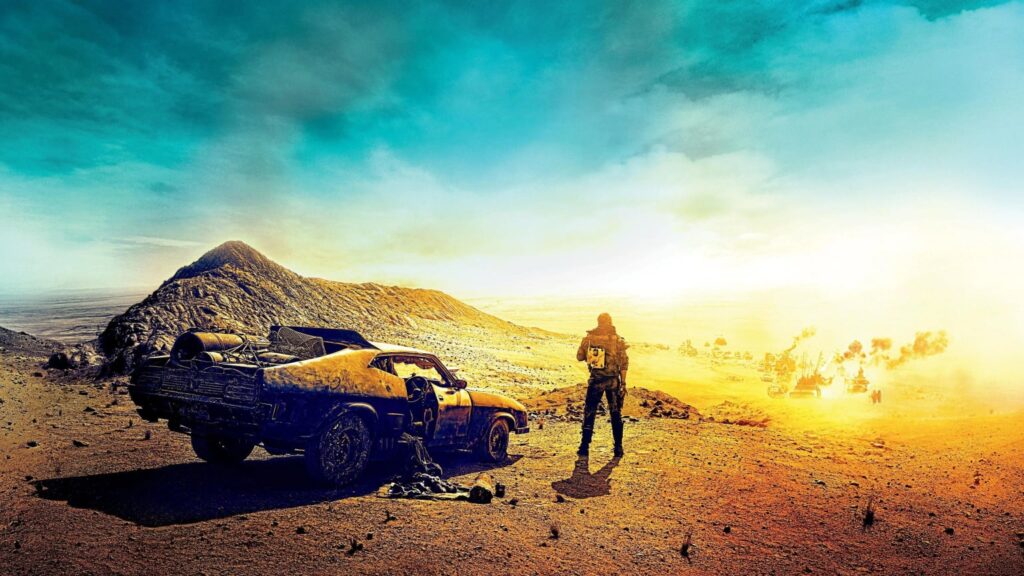
Mad Max: Fury Road is controlled chaos of the highest order. George Miller takes what is essentially an extended pursuit across the desert and turns it into a thrilling demonstration of how framing, editing, production design and physical movement can tell a story at tremendous speed. The central point of this Mad Max Fury Road review action filmmaking analysis is simple: the movie looks wild because every element has been disciplined enough to make wildness readable.
Our verdict George Miller turns a simple desert pursuit into a masterclass in controlled chaos. Its relentless pace and sparse characterization may test some viewers, but the action remains thrilling because every cut, vehicle and movement has a clear purpose.

Mad Max: Fury Road (2015)
That distinction matters. Plenty of action movies can throw vehicles, bodies and visual effects across the screen; far fewer can do so while making the audience understand where to look, who is in danger and why the next movement matters. Fury Road almost never mistakes confusion for intensity. Its spectacle works because Miller and his collaborators have arranged the madness with ruthless precision.
The action stays clear because the frame guides your eye
Fury Road moves quickly enough that conventional coverage could easily collapse into visual soup. Instead, cinematographer John Seale keeps the key face, vehicle or threat close to the center of the image. In his discussion of the film’s cinematography, Seale described this as a deliberate method for guiding the viewer toward important information and supporting unusually fast cutting. British Cinematographer’s interview with John Seale explains how that center-oriented approach became part of the production’s visual plan.
The result is not simplistic composition. It is eye-trace management: one shot places the crucial information where the next shot can immediately replace it. Your gaze does not have to search every new image from scratch, so the edit can accelerate without leaving comprehension behind. Fury Road can cut between drivers, passengers, machines and approaching hazards while preserving the objective that connects them.
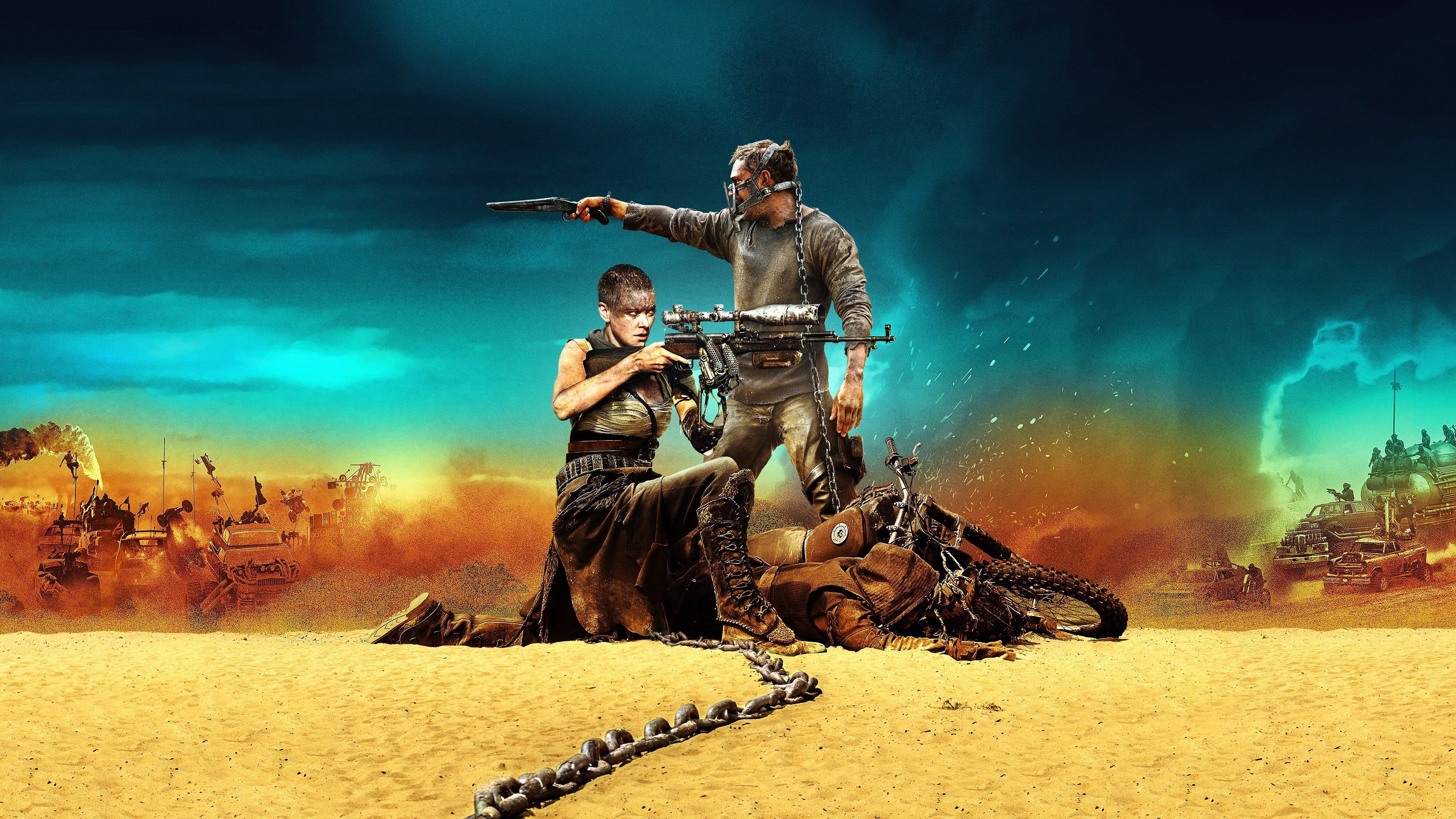
That is why the movie feels faster than many action films that contain more frantic camerawork. Miller does not merely shorten shots; he reduces the time the audience needs to decode them. Each image hands attention to the next one. The technique becomes almost invisible in motion, but it is the foundation of the film’s velocity.
For a different kind of muscular visual storytelling, MovieBunker’s review of Predator as an action-thriller classic considers another film that understands the value of readable danger. Fury Road pushes that principle toward maximalism, surrounding its simple pursuit with an absurd quantity of moving parts without surrendering the central line of action.
Thousands of storyboards turn speed into storytelling
The clarity began long before the footage reached the editing room. The production was designed from approximately 3,500 storyboards, an especially significant choice for a movie with sparse dialogue. Rather than treating action as decoration added to a conventional screenplay, Fury Road makes movement its primary dramatic language. A vehicle changing position, a character choosing where to go or a threat entering the frame can carry information that another film might stop to explain.
That approach also gives the pursuit structure. The storyboards establish what must be communicated, while the edit controls when the audience receives it. The movie keeps renewing the immediate problem without forgetting the larger objective. Its action is not a collection of interchangeable collisions; every burst of activity is organized around pursuit, escape or survival.
Editor Margaret Sixel had an enormous amount of material from which to build that momentum. She said the two-hour film was assembled from roughly 470 hours of footage, with some scenes covered by 12 to 20 cameras. That volume could have produced shapeless excess. Instead, it allowed the edit to find fresh angles while maintaining a stable point of attention.
This is where Fury Road separates relentless pacing from mere impatience. The cuts are rapid, but the movie is not desperately hiding its action. It keeps changing scale and perspective while protecting the information needed to follow the chase. Viewers interested in another modern example of sustained, carefully organized spectacle can continue with our John Wick: Chapter 4 review, although Miller’s wasteland machinery gives Fury Road a visual character entirely its own.
Practical stunts and digital effects belong to the same machine
Fury Road is sometimes discussed as though its appeal proves that practical filmmaking is inherently pure and computer-generated imagery inherently bogus. The finished movie is much more interesting than that tired argument. Its production used photographed stunt work and more than 150 vehicles conceived under production designer Colin Gibson, but the final film also contained roughly 2,000 visual-effects shots.
Those digital contributions included cleanup, wire and tire-track removal, compositing, environmental work, sky replacement, day-for-night work and major effects transformations. The achievement is not the absence of CGI. It is the intelligent combination of physical material and digital control.
Real vehicles, performers, dust and momentum give the images mass. Digital work then removes unwanted production traces, expands the environment and intensifies what the camera captured. One method supplies weight; the other shapes and extends it. Because the underlying movement often has a photographed physical basis, the fantasy retains texture even when the finished image has been heavily manipulated.
For me, that integration is essential to the film’s personality. The machines do not appear to float through abstract space. They seem to strain, collide and occupy the same hostile environment as the people operating them. Miller is not asking the audience to admire a technical category. He is using every available tool to make a deliberately ridiculous world feel dangerous enough to matter.
The vehicles build a world while the movie keeps moving
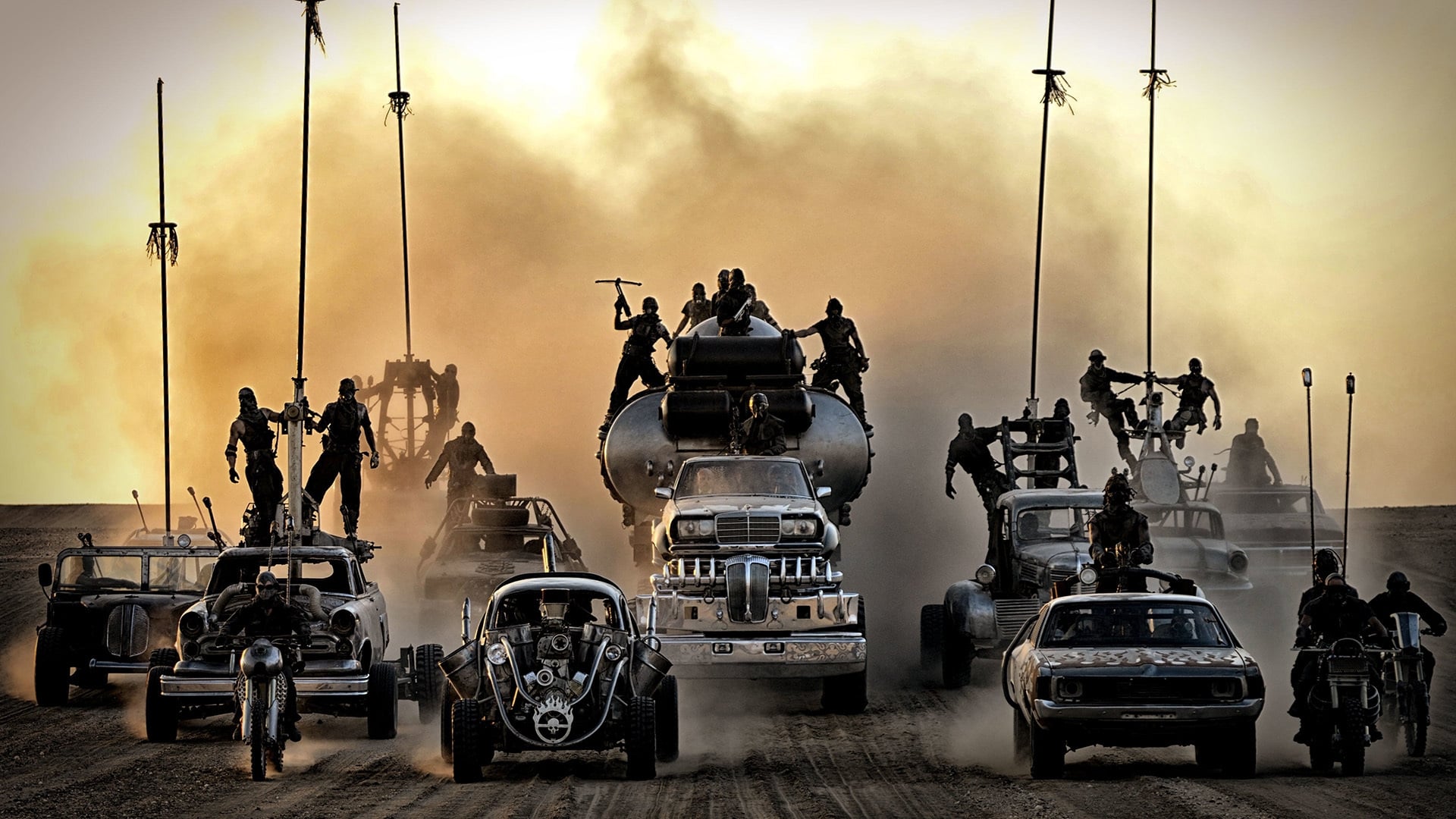
The production design does not wait politely for the chase to stop. Each distinctive machine communicates function, status and threat while in motion. More than 150 vehicles were designed for the production, giving Miller a vocabulary of silhouettes and formations that can be recognized at speed. They serve as transport, weapons, landmarks and social signals at once.
That visual specificity prevents the convoy from becoming a generic mass of metal. The audience can distinguish important elements without needing a spoken briefing about every group or machine. Grotesque design becomes exposition. The Wasteland feels socially organized because its hierarchy has been turned into hardware.
This is worldbuilding with excellent manners: elaborate, strange and almost never allowed to hold up the movie. Fury Road trusts the audience to absorb culture through costume, bodies, vehicles and behavior. Its images provide enough information to make the world feel larger than the immediate pursuit, but Miller keeps the story fixed on the urgent problem in front of his characters.
Furiosa gives the spectacle its moral engine
The premise begins with Furiosa escaping the tyrannical Immortan Joe with several captives; Max joins a flight she has already put in motion. That ordering is crucial. Furiosa is not cargo inside somebody else’s adventure, and Max does not arrive to invent the story for her. Her decision creates the movie’s direction, while his involvement changes how that effort can proceed.
Because Furiosa acts first, the chase has more than a mechanical objective. Every pursuit is connected to her attempt to break away from Joe’s control. The film’s visual grammar and moral stakes therefore reinforce each other: forward movement means agency, while the forces bearing down on the escapees represent its violent denial.
The sparse characterization will not satisfy everyone. Fury Road defines its people primarily through decisions, posture, movement and changing cooperation rather than extended conversation or intricate psychological disclosure. I think that economy suits the film because it lets character emerge from pressure. Someone seeking dense dialogue and lengthy interior reflection may reasonably find the archetypal construction thin.
Its relentless pace is both the thrill and the barrier
The most obvious reservation is inseparable from the movie’s greatest strength: Fury Road provides very little room to breathe. Its feature-length pursuit structure has drawn dissent from viewers and critics who find that constant movement leaves too little dramatic substance or modulation. I understand that response even though I do not share it.
For me, the pressure is exhilarating because the film keeps changing the immediate visual problem while holding onto a simple objective. The accumulation has shape. Even so, viewers who prefer action to arrive in isolated set pieces, separated by substantial dialogue and recovery time, may experience the later stretches as more exhausting than escalating.
This is not a minor question of taste. Fury Road commits so completely to visual storytelling that anyone unmoved by its rhythms will find few alternative pleasures to lean on. It has sparse dialogue, limited conventional interiority and no interest in slowing down simply to reassure the audience that it has themes. The film expresses itself through decisions made under velocity.
Final verdict: an action masterclass with no interest in moderation
Mad Max: Fury Road remains difficult to match because its excess is built on restraint in all the places that count. The compositions direct attention. The storyboards turn movement into narrative. The editing accelerates without destroying geography. Physical stunts and digital effects reinforce rather than compete with one another. Production design communicates an entire social order while its machines are still moving.
It is not a universally comfortable experience. The near-continuous pursuit and sparse dialogue can be punishing if you need gentler pacing, verbal texture or conventional dramatic pauses. But viewers who want intense, visually driven action should treat it as essential. Fury Road is loud, strange and gloriously excessive, yet underneath the noise is one of the most disciplined pieces of blockbuster filmmaking of its era.
References
- John Seale ACS ASC / Mad Max: Fury Road – British Cinematographer
- John Seale, ASC, ACS: Framing Mad Max: Fury Road
- Oscars 2016: How one film editor goes from her first action movie, 'Mad Max: Fury Road,' to an Oscar nod – Los Angeles Times
- A graphic tale: the visual effects of Mad Max: Fury Road – fxguide
- Mad Max: Fury Road | Rotten Tomatoes
- Mad Max: Fury Road Reviews – Metacritic