

Midnight Run works because Robert De Niro and Charles Grodin turn irritation into intimacy without sanding away the irritation. Martin Brest’s 1988 action comedy has all the expected machinery—mobsters, federal agents, a rival bounty hunter and a long trip that refuses to go according to plan—but its lasting appeal comes from two wounded idealists gradually recognizing each other. The pursuit supplies momentum. De Niro and Grodin supply the movie.
Our verdict Midnight Run turns a conventional cross-country pursuit into a warm, sharply funny character comedy. Robert De Niro’s simmering irritation and Charles Grodin’s quiet persistence make the relationship far more compelling than the familiar chase mechanics.
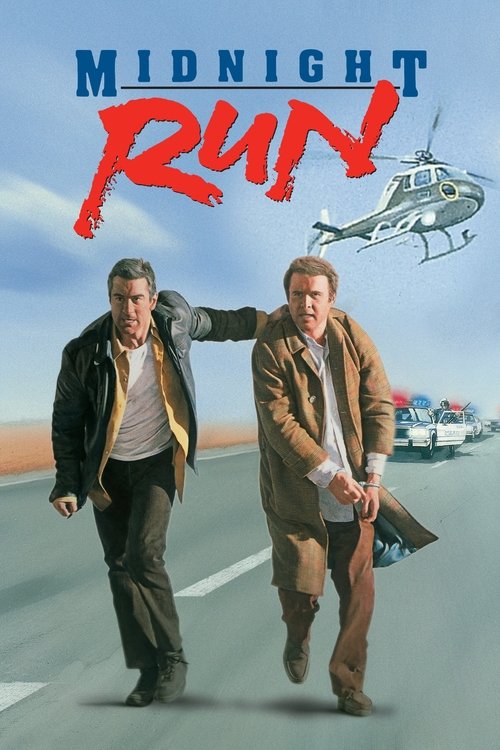
Midnight Run (1988)
De Niro plays Jack Walsh, a bounty hunter hired to transport fugitive accountant Jonathan “the Duke” Mardukas, played by Grodin, from New York to Los Angeles. The assignment becomes a cross-country scramble as the FBI, the mob and another bounty hunter close in from different directions. It is a sturdy comic-thriller setup rather than an especially original one. What elevates it is the conversation taking place inside the chase.
One personal question changes the whole journey
Early in the trip, the Duke asks Jack whether he has a family. Jack treats the question as an invasion, which is both understandable and revealing: this man can deal with threats, weapons and professional betrayal, but a calm inquiry about his private life immediately puts him on the defensive. The Duke continues asking about Jack’s family and his past as a police officer as the journey unfolds.
At first, the questioning is simply funny. Grodin delivers it with the maddening patience of someone who has discovered that politeness can be more disruptive than aggression. He never needs to match Jack’s volume because another softly spoken question does more damage. Jack snaps, threatens and tries to restore the transactional nature of their relationship; the Duke behaves as though they are two reasonable adults enjoying an ordinary conversation.

That is the film’s emotional trick. It never announces that these men are bonding, and it does not suddenly make either of them easy company. Their connection develops through annoyance, observation and reluctant disclosure. For me, that slow change is much more convincing than the instant affection imposed by weaker buddy comedies.
De Niro simmers while Grodin quietly applies pressure
De Niro is funny precisely because he does not play Jack as a comedian. He holds the character’s temper in check until maintaining control becomes its own exhausting performance. A glare, pause or defeated response carries the joke. Jack has physical authority, but De Niro’s best moments are reactive: the split second in which he realizes that the Duke is still talking, still asking questions and still refusing to be intimidated in the approved manner.
Grodin works at the opposite temperature. His tiny inflections and half-whispered observations make the Duke sound reasonable even when he is being spectacularly intrusive. He plays the character as an active moral nuisance rather than human luggage. The Duke complains, analyzes and argues until Jack can no longer pretend this is merely a delivery job. Their mismatch is not just loud versus quiet; it is a man desperate to close himself off trapped beside someone constitutionally incapable of leaving a subject alone.
Brest wisely lets these exchanges breathe. According to the AFI Catalog’s production history, actors improvised during production, while Grodin’s first audition with Brest was itself an extended improvisation. That does not establish that any particular finished line was invented on set, but the looseness is visible in the rhythm. Jokes emerge from two people trying to control an interaction that keeps slipping away from both of them.
The pursuers help—until the machinery takes over
The competing pursuers mostly strengthen the comedy because each applies a different kind of pressure. Yaphet Kotto’s FBI agent brings exasperated authority, John Ashton’s rival bounty hunter adds bruising professional competition, and the mobsters place a genuine threat behind the escalating complications. The supporting cast turns the chase into a crowded argument in which everybody believes they are the only competent person present.

That surrounding chaos also gives De Niro and Grodin more to push against. Jack keeps trying to impose a professional plan while the Duke tests its logic, its morality and occasionally Jack’s remaining patience. The film understands that a pursuer can be funnier as an interruption than as a major dramatic force, and its ensemble usually arrives, causes trouble and gets out before the central relationship loses focus.
Brest gives the journey convincing physical breadth as well. Principal photography lasted 17 weeks and used locations including New York, Chicago, Los Angeles, Michigan, Las Vegas, Arizona and New Zealand. The changing environments make the trip feel like an actual ordeal rather than a procession of interchangeable backlots. Viewers interested in another stripped-down crime film built around movement and professionalism should also see our review of Walter Hill’s The Driver.
Still, the pursuit is less distinctive than the relationship at its center. The gunfights, escapes and reversals keep the road movie moving, but the transport mission becomes easier to anticipate than either lead. Whenever the machinery takes over, Midnight Run briefly becomes a more ordinary action comedy. It is never inert, yet no mechanical complication can compete with Grodin asking one more personal question and De Niro looking as though patience has become his newest enemy.
A familiar formula finds real moral weight
In his contemporary review of Midnight Run, Roger Ebert argued that the developing relationship was more interesting than the increasingly predictable chase and saw both men as considering themselves more ethical than the system around them. That remains the most useful way into the film, but its achievement goes beyond making two decent men likable. Jack and the Duke have both turned moral certainty into a defense mechanism. Their growing respect matters because each gradually recognizes principle beneath the other man’s infuriating behavior.
That moral seriousness never smothers the comedy. Instead, it explains why the jokes accumulate emotional weight. Midnight Run does not reinvent the road movie or the mismatched-partner formula; it demonstrates how much life performers can find inside familiar architecture when a director gives them room to listen, interrupt and change.
The chase is entertaining, the ensemble is reliably funny and the location work gives the journey scale. Yet De Niro’s simmering defensiveness and Grodin’s serene persistence remain the reason to watch. Midnight Run is highly recommended for anyone who prefers buddy comedies built on timing, character and affection earned the difficult way. The plot travels a familiar road, but these two make every mile worth taking.