
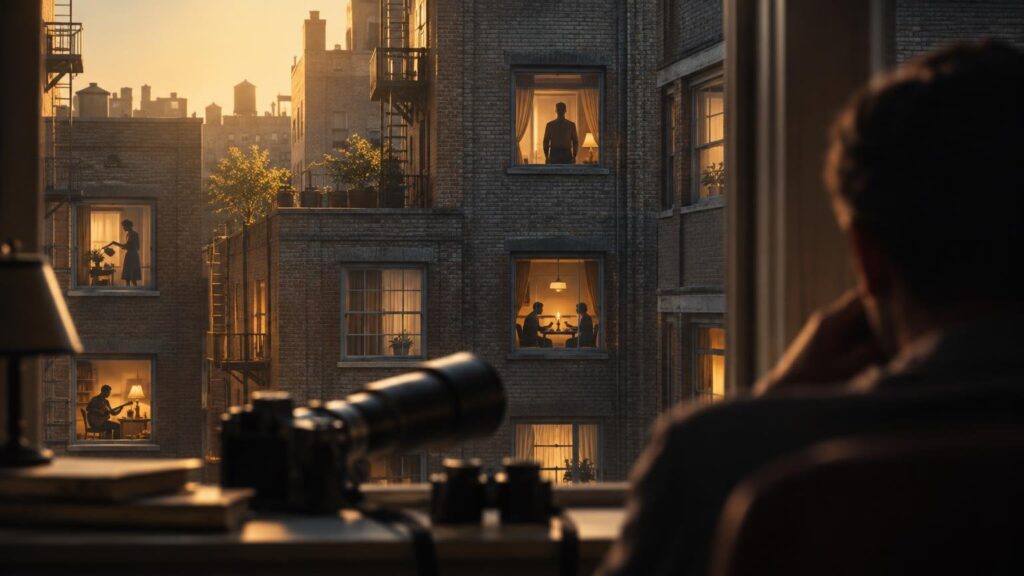
Rear Window does not create suspense by hiding everything. It creates suspense by showing us just enough to become dangerously confident. From Jeff’s apartment, a courtyard full of open windows appears to offer direct access to other lives. In reality, each window supplies fragments: gestures without dialogue, objects without explanations and reactions separated from their causes. Jeff turns those fragments into stories, and the audience does the same.
That is the essential trick of Alfred Hitchcock’s 1954 film. Its restricted viewpoint makes Jeff’s suspicions persuasive while preventing either him or us from properly testing them. The result is more than an elegant mystery. Rear Window is an argument about how quickly observation becomes interpretation—and how eagerly spectators confuse a compelling interpretation with the truth.
The apartment is both a viewing platform and a trap
Directed and produced by Hitchcock, Rear Window was written by John Michael Hayes from Cornell Woolrich’s story “It Had to Be Murder.” James Stewart plays photographer L.B. “Jeff” Jefferies, confined to a wheelchair by a broken leg, while Grace Kelly plays Lisa Fremont and Thelma Ritter plays Stella. Robert Burks served as cinematographer and George Tomasini as editor.
Jeff’s immobility gives the film its governing rule: he can look, but he cannot easily investigate. The viewer inherits that limitation. As the Yale Film Archive’s analysis of Rear Window notes, the film largely restricts what we see and hear to what is available from Jeff’s apartment. The courtyard apartments are presented, with rare exceptions, as Jeff can perceive them from his room.
This is restricted viewpoint rather than a continuous literal first-person camera. We see Jeff looking, the object of his attention and then Jeff’s response. That alternation matters. A shot of an apartment supplies information; the return to Stewart’s face supplies an interpretation. Curiosity, amusement, desire and alarm become instructions for how to read an image that might otherwise remain ambiguous.
The enormous Paramount courtyard set made that visual system possible. According to the AFI Catalog, it measured 98 feet wide, 185 feet long and 40 feet high, with 31 apartments. Long lenses helped approximate Jeff’s telephoto-camera perspective, while performers across the set received cues through short-wave radio and hidden microphones. The set may be physically expansive, but the long-lens view compresses it into a collection of little screens. Distance seems to disappear even though Jeff remains unable to cross it.
Rear Window turns observation into inference
The neighbors first appear as readable types: Miss Lonelyhearts, Miss Torso, the songwriter and the salesman with his unwell wife. Those labels make the courtyard easy to organize, but they are also warnings. Jeff is not learning complete biographies. He is assigning genres to strangers: romantic tragedy in one window, comedy in another and domestic menace in a third.
The film continually separates three things that viewers naturally want to collapse into one: what Jeff observes, what the movie has actually confirmed and what the available fragments encourage us to assume.
| What Jeff observes | What the film confirms | What viewers are encouraged to infer |
|---|---|---|
| Miss Lonelyhearts prepares dinner for two and performs an imaginary encounter. | She is alone and acting out the presence of a guest. | Her private life can be reduced to a complete story of romantic despair. |
| Miss Torso entertains several male visitors. | Different men enter and leave her apartment. | Jeff’s teasing description accurately defines her relationships and desires. |
| A scream and breaking glass are heard during the night. | Disturbing sounds have come from somewhere beyond Jeff’s room. | The sounds belong to the particular crime narrative forming in Jeff’s mind. |
| The salesman makes late-night trips while carrying a sample case. | He repeatedly leaves and returns under suspicious circumstances. | The case contains evidence and each unexplained movement has a criminal purpose. |
None of Jeff’s suspicions is absurd. That would make the film a simple lesson about minding one’s own business. Instead, Hitchcock gives each theory enough visual support to feel intelligent. The danger lies in treating plausibility as confirmation.
Detective Tom Doyle is important because he supplies competing explanations. Reports that Mrs. Thorwald left, a signed postcard and information about a trunk collected at the train station all challenge Jeff’s theory. These details do not automatically settle the matter, but they expose how Jeff processes evidence: information that supports his suspicion feels revealing, while information that contradicts it feels like a puzzle to be defeated.
That pattern is familiar because it is also how audiences watch mysteries. Once a film teaches us where to look, every flower bed, suitcase and drawn blind starts glowing with significance. Rear Window makes confirmation bias entertaining, then asks whether entertainment has made it any less reckless.
Reaction shots recruit the audience
James Stewart’s performance is crucial because Jeff’s face converts distant movement into immediate drama. A neighbor’s action may occupy only a small part of the courtyard, but Jeff’s reaction arrives in close-up. The editing therefore gives his interpretation more visual weight than the event itself.
This is why the film implicates viewers without pretending that looking is always evil. Watching is pleasurable, and Rear Window is exceptionally good at providing things worth watching. The courtyard contains flirtation, loneliness, creative frustration, marriage, illness and possible violence. Jeff’s attention moves between them much as a moviegoer’s attention moves between tones and stories.
John Belton’s Library of Congress essay on Rear Window describes Jeff as an in-film spectator whose position draws the audience into voyeurism. Jeff sits in darkness facing illuminated rectangles. His camera lens enlarges selected details. He watches other people experience danger while remaining physically separated from it. The arrangement is not a subtle metaphor for moviegoing, but subtlety would almost be a waste here.
Stella voices the moral objection, warning about a “race of peeping Toms” and arguing that people should look into their own homes. Lisa later dismisses the problem with the wonderfully practical line, “I’m not much on rear window ethics.” Her joke captures the film’s moral momentum: objections become less persuasive as the mystery becomes more exciting.
Lisa’s growing involvement also changes how Jeff sees her. He initially regards her as too refined for the adventurous life he imagines for himself. Once she accepts physical risk and participates in his investigation, she becomes more legible to him. That development is romantic, but it is not entirely flattering. Jeff values Lisa more when she begins performing inside the kind of suspense story he already understands.
Sound proves how little the image can establish
Rear Window’s sound design extends the courtyard without making it fully knowable. The soundtrack is principally diegetic: music usually comes from neighboring apartments, apart from the opening titles and a few concluding notes. Conversations drift across the courtyard, but distance swallows crucial words. Music connects apartments whose occupants may barely know one another, while screams and crashes arrive without reliable visual sources.
This matters because Jeff’s camera appears to offer mastery. Binoculars and a telephoto lens make distant objects larger, but magnification cannot restore missing context. A close view of the wrong detail remains incomplete information. The soundtrack keeps reminding us that life continues outside the chosen frame.
Hitchcock explores a related kind of perceptual obsession in Vertigo, where looking also becomes a way of replacing another person with a story that the protagonist can control. Rear Window is more playful, but its central criticism is just as sharp: intense attention does not guarantee understanding.
Spoiler Analysis: When the watched man looks back
The later evidence strengthens Jeff’s case. Thorwald reacts strangely when the neighbors’ dog disturbs the flower bed. Jeff’s photographs reveal a change in the height of the zinnias. Mrs. Thorwald’s handbag and jewelry remain in the apartment, and Lisa discovers her wedding ring. These clues move the suspicion closer to confirmation, but the film preserves the distinction until Thorwald’s confrontation and confession establish that he killed his wife.
The resolution does not simply announce that Jeff was right. It punishes the comfortable position from which he was right. Thorwald notices the signal Lisa sends toward Jeff’s apartment, identifies the watcher and crosses the courtyard. The observed subject becomes an active observer, while Jeff’s supposedly protected viewing room becomes the exposed window.
Yale’s film notes describe this as a breach of the screen-like boundary between Jeff and the courtyard. That breach is frightening because the film has trained us to trust the separation. Jeff can enlarge danger, discuss it and even direct other people into it, all while remaining outside the frame in which consequences occur. Thorwald’s arrival destroys that arrangement.
Jeff’s flashbulbs offer a last visual defense. He cannot overpower Thorwald, so he repeatedly blinds him with bursts of light. It is a fitting weapon for a photographer: looking becomes an attack, and the apparatus used to observe finally reveals its capacity to violate. Yet each flash provides only a momentary delay. Vision cannot restore the safety that Jeff’s watching has already compromised.
The single viewpoint creates suspense by denying certainty
Rear Window works because its restricted perspective performs two jobs at once. It makes viewers vulnerable to Jeff’s mistakes, but it also makes them active participants in solving the mystery. A more mobile camera could verify where Thorwald goes, show what is inside the case or identify the source of every sound. That version would contain more information and far less suspense.
That is why Rear Window remains such a precise study of cinematic point of view. Its windows do not provide transparent access to reality. They provide frames, and frames always exclude something. Hitchcock makes us feel clever for interpreting what is inside them, complicit for enjoying the intrusion and frightened when the person inside the frame finally stares back.