
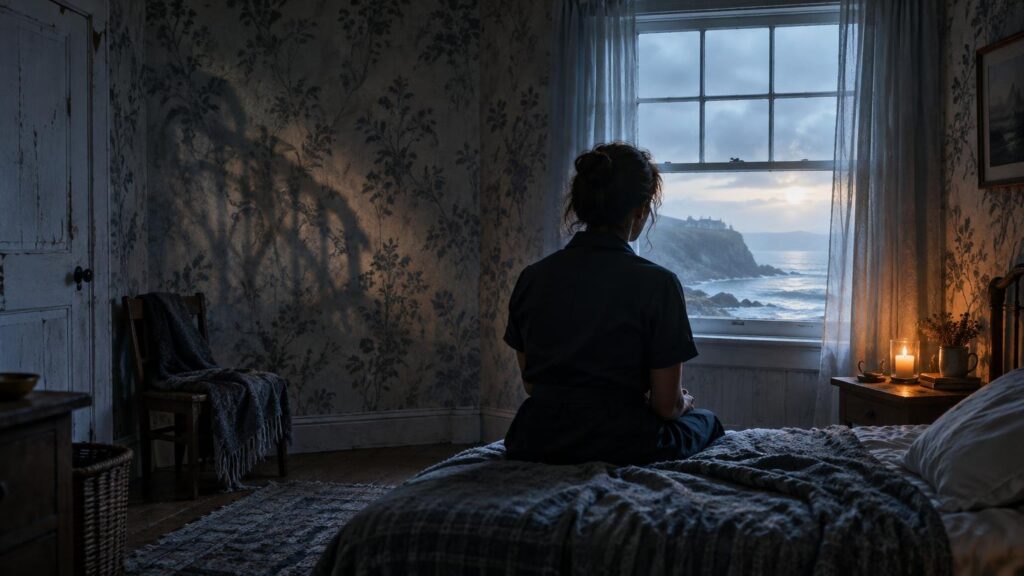
This Saint Maud 2019 review comes down to one unnerving achievement: Rose Glass traps us inside a woman’s need for absolute meaning without ever making that experience comfortably legible. The film is bleak, intimate and fiercely controlled, turning religious certainty, loneliness and physical discomfort into psychological horror that gets under the skin rather than repeatedly jumping out at it.
Our verdict Rose Glass’s fiercely controlled debut turns religious certainty, loneliness and bodily discomfort into intimate psychological horror. Morfydd Clark’s unnervingly physical performance and the film’s suffocating atmosphere make its sparse story remarkably potent.
Saint Maud (2019)
Glass’s feature directorial debut follows Maud, a newly devout and isolated hospice nurse assigned to care for Amanda, a terminally ill former dancer. Maud becomes convinced that saving Amanda’s soul is her calling, but the film is less interested in establishing whether she has received a divine mission than in showing what happens when conviction leaves no room for doubt. Morfydd Clark’s frighteningly physical performance and Jennifer Ehle’s sly, uninhibited counterweight give that sparse premise all the dramatic tension it needs.
Saint Maud Turns Certainty Into the Real Monster
The smartest thing about Saint Maud is that it does not stand safely outside Maud and explain her. Glass builds the film around her restricted perspective, forcing us to experience private revelation, memory and ordinary physical space through a consciousness that feels increasingly unstable. In a Sight and Sound interview about the film, Glass described it as a highly subjective work designed to place the audience inside its central character’s head. That intention is not merely thematic background; it is the engine of the movie.
Close framing, visual distortion and oppressive interiors make objective distance difficult. Maud’s world seems to contract around her as her purpose expands, a nasty contradiction that gives the film much of its power. She believes she has found a cosmic role, yet her physical environment has rarely felt smaller. The result is horror built from enclosure: one room, one body and one interpretation of events that cannot tolerate competition.
I admire that Glass refuses to make the ambiguity into a puzzle with a tidy answer key. The question is not simply whether Maud’s experiences are spiritual or psychological. What matters is how desperately she needs them to mean something absolute. Salvation becomes seductive because it offers purpose, forgiveness and authority all at once. It also permits Maud to transform concern for another person into control over that person.
That distinction prevents Saint Maud from becoming a routine possession story or a clinical case study. The film does not need a demon waiting in the hallway when certainty itself can reorganize every disappointment into proof. Maud’s faith gives shape to her loneliness, but it also seals her inside it.
Morfydd Clark Makes Conviction Feel Physical
Clark gives the film its frightening credibility. Maud is tightly wound even when she appears still, and Clark makes self-denial look like a continuous physical effort. Her posture, guarded expressions and sudden flashes of intensity suggest someone attempting to discipline every unruly impulse into submission. This is not a performance that asks for easy sympathy, but it never reduces Maud to a horror mechanism either.
The film offers only restrained glimpses of Maud’s past, trusting Clark to make the missing history felt without delivering a convenient explanatory monologue. Rose Glass and Clark leave enough visible pain to suggest why a totalizing belief system might become attractive while refusing to turn that pain into a simple diagnosis. The performance keeps Maud recognizably human even as her certainty becomes terrifying.
Ehle’s Amanda is the ideal destabilizing presence. A former dancer accustomed to pleasure, attention and personal freedom, she appears to embody everything Maud has renounced. Ehle plays her with warmth, impatience, amusement and cruelty in combinations that resist a clean moral label. Amanda can be perceptive about Maud without truly understanding her, just as Maud can be attentive to Amanda’s suffering while refusing to recognize her autonomy.
Their relationship is the movie in miniature: two lonely women convinced they understand what the other needs. Evidence around the production and Glass’s comments consistently frames their connection as one defined by mutual misunderstanding rather than healing companionship. That adversarial intimacy makes each attempt at care feel capable of becoming an intrusion. A touch, a conversation or a small shift in authority carries more tension than a conventional horror set piece would.
The Atmosphere Does More Than the Plot
For me, the atmosphere is Saint Maud’s strongest element. Cinematographer Ben Fordesman, editor Mark Towns, composer Adam Janota Bzowski and the film’s sound team help turn Maud’s isolation into a complete sensory environment. Amanda’s house feels gloomy and oppressive without becoming a generic haunted mansion, while the world beyond it offers little relief. Sound frequently makes private sensation feel enormous, as though Maud’s body were another confined room with something reverberating through its walls.
The film’s visual language becomes more heightened as Maud’s condition deteriorates, but Glass does not abandon the intimate scale that makes those images effective. The heightened moments have tactile force because the production used practical effects wherever possible while also planning stunt and visual-effects work. It would be inaccurate to call the movie exclusively practical, but its practical-forward approach gives the bodily discomfort a weight that cleaner, more visibly artificial imagery might have lost.
Saint Maud shares with the best body-conscious horror an understanding that physical sensation can express an internal crisis more efficiently than dialogue. Viewers who respond to that quality may also appreciate our review of the disturbing coming-of-age horror Raw, another film in which the body becomes a battleground for identity and desire. Glass’s movie is quieter and more ascetic, but both understand that transformation is most unsettling when it feels tactile.
Crucially, the film does not inflate itself into action-horror. There are shocks and moments of physical intensity, but no attempt to manufacture momentum through chases or elaborate combat. Its dread accumulates through repetition, stillness and the increasing pressure of Maud’s interpretation. Anyone waiting for the movie to reveal a larger supernatural mythology may find that restraint frustrating. I found it bracing.
Its Austerity Is Both a Strength and a Limitation
At roughly 84–85 minutes, Saint Maud is compact, but compact does not always mean brisk. The central trajectory is established early, and the middle occasionally feels undernourished rather than hypnotic. Once the conflict between Maud’s certainty and Amanda’s resistance is in place, the film develops that pressure through subtle variations instead of major narrative turns.
That approach suits the movie’s claustrophobia, yet it also makes the destination feel somewhat predetermined. Viewers wanting a fuller account of Maud’s past, substantial plot development or an escalating series of supernatural incidents may feel that Glass has stretched a short, sharp premise. I would not go that far—the performances and formal control sustain the feature—but there are moments when the film’s disciplined minimalism comes close to thinning itself out.
The treatment of faith is another limitation, although a more interesting one. Saint Maud is persuasive about dangerous certainty: belief can become a means of escaping ambiguity, judging others and converting pain into purpose. It is less curious about religious conviction as a lived experience beyond pressure, obsession or refuge. Because we remain so closely tied to Maud, faith rarely gets the space to exist outside her need for it.
That narrowness is dramatically effective, but it slightly restricts the film’s thematic range. The ambiguity concerns the source of Maud’s experiences; it does not produce an equally expansive exploration of belief and unbelief. Saint Maud ultimately has more to say about the appetite for absolutes than about religion itself. For me, that is enough to make the film potent, though not quite as philosophically complete as its imagery sometimes suggests.
Its use of unstable perception also places Saint Maud in a long tradition of psychological movies that make subjectivity part of the suspense. Readers interested in a very different but equally obsessive example can revisit our review of Alfred Hitchcock’s Vertigo. Glass is working on a much smaller canvas, yet she shares Hitchcock’s interest in how desire can overpower reality rather than merely distort it.
A Slow-Burning Horror Film Worth Surrendering To
Saint Maud is highly recommended for viewers who like bleak, performance-led psychological horror and can accept suggestion in place of explanation. Its scares emerge from proximity to a mind seeking absolute order, not from a steady supply of monsters or jump-scare machinery. Clark makes that proximity uncomfortable, Ehle gives it resistance, and Glass maintains an extraordinary level of control over the resulting friction.
This is not the right choice for anyone seeking plot-heavy supernatural thrills, reassuring answers or action spectacle. The sparse narrative and severe tone demand patience, and the movie’s restricted treatment of faith leaves legitimate room for disagreement. Even so, its few limitations come from the same concentration that makes it distinctive.
Saint Maud understands that the desire to be chosen can be as frightening as any curse. Glass takes a lonely woman’s search for purpose and turns it into a suffocating collision between care, judgment and control. The film may be small, but its conviction is enormous—and unlike Maud’s, it is earned.
References
- Saint Maud | A24
- Rose Glass on Saint Maud's interior scares | Sight and Sound
- Saint Maud review: a heady British horror duet | Sight and Sound
- Saint Maud movie review & film summary
- Rose Glass uses horror to examine mental illness in 'Saint Maud' – Los Angeles Times
- Microsoft Word – SaintMaud_presse.docx
- Saint Maud (2019) directed by Rose Glass • Reviews, film + cast • Letterboxd