
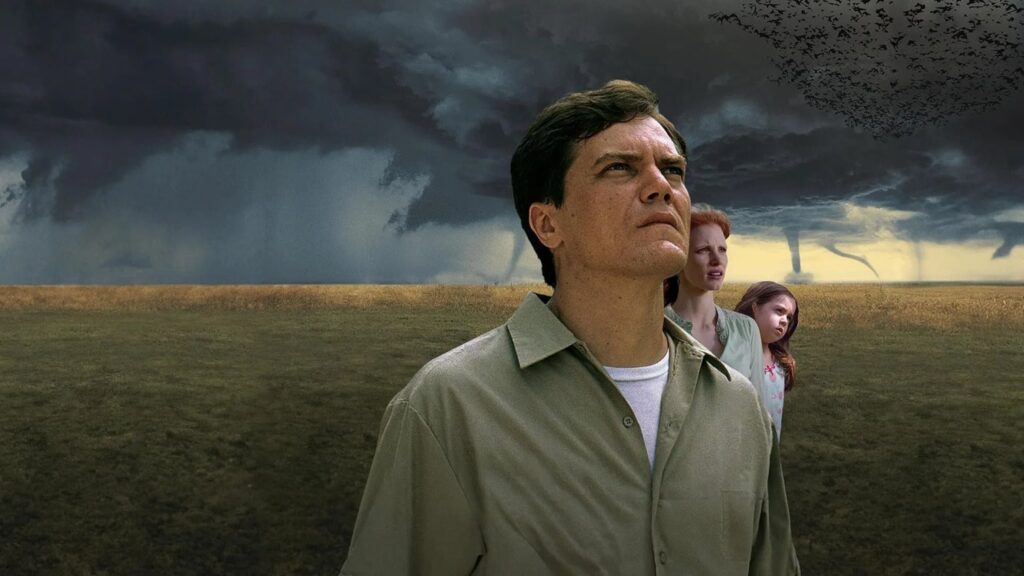
Take Shelter is a masterful slow-burn thriller because it understands that the end of the world is frightening, but believing the end is coming can be even worse. Jeff Nichols turns visions of an approaching storm into an intimate test of trust, responsibility and communication. The spectacle matters; the possibility that fear itself could destroy a family matters more.
Our verdict A masterful slow-burn thriller in which apocalyptic dread becomes painfully intimate. Michael Shannon and Jessica Chastain give Jeff Nichols’ storm visions their real force: the terrifying possibility that fear itself can destroy a family.

Take Shelter (2011)
Curtis LaForche is an Ohio husband and father whose increasingly disturbing visions drive him to expand the storm shelter in his backyard. He cannot determine whether he is receiving a warning or experiencing a mental-health crisis, yet his attempts to protect his family begin damaging its finances, his employment, his friendships and his standing in the community. Sony Pictures’ official synopsis establishes those pressures without resolving the central uncertainty.
The atmosphere makes ordinary Ohio feel apocalyptic
For me, the atmosphere is the film’s greatest achievement. Quiet homes, broad horizons and familiar workplaces gradually feel pressurized, as if the weather has entered every conversation before the clouds have arrived. Nichols does not treat the visions like detachable horror set pieces. They invade the film’s otherwise naturalistic world, making ordinary surroundings feel untrustworthy.
Nichols has explained that he used slow, creeping dolly movements to create pressure around the characters and wanted the visions to occupy the same visual reality as everything else. His discussion of the film’s visual approach with Interview Magazine clarifies why the transitions feel so unnerving: the camera does not announce when reality has become a nightmare.

That restraint lets dread accumulate rather than jump out from behind the furniture every few minutes. The storm imagery is spectacular when it needs to be, but the film’s most frightening spaces are often domestic ones. Curtis can leave a nightmare; he cannot easily escape the consequences of what he does after waking up.
Michael Shannon makes protection look like self-destruction
Michael Shannon gives a powerhouse performance without reducing Curtis to ominous stares and nervous tics. The dependable, capable family man remains visible even as anxiety takes control. That contrast is crucial: Curtis does not suddenly become a different person, and his decisions never settle neatly into either heroism or madness.
Shannon makes preparation and obsession look frighteningly similar. Each escalation follows a recognizable protective instinct, but each also isolates Curtis further. He spends money, risks relationships and withholds information while insisting, at least to himself, that he is securing his family’s future. The tragedy is not that he stops caring about them. It is that his fear begins dictating what caring must look like.
Where Zodiac turns obsession into an expansive procedural, Take Shelter traps it inside a marriage, a workplace and a backyard. The scale feels smaller, but the emotional damage is immediate. Every practical consequence makes the movie’s enormous threat feel painfully close.
Jessica Chastain gives the storm an emotional cost
Jessica Chastain prevents Samantha from becoming incidental collateral damage in Curtis’ crisis. Her alarm and anger are matched by a credible commitment to the marriage, which means their confrontations carry more than the usual dramatic function of somebody demanding that the protagonist explain the plot.

Nichols identified marital communication as the story’s emotional core and Curtis’ decision to withhold his fears as his consequential mistake. The Washington Post’s conversation with Nichols and Shannon supports that reading. Chastain makes the idea tangible: every incomplete explanation forces Samantha to respond not only to Curtis’ fear, but also to the practical wreckage appearing around her.
Their marriage is therefore not a subplot running alongside the apocalypse. It is the film’s real battleground. Curtis may be terrified by what the sky could do, but Samantha must confront what secrecy is already doing to their home. Chastain’s performance keeps the film humane when it could easily have become a showcase for one man’s unraveling.
The slow burn earns its tension—mostly
At 124 minutes, Take Shelter demands patience. Its deliberate build occasionally feels heavier than necessary, particularly when the central uncertainty is already firmly established. Viewers waiting for brisk disaster action will probably find the pacing oppressive rather than hypnotic.
Yet most of that time is well spent because Nichols attaches Curtis’ behavior to concrete consequences. The film is simultaneously a psychological thriller, a family drama and a nightmare about how quickly economic and social security can collapse. It does not need a ruined city when a lost job, damaged friendship or unpaid expense can make one household feel as if its world is ending.
The final movement is bold and likely to divide viewers. I find its imagery powerful, but its emphatic gesture risks narrowing an ambiguity that was more disturbing when illness and catastrophe remained inseparable possibilities. It does not undo the film’s achievement; it simply replaces some of its suffocating uncertainty with a louder final statement.
A disaster movie about the fear inside the shelter
Take Shelter is essential viewing for anyone who likes patient psychological thrillers, ambiguous horror and performance-led family dramas. Shannon supplies the barely contained panic, Chastain gives that panic a human cost, and Nichols makes every calm horizon look capable of betrayal.
Do not approach it expecting tidy answers or a conventional parade of disaster set pieces. Approach it as a film about the terrifying distance between protecting a family and shutting that family out. Take Shelter lives in that distance, and its dread lingers long after the weather clears.