
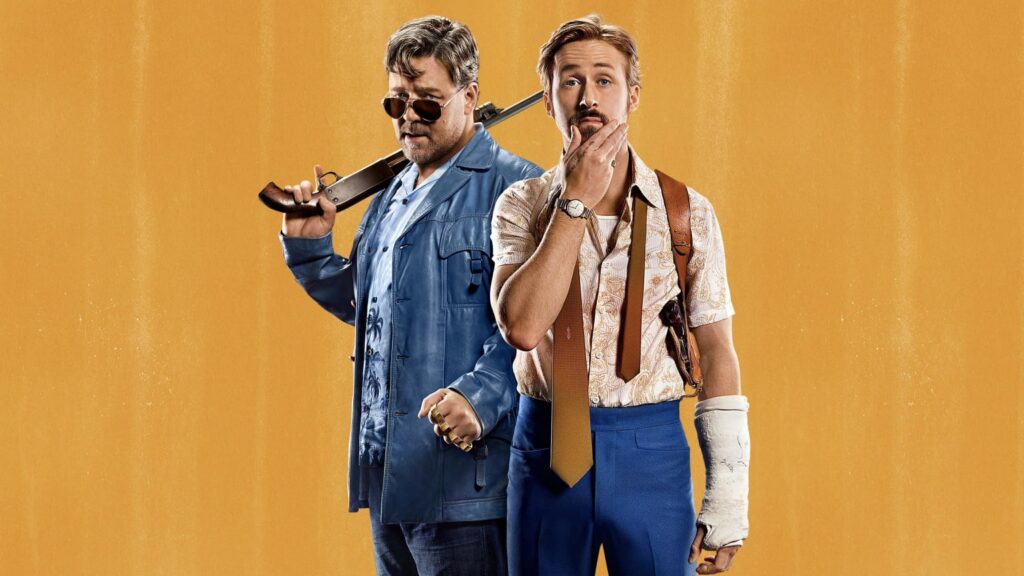
TL;DR: This The Nice Guys review comes down firmly in favor of Shane Black’s bruising comic noir. Ryan Gosling and Russell Crowe are hilarious together, the action is unusually easy to follow, and 1977 Los Angeles looks like a glamorous party with something decomposing beneath the floorboards. The mystery eventually ties itself into more knots than it needs, but the people stumbling through it are far more entertaining than the solution.
Our verdict The Nice Guys is a filthy, funny comic noir powered by Ryan Gosling and Russell Crowe’s beautifully mismatched chemistry. Its conspiracy grows needlessly tangled, but the physical comedy, legible action and decadent 1970s Los Angeles atmosphere make it an easy recommendation.
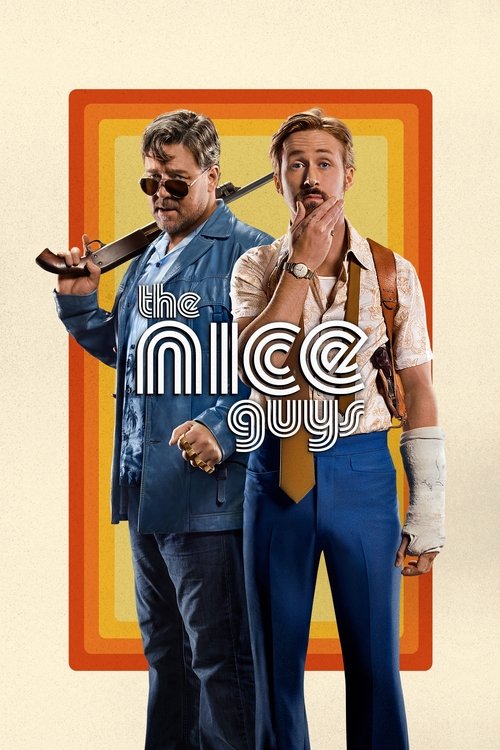
The Nice Guys (2016)
The title contains the film’s best joke and its moral argument. Holland March and Jackson Healy are not nice guys when we meet them. One is a shabby private investigator whose professional methods have a flexible relationship with competence; the other hurts people for money and prefers not to overthink the arrangement. Their investigation gradually pushes them toward something resembling decency, but Black wisely refuses to turn that movement into a solemn redemption march. These men reveal themselves through bruises, panic, humiliation and failure. Detective brilliance barely gets a look in.
Directed by Black and written by Black and Anthony Bagarozzi, the 2016 film follows March and Healy as they investigate a missing young woman and a death connected to the adult-film business in Los Angeles. What begins as an uneasy partnership expands into a larger conspiracy. That is enough setup. The case matters primarily because it keeps throwing these beautifully mismatched disasters into rooms they are not equipped to control.
The Nice Guys review: failure is the real detective method
Most mismatched-partner movies divide competence neatly. One character is reckless, the other restrained; one breaks the rules, the other complains before joining in. The Nice Guys makes a smarter and funnier choice: neither man gets to remain cool for very long. Healy can enter a scene with the blunt certainty of a traditional enforcer, but the movie keeps finding ways to expose the limitations of force. March can occasionally notice something useful, yet every spark of detective instinct is surrounded by vanity, cowardice or a fresh physical calamity.
That constant deflation gives the comedy its character. Black does not merely place jokes between plot points. He makes bodily failure the mechanism through which we understand these men. Falls hurt. Doors, ledges and loose objects become threats. An escape can collapse into ungainly panic before anyone has time to manufacture a heroic pose. The laughs come from watching masculine confidence collide with physical reality, usually at speed.
For me, that is why the film’s familiar buddy-comedy machinery feels so lively. March and Healy are not secretly flawless professionals waiting for the screenplay to validate them. They are compromised men who become marginally better because circumstances force them to depend on somebody else. Their progress is messy enough to be convincing and ridiculous enough to avoid sentimentality.
Gosling panics while Crowe absorbs the damage
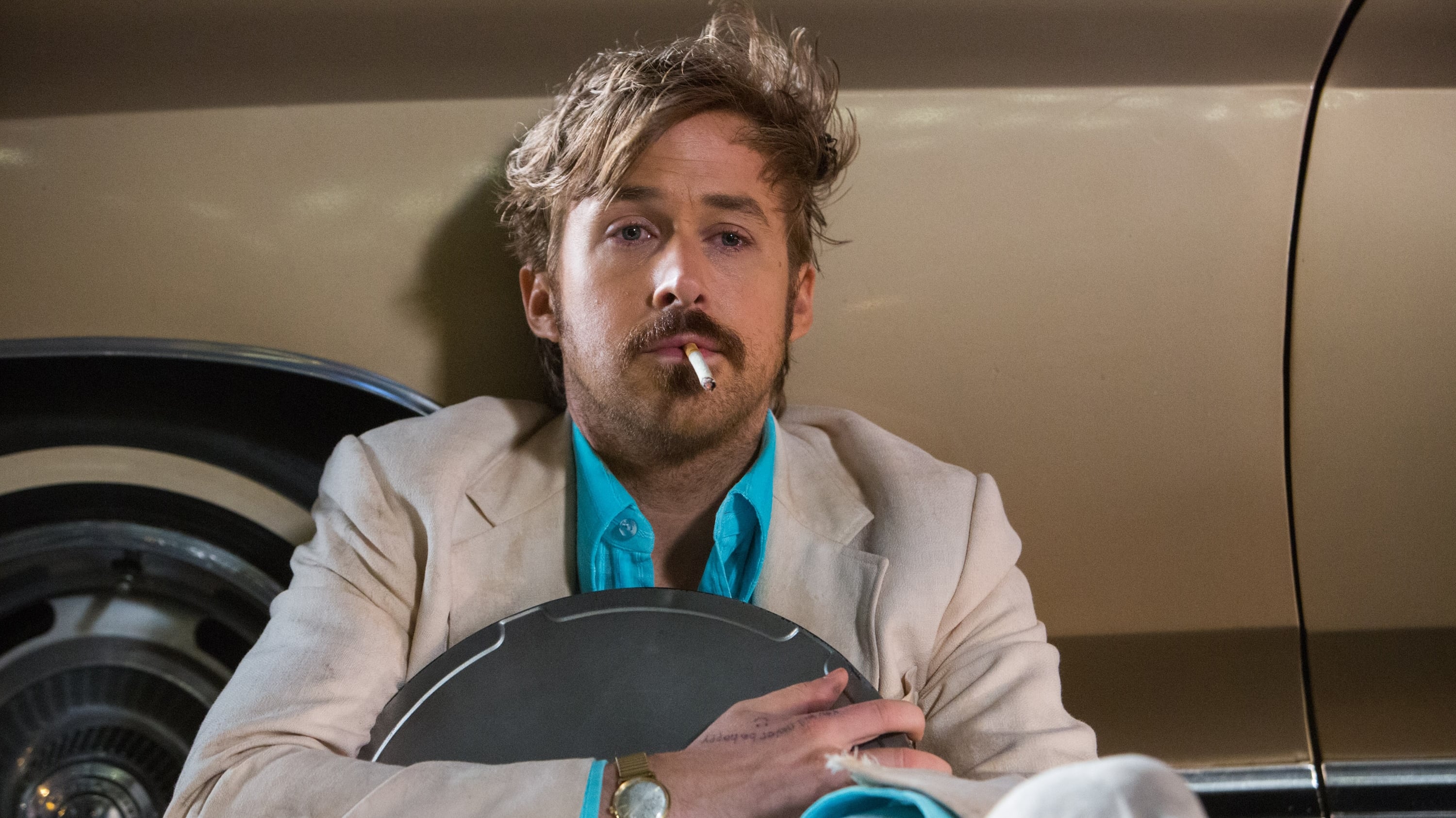
Ryan Gosling commits completely to March’s fear, vanity and elastic physical comedy. His performance is broad without becoming weightless because he never treats March’s panic as a decorative quirk. This man truly believes every fresh disaster may be the one that kills him, and Gosling allows that conviction to travel through his entire body. A yelp, a recoil or an ill-considered movement can tell us as much about March as a page of dialogue.
Russell Crowe gives Gosling exactly the counterweight he needs. Healy is restrained, heavy and dry, often reacting to March’s latest collapse with the weary stillness of a man reconsidering every decision that brought him into the room. Crowe does not compete for comic volume. He lets pauses, blunt observations and physical presence do the work. The pairing succeeds because both actors understand that rhythm: Gosling spirals, Crowe waits, and then Healy’s own limitations puncture the idea that he is the sensible one.
Angourie Rice is just as important as Holly, March’s daughter. She is alert enough to recognize what the adults miss and morally serious enough to expose how thoroughly her father has failed at being responsible. That prevents March from becoming merely an adorable screw-up. Holly loves him, but the film does not confuse affection with absolution.
Her presence gives the comedy a necessary pressure point. March cannot keep treating dysfunction as a lifestyle when his daughter is standing nearby, watching and judging. Holly also complicates the movie’s cynical world: she has not accepted brutality and corruption as the natural order, even when nearly every adult around her has. The men’s movement toward decency would feel abstract without her. With her, it becomes a test they repeatedly fail before showing faint signs of improvement.
Los Angeles glows because everything underneath is rotten
The performances would be enough to carry a smaller comedy, but the atmosphere makes The Nice Guys feel complete. This version of 1977 Los Angeles is full of seductive color, decadent parties and adult spaces that promise liberation while functioning as marketplaces for exploitation. It looks inviting from a distance and increasingly diseased as the characters move through it.
Cinematographer Philippe Rousselot described building the period through locations, costumes, hair, contrast-heavy lighting and seedy neon environments rather than relying on a single visual trick. His discussion of the film’s cinematography also identifies the production as his first digitally shot feature. The result has texture without turning the decade into a costume parade. The clothes, cars and nightlife establish the period, but the lighting gives it an attitude.
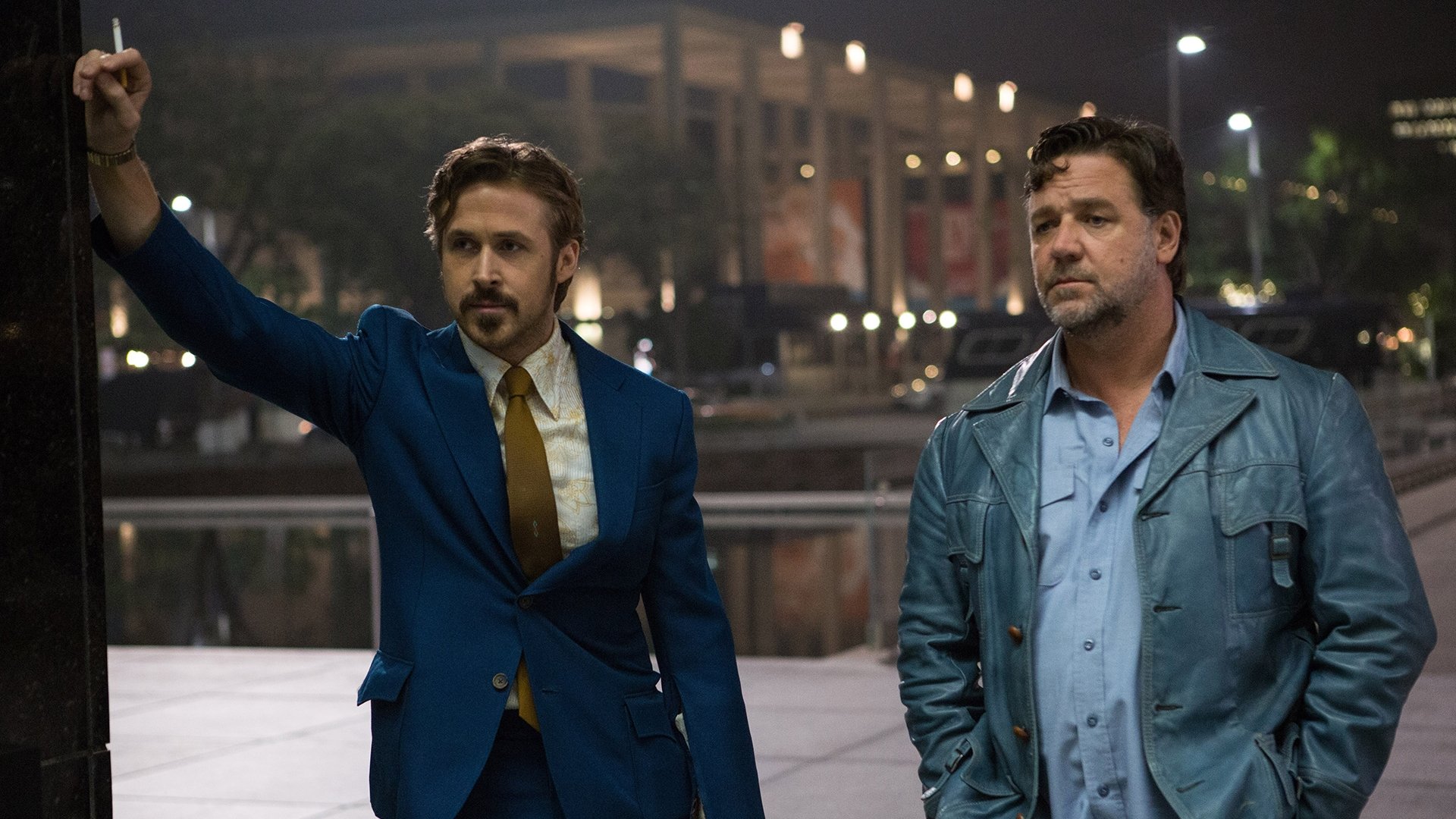
For me, the contrast is the key. Warm pools of light and saturated color make this world pleasurable to look at, even as the story uncovers uglier transactions beneath its surface. The production design and cinematography do not simply announce “the seventies” with a wink. They make glamour and corruption feel inseparable. The city sells fantasy professionally, and almost everyone in the film is either buying, packaging or being damaged by one.
That makes The Nice Guys a different kind of neo-noir from the more restrained redemption story discussed in MovieBunker’s review of The Locksmith. Black wants the grime, but he also wants the absurdity of watching two men slip in it. The sleaze is not background decoration; it is the environment against which their limited moral improvement becomes visible.
Readable action gives the slapstick painful weight
The action works for the same reason the physical comedy works: we can see what is happening. Rousselot said the approach was designed to preserve legible movement rather than bury it under frantic cutting or unnecessary camera shake, with handheld, Steadicam, dolly, crane and static setups used according to the scene. That flexibility matters. The camera can move without behaving as though clarity is an embarrassing old habit.
Because the film establishes bodies in space, collisions have setup, impact and consequence. A fall is funnier when we understand where someone fell from. A botched escape gains momentum when the geography remains coherent. The Nice Guys does not ask editing to manufacture energy after the fact; it lets staging, performance and timing create it inside the frame.
That clarity also keeps the violence from becoming frictionless. Black can play an impact for a laugh while still allowing it to hurt. The film’s best action-comedy beats are not weightless cartoons. They are small disasters endured by characters whose confidence consistently exceeds their balance. Viewers who appreciate action built around readable space rather than visual static may also enjoy MovieBunker’s look back at Predator as an action-thriller classic.
The conspiracy is less rewarding than the chaos around it
The central investigation supplies forward momentum, but it is the film’s clearest weakness. As conspirators, motives and case mechanics accumulate, the story begins demanding more attention than its answers reward. Individual confrontations are sharp; the connective plotting can feel like paperwork filed between them.
A complicated mystery is not automatically a rich one. The Nice Guys has enough moving parts to support a serious procedural, but its real interests lie elsewhere: damaged masculinity, compromised decency, Hollywood commerce and the strange intimacy created by surviving humiliation with another person. Whenever the screenplay pauses to explain how another piece fits into the conspiracy, I find myself waiting for March, Healy or Holly to disrupt the explanation by behaving like recognizable human beings.
The abrasive R-rated tone is the other meaningful reservation. The sexual material and violence belong to this deliberately sleazy environment, but Holly’s movement through adult spaces creates discomfort that the film does not always examine as sharply as it exploits for comedy. Film Comment raised a substantially harsher objection to this aspect of the movie, as well as to its busy plotting. I do not share that review’s overall severity because Holly provides genuine moral resistance rather than functioning only as an innocent prop. Still, the tension does not disappear simply because the film knows it is being provocative.
That caveat will matter more to some viewers than the tangled mystery. The Nice Guys is not a genial retro caper wearing a little dirt for style. It is profane, violent and deliberately immersed in an adult entertainment economy. Anyone expecting cuddly odd-couple banter with tasteful noir shadows has wandered into the wrong Los Angeles.
The verdict: a filthy comedy with a decent heart
The Nice Guys succeeds because it understands that chemistry is not merely two actors trading clever dialogue. It is rhythm, contrast and the pleasure of watching one performer create the exact conditions the other needs to be funny. Gosling’s frantic elasticity and Crowe’s heavy restraint make March and Healy feel freshly incompatible, while Rice ensures their failures retain consequences.
I like the bruising character comedy more than the expanding conspiracy, but the imbalance is easy to forgive when the film is this confident about movement, atmosphere and performance. Black turns failure into both a punchline and a moral process. March and Healy do not become decent by discovering hidden nobility. They edge toward it because every attempt to preserve their selfishness ends in embarrassment, injury or the judgment of someone less corrupt.
That makes The Nice Guys an easy recommendation for viewers who want an adult buddy comedy with noir grime, vivid period atmosphere and action they can actually follow. The mystery is not airtight and the tone is intentionally abrasive, but the central partnership is irresistible. These men may never fully deserve the title. Watching them fail their way toward it is the whole pleasure.