
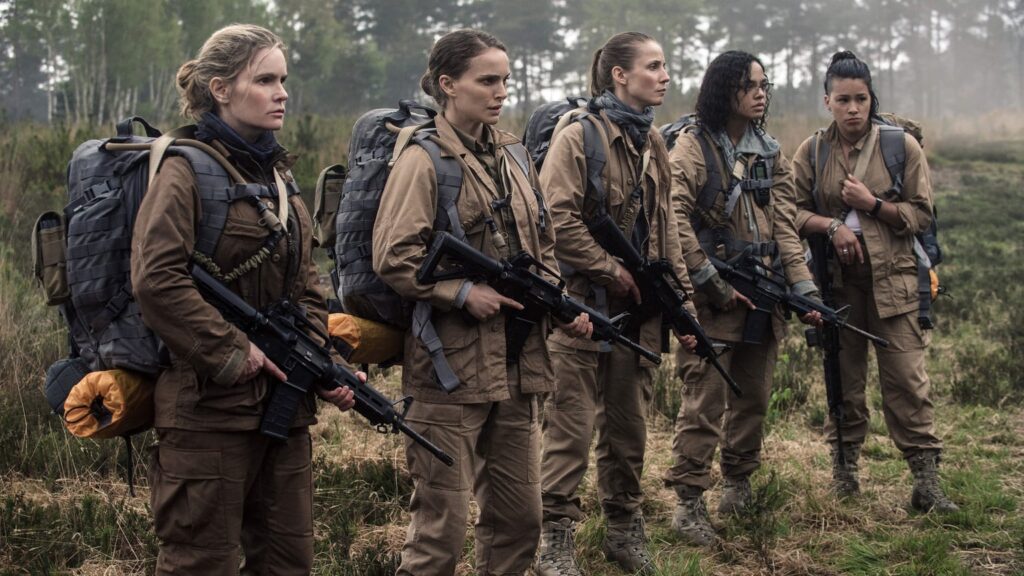
Alex Garland’s Annihilation is beautiful, frightening and refreshingly unwilling to explain itself into submission. This Annihilation 2018 review comes down firmly on the side of its ambiguity: the film succeeds because it treats the unknown as a destabilizing force rather than a puzzle box with an answer hidden inside. Its emotional restraint sometimes creates distance, but the combination of mournful performances, biological horror and overwhelming atmosphere makes that distance feel more haunting than hollow.
Our verdict Alex Garland’s Annihilation is a haunting, visually audacious science-fiction nightmare whose controlled ambiguity, mournful performances and sensory dread outweigh its moments of emotional distance.
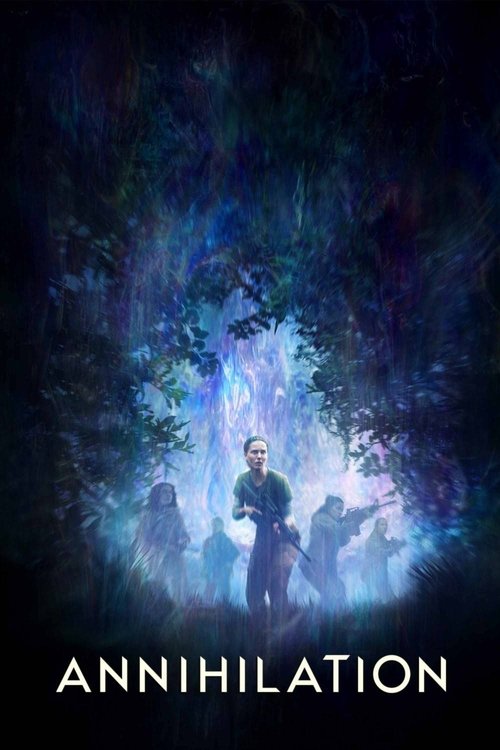
Annihilation (2018)
Written and directed by Garland from Jeff VanderMeer’s novel, the film follows Lena, a biologist and former soldier who enters a mysterious expanding quarantine zone after her husband returns gravely ill from an earlier mission. She joins a specialist expedition confronting landscapes and organisms that have been altered into something new and deeply wrong. That is all the setup the movie needs. Annihilation is less interested in mapping this territory than in asking what happens when people can no longer trust the boundaries between themselves and the world around them.
Annihilation turns beauty into a warning
The film’s greatest achievement is its atmosphere. Inside the quarantined area, natural beauty and physical corruption are not opposites; they appear to be products of the same process. Garland repeatedly presents the strange as alluring before allowing its implications to become horrifying. The result is a landscape that invites closer inspection even when every sensible instinct says to back away.
That collision between wonder and disgust gives Annihilation its identity. The altered environment does not resemble the usual blockbuster wasteland, where danger helpfully announces itself through gray skies, rubble and a permanent shortage of working light bulbs. Its color and abundance make it more unsettling. Life is not disappearing here. It is flourishing according to rules the expedition cannot understand, and that possibility is much scarier than another sterile movie apocalypse.
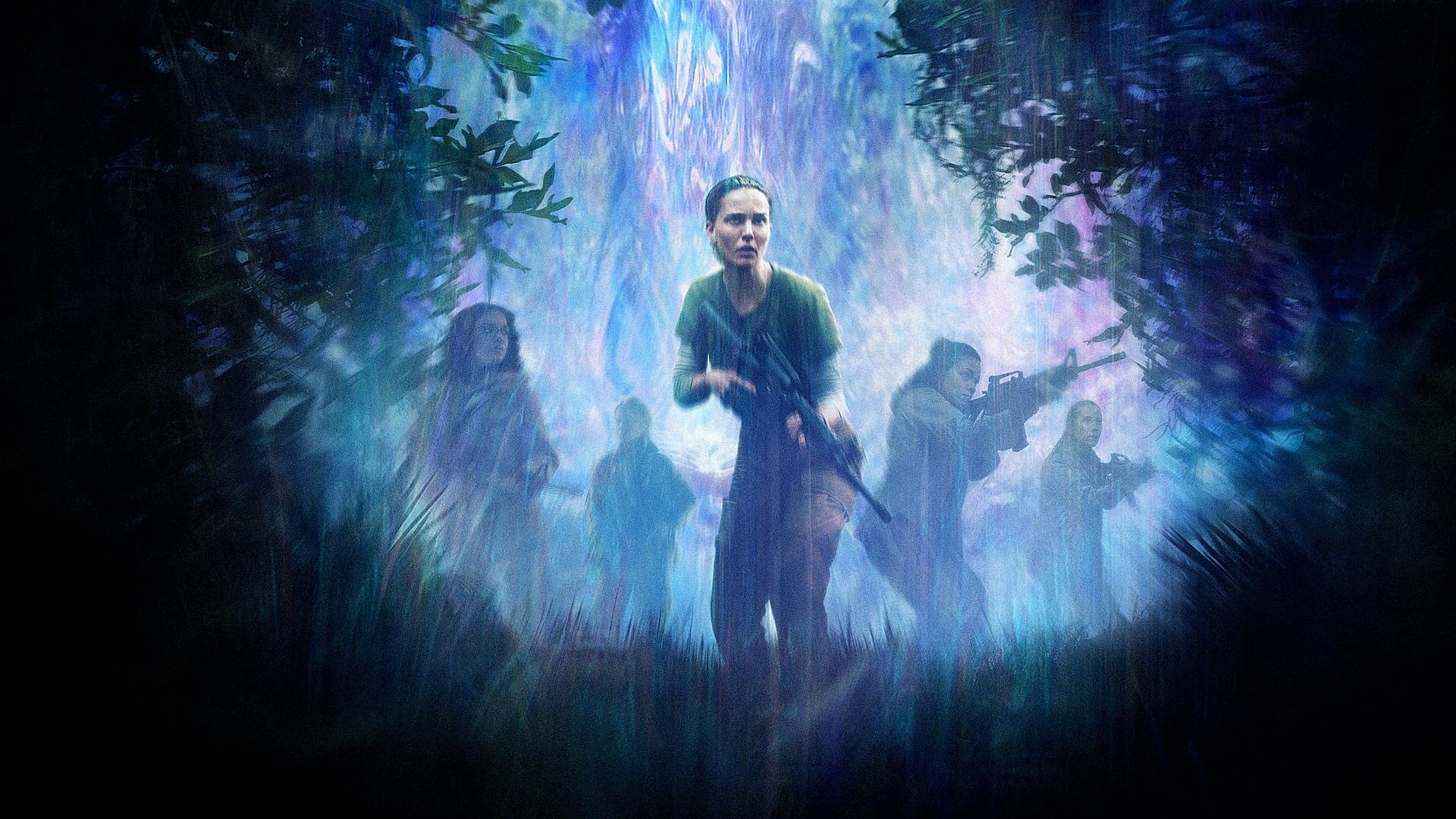
The body horror follows the same principle. Garland does not use mutation merely as a delivery system for grotesque effects. Physical change becomes an assault on identity: the body is no longer a stable possession but material that can be rewritten. For me, that idea is the source of the film’s deepest fear. Its images are memorable because they carry a philosophical threat, while the threat becomes frightening because the images give it flesh.
Ben Salisbury and Geoff Barrow’s score is essential to the effect. The music can suggest contemplation or fragile wonder before twisting those sensations into cosmic unease. Together with the sound design, it gives the film a low, persistent anxiety even during its quietest stretches. Annihilation contains sudden creature threats and bursts of survival action, but it never depends on continuous combat. Anticipation does more work than spectacle.
Garland protects the mystery instead of burying it in lore
A weaker version of this story would arrive carrying several suitcases of mythology. It would establish committees, protocols and scientific terminology, then stop every few minutes to explain what the audience had just seen. Garland is more disciplined. Information arrives through brief exchanges, fragments of observation and flashbacks to Lena’s relationship with her husband, Kane. The film provides enough context to establish the emotional and physical stakes without pretending its central phenomenon can be reduced to a tidy presentation.
That restraint keeps the unknown genuinely unknown. The expedition members can identify patterns and form theories, but expertise does not magically grant control. Importantly, the movie does not make them foolish simply to accelerate the danger. They remain broadly recognizable as capable specialists placed under extraordinary pressure. Their decisions may not always be reassuring, but they emerge from exhaustion, fear and deteriorating certainty rather than the usual horror-movie requirement that somebody investigate the ominous noise alone.
The team is not a banter-driven found family, either. Its tense, functional exchanges belong to people trying to remain professional after the available rules have stopped making sense. That choice deprives the film of some easy warmth, but it also protects the mournful seriousness of the mission. Garland is interested in people carrying private damage into an environment that can make that damage physical.
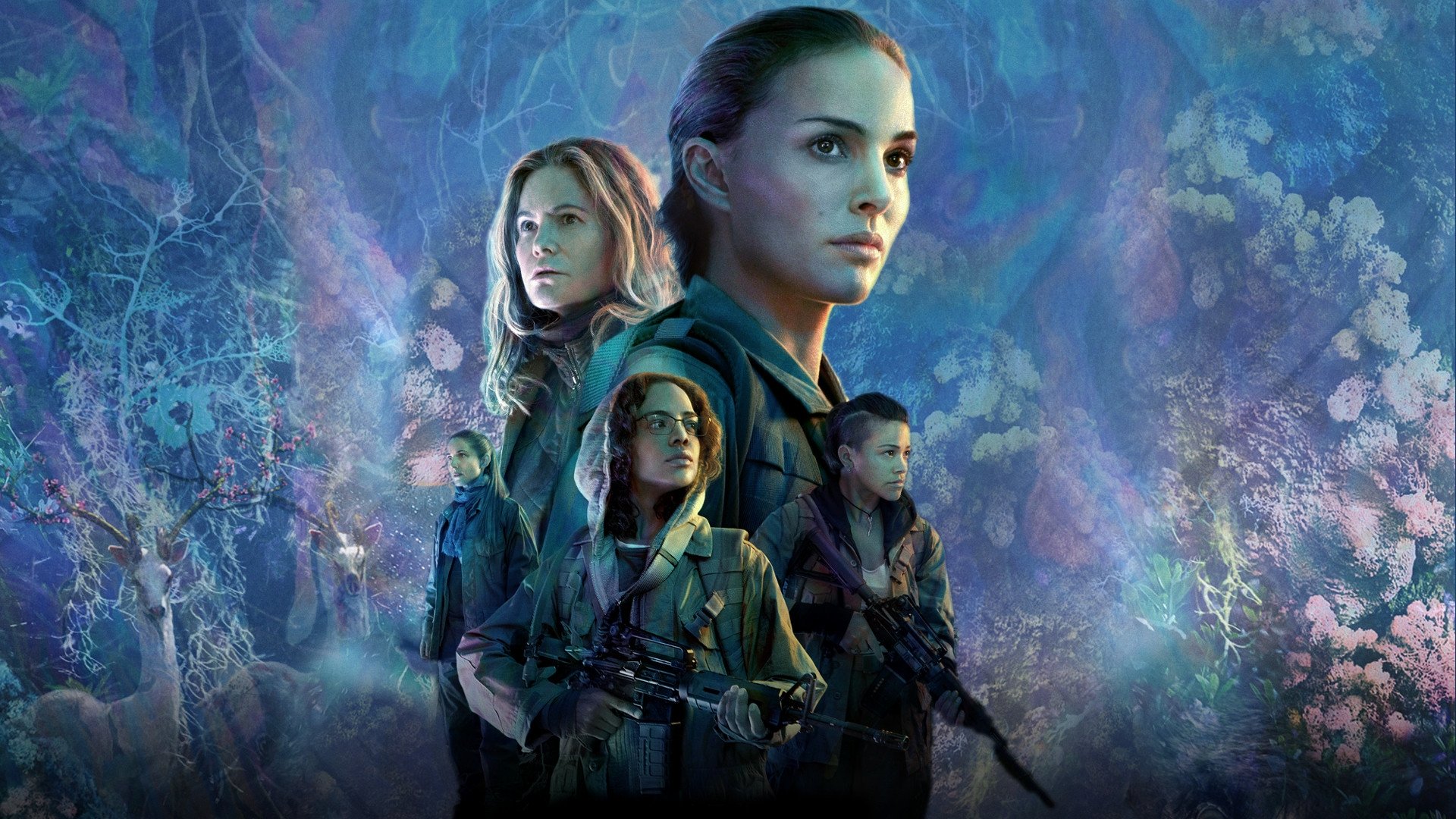
The pacing reflects the same approach. Annihilation is a slow burn, but it is not inert. Garland lets unease accumulate through environmental details and incomplete discoveries, then punctures that control with short, forceful confrontations. Viewers wanting a fast creature feature may find its patience frustrating. Anyone receptive to atmospheric science fiction should find that the waiting is the point: every quiet passage provides more time to notice that something fundamental is slipping.
That makes Annihilation a useful companion to No One Will Save You, another science-fiction horror film that builds tension through isolation and an intrusion that resists easy translation. Garland’s movie is more contemplative and biologically fixated, but both understand that an unknown presence becomes less frightening when a screenplay insists on explaining every silence.
Natalie Portman gives the nightmare a human center
Natalie Portman holds the high-concept material together by resisting easy sentimentality. Lena is determined and observant, but Portman does not turn competence into invulnerability. Her restraint suggests a person accustomed to analyzing the world who is also carrying private damage that analysis cannot resolve. The performance gives Garland an emotional center without forcing Lena to verbalize every feeling.
The flashbacks between Lena and Kane are especially important because they prevent the film’s ideas about change and self-destruction from becoming abstract decoration. Their relationship is presented in selective pieces rather than as a complete psychological case file. We see affection, intimacy and tension, but the film leaves room around those memories. Oscar Isaac’s guarded presence complements Portman’s approach: their shared history feels emotionally significant without being packaged into a reassuring romantic explanation.
Jennifer Jason Leigh, Gina Rodriguez, Tessa Thompson and Tuva Novotny complete the expedition ensemble. Each brings a distinct temperament to the group without turning the mission into a parade of elaborate backstories. That economy preserves momentum and seriousness, but it also contributes to the movie’s most substantial limitation. Some members of the expedition can register as expressions of the film’s themes before they feel like fully immediate human beings.
I admire the control of these performances more than I emotionally connect with every character. Annihilation often asks its actors to internalize fear rather than broadcast it, which fits the material but limits the range of its human drama. Portman carries that burden best because Lena’s restraint is surrounded by enough relational detail to suggest the pain underneath it. Elsewhere, the film’s imagery can overpower the people standing inside the frame.
The effects give impossible images physical weight
Annihilation’s visual power comes partly from the way practical construction and digital alteration reinforce one another. The production built physical Mandelbulb-inspired set pieces, used practical creature elements and performer reference, and combined that material with computer-generated animation and enhancement. For at least one creature attack, cable work and practical stand-ins were used before the digital creature was added. VFX supervisor Andrew Whitehurst’s production breakdown documents that hybrid process.
That practical-and-digital combination matters because the film is about boundaries becoming unstable. Sets, performers and creatures still appear to occupy a shared physical space, even when the imagery becomes impossible. Its brief action sequences consequently retain weight: bodies do not seem to be floating through a frictionless effects demonstration. The digital work mutates a tactile foundation instead of replacing it.
The same quality makes the more disturbing imagery difficult to shake. Like the bodily transformations in Raw, the horror works because physical change also represents a crisis of selfhood. Annihilation operates on a larger cosmic scale, but it shares the understanding that the most disturbing invasion is one that dissolves the distinction between an external threat and something already happening inside the person confronting it.
Its emotional distance is both a weakness and a strategy
The film’s restraint has a cost. At times, its imagery and ideas command more attention than the immediate human drama, while the sustained solemnity can make the characters feel remote. Annihilation is easier to admire sensorially and intellectually than it is to embrace emotionally. That is not a fatal flaw, but it is the reservation most likely to determine whether a viewer becomes entranced or simply watches the movie from a chilly distance.
Yet warmth is not the only measure of emotional effectiveness. The film’s sadness emerges through suppression, damaged relationships and the growing sense that identity is less secure than people need it to be. Its distance supports that conception. The characters are entering an environment that disrupts ordinary human categories, and Garland gradually removes the comforting narrative structures that would usually keep both them and the audience oriented.
The conclusion intensifies that strategy by refusing comprehensive answers. It is deliberately opaque and likely to divide viewers who expect the mystery to click neatly into place. Garland provides enough thematic and visual material to support interpretation, but he does not close every gap. I find that choice more haunting than frustrating. Explaining the phenomenon completely would reduce it from an encounter with the unknowable to an unusually elaborate workplace incident.
Annihilation 2018 review verdict
Annihilation is highly recommended for viewers who enjoy slow-burning science fiction, cosmic horror, body horror and endings that remain active in the mind after the credits. Its controlled flow of information, mournful performances and practical-digital imagery all serve the same idea: transformation can be beautiful, terrifying and impossible to separate cleanly from destruction.
Those seeking rapid action, extensive lore or conventional closure should approach with caution. The film will not meet those expectations halfway, and its emotional reserve is a genuine barrier rather than a trivial complaint. But for viewers willing to sit with uncertainty, Annihilation is an unusually confident studio genre film. Garland understands that the unknown stops being frightening the moment it becomes completely manageable. His smartest decision is to let some of it remain beyond our grasp.
References
- Annihilation | Paramount Pictures
- Annihilation | Rotten Tomatoes
- Annihilation review – Natalie Portman thriller leaves a haunting impression | Science fiction and fantasy films | The Guardian
- Annihilation movie review & film summary
- Mandelbulbs, mutations and motion capture: the visual effects of Annihilation – vfxblog