
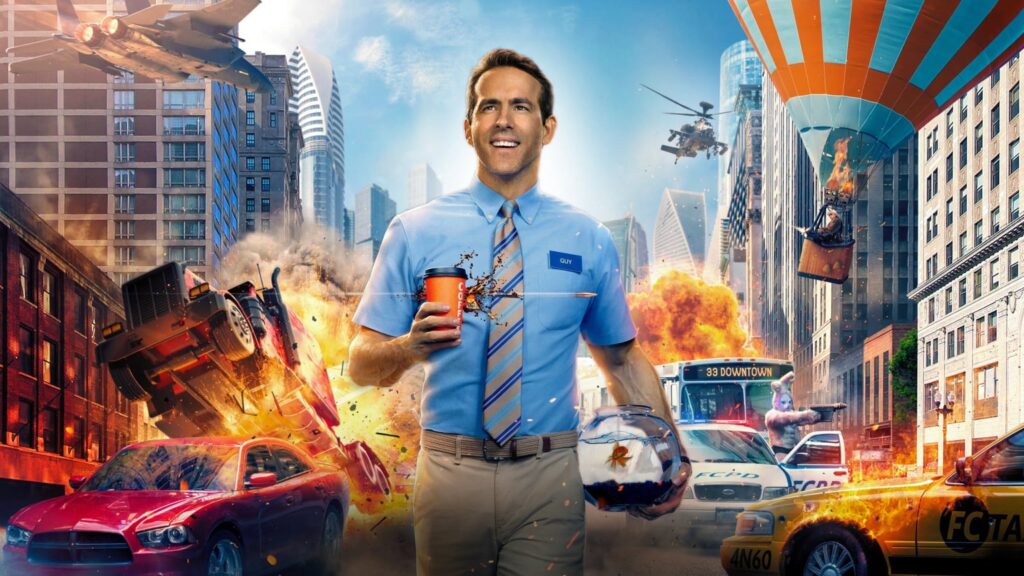
TL;DR: This Free Guy 2021 review finds a genuinely likable agency fable inside a much less satisfying studio blockbuster. Ryan Reynolds gives the movie an easy comic center, Jodie Comer supplies its most versatile performance, and Free City has the tactile bustle of a game people might actually play. Unfortunately, the screenplay keeps explaining its own machinery while the action, references and corporate back-patting fight for attention.
Our verdict Free Guy has an appealing agency fable, lively game-world design and an engaging Jodie Comer, but relentless spectacle, clumsy exposition and corporate fan service keep this cheerful blockbuster stuck at an average score.
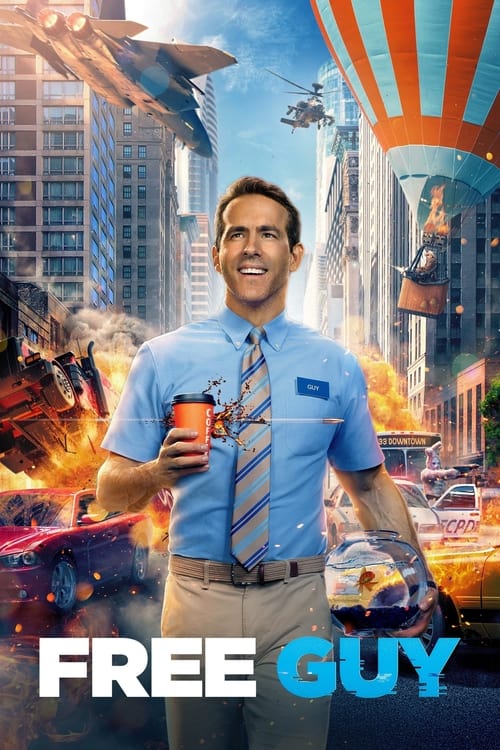
Free Guy (2021)
Directed by Shawn Levy from a screenplay credited to Matt Lieberman and Zak Penn, Free Guy runs for 115 minutes and follows a bank teller who discovers that he is a non-player character in an open-world video game. He begins breaking from his programmed routine just as forces outside the game threaten his world and its inhabitants. It is a smart, clean premise. The frustrating part is how often the film behaves as though it needs to install three pages of terms and conditions before letting that premise breathe.
Free Guy 2021 review: The NPC story is the real attraction
Free Guy works best when it concentrates on Guy’s movement from cheerful compliance toward self-determination. His sunny routine is initially funny because its absurdity is obvious to everyone except him. Violence and catastrophe are simply part of the scenery, and Guy accepts the limits of his world because he has never imagined that choice was possible. Once he begins acting for himself, the film finds a warm and accessible way into questions about agency and personhood.
This is not especially radical science fiction, but it does not need to be. The appeal lies in watching a background character realize that being harmless is not the same as being free. Guy’s rebellion is sweet rather than angry, which suits Reynolds’ relaxed comic persona. He can sell bewilderment, politeness and the occasional knowing gag without turning Guy into an entirely different person the moment the plot needs him to become heroic.
The limitation is that Reynolds’ familiar glibness never completely disappears. Guy remains likable, but the performance is more convincing as the foundation of an empowerment comedy than as the center of a romance. The romantic development asks for a degree of sincerity that the movie’s rapid jokes and Reynolds’ polished charm do not always provide. The friendship between Guy and Buddy, played by Lil Rel Howery, is simpler and more effective. It gives Guy’s expanding awareness an emotional connection that does not require the screenplay to force a grand romantic payoff.
Jodie Comer connects two very different worlds
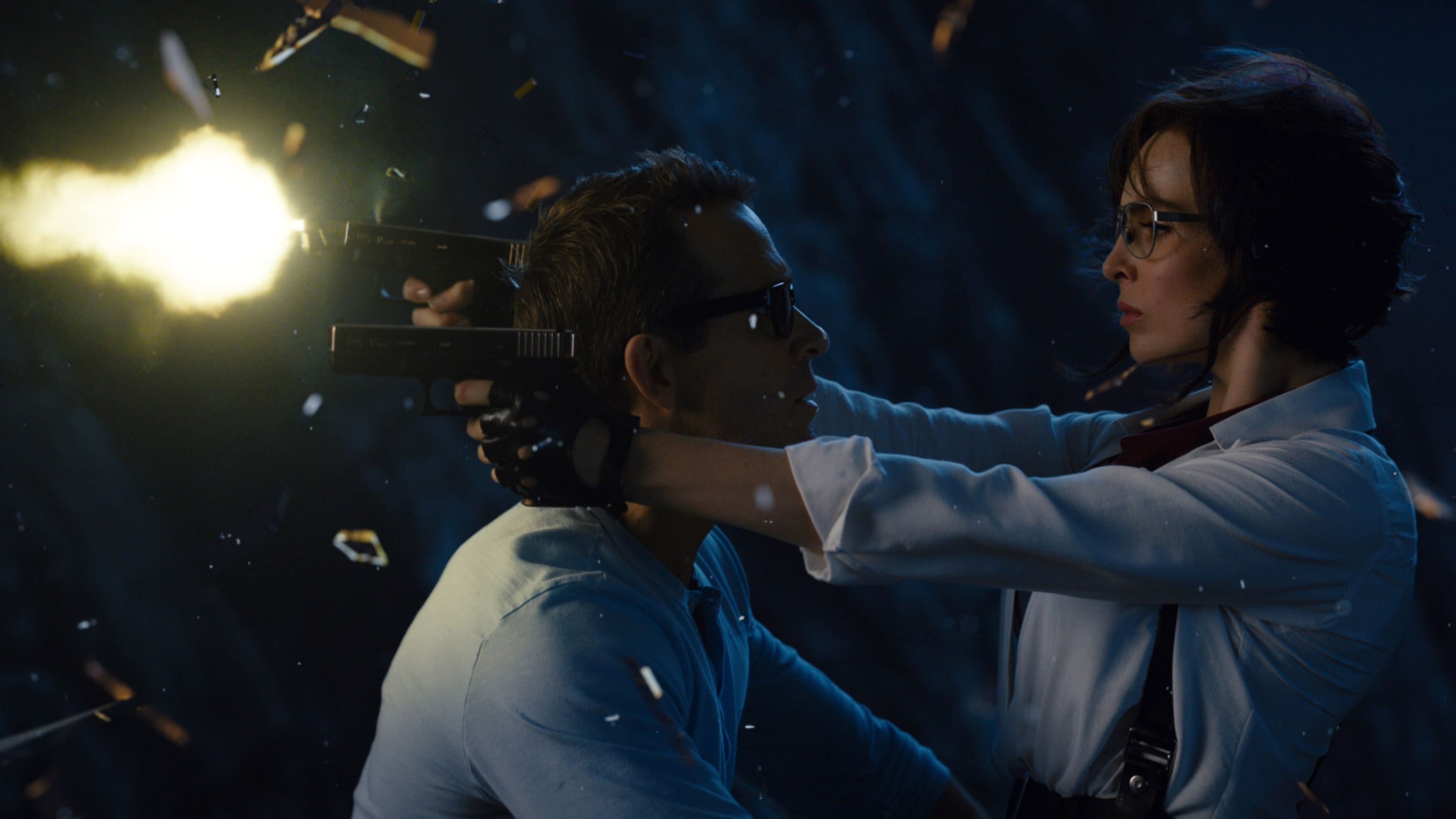
Jodie Comer is the film’s strongest performer because she has to make its split reality feel coherent. As Millie in the real world and Molotov Girl inside Free City, she moves between grounded frustration and heightened action-comedy swagger without treating either side as a throwaway disguise. That range helps connect Guy’s innocent awakening to the human conflict involving creative ownership, code and corporate control.
Comer also handles the movie’s tonal gear changes more comfortably than the screenplay does. She can participate in the exaggerated game-world comedy and then give the underlying dispute some urgency. Joe Keery provides support as Keys, while Taika Waititi’s Antwan embodies the film’s corporate villainy at maximum volume. That broadness fits a movie where subtlety has apparently been classified as downloadable content, but it also prevents the real-world conflict from becoming as persuasive as Guy’s internal transformation.
Free City looks more convincing than the story surrounding it
Free Guy understands the visual texture of contemporary games. Free City is crowded with robberies, vehicles, weapons, avatars and environmental chaos, while Guy’s ordinary routine continues in the middle of it all. The contrast is a strong running joke and an effective piece of world-building: what looks like apocalyptic madness to us is simply another working day for an NPC.
That texture comes from a deliberate mixture of physical production and digital augmentation. In production designer Ethan Tobman’s account of building Free City, the filmmakers developed different visual rules for the real world, the game environment and player perspectives. Street-level blocks, vehicles, signs and other elements were physically constructed, while visual effects expanded the city and supplied its artificial game-world scale. Visual-effects supervisor Swen Gillberg likewise described action combining live car chases with CG crashes, vehicles, helicopters and city extensions.
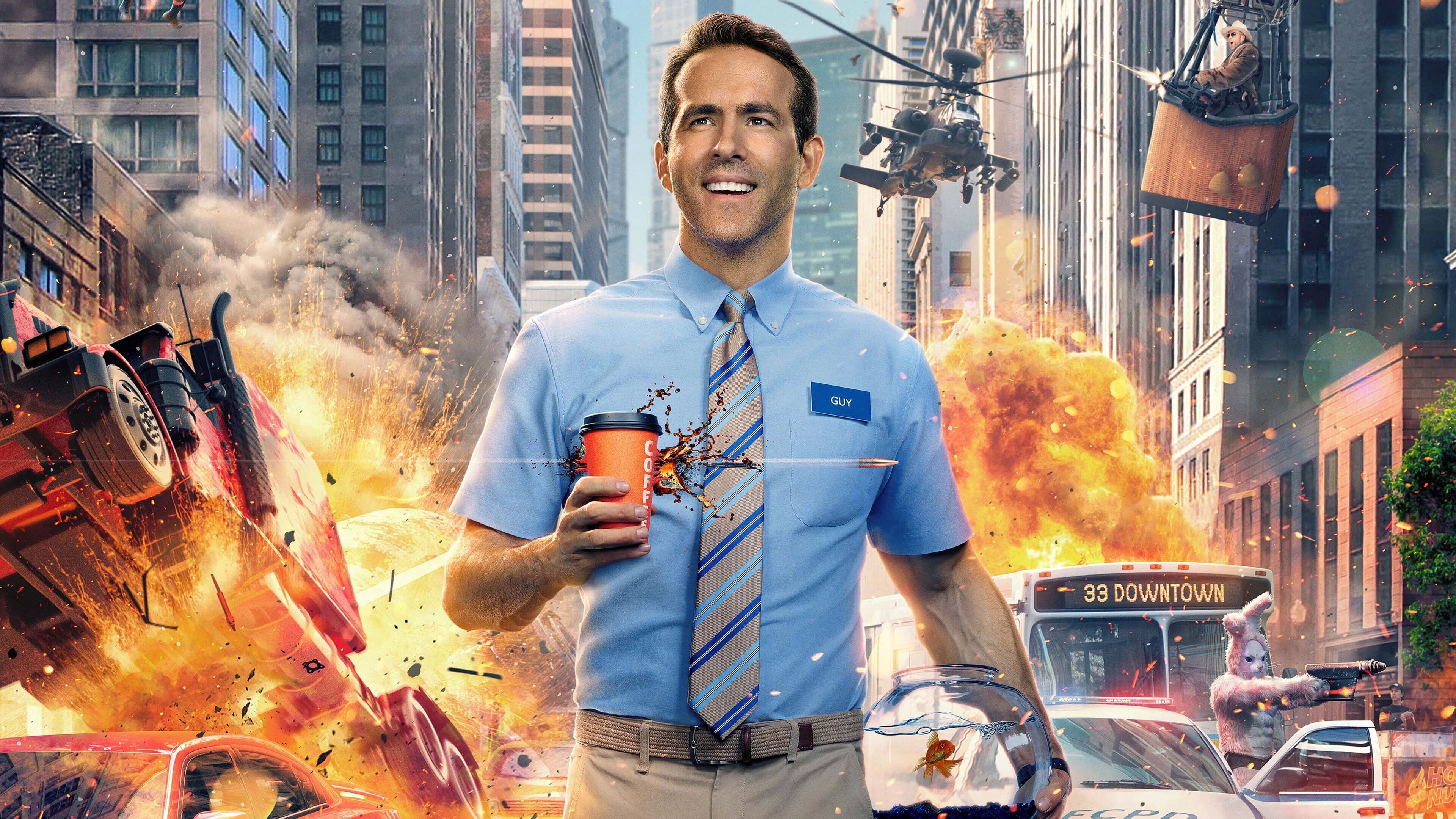
The result is more tactile than a purely synthetic digital playground. Free City has enough physical weight to keep Guy emotionally present within it, while its amplified colors and impossible incidents mark it as a designed space. The murkier real world provides a visual distinction, although that contrast is more effective as design than drama. The game is where the film’s imagination lives; reality is where characters frequently stand around explaining what the game means.
The filmmakers drew on games including Grand Theft Auto, Fortnite, Overwatch, Apex Legends, Red Dead Redemption, Horizon Zero Dawn and Halo when shaping the world. That broad vocabulary makes Free City recognizable without reducing it to one direct parody. It is an important success, especially when game adaptations and game-inspired stories so often reproduce iconography without understanding the rhythm of play. MovieBunker’s review of Halo’s difficult leap from console to television addresses another version of that problem.
The exposition keeps interrupting the fun
Free Guy’s biggest structural weakness is its inability to trust the premise. The screenplay repeatedly pauses to discuss artificial intelligence, code, ownership, routines and the relationship between game events and real-world decisions. Some explanation is inevitable in a story operating across multiple realities, but the volume of it makes the plotting feel mechanical. The characters are often maintaining the concept rather than living inside it.
That becomes especially damaging as the film expands. Guy’s awakening is direct and emotionally legible; the corporate and technical conflict is not. Instead of giving the central idea greater weight, every additional explanation puts more machinery between the audience and Guy. Ars Technica similarly identified the information dumps and weaker late-film landing as significant problems, even while praising the movie’s attention to gaming culture and Comer’s performance. For me, the controlled discovery of Guy’s early arc is far more engaging than the busy mythology built around it.
The pacing suffers for the same reason. Free City is intentionally hectic, and the barrage of gunfire, crashes, explosions and rapid-fire gags initially captures the sensory overload of a multiplayer sandbox. But near-constant intensity flattens the comic timing. A joke, an action beat and an emotional realization cannot all land properly when the movie is already sprinting toward the next visual interruption.
Corporate fan service undermines the rebellion
There is an interesting conflict at the center of Free Guy involving creativity, ownership and the power of a corporation to erase something valuable when it becomes inconvenient. The movie wants us to cheer for individual agency and resist a system that treats people and ideas as disposable assets. That is a worthwhile foundation for a mainstream comedy, even if the corporate storyline is painted in broad strokes.
The problem is the film’s conspicuous use of familiar Disney-owned imagery. Those references may provide quick recognition, but they sit awkwardly inside a story that is ostensibly suspicious of corporate control over creativity. The Los Angeles Times also criticized the late IP references as distracting and pandering. I find them less like organic punchlines than a studio pausing the rebellion to inventory its own toy cupboard.
This contradiction would matter less if the references were sharper jokes. Instead, recognition becomes the joke: the audience knows the thing, the movie knows that the audience knows the thing, and everyone is expected to applaud the transaction. Free Guy is at its most charming when Guy discovers an identity beyond the role assigned to him. It is at its least convincing when the film itself retreats into the safety of established brands.
Is Free Guy worth watching?
Free Guy is a reasonable casual watch for Ryan Reynolds fans, gamers and families looking for a bright action comedy. It has an appealing hero, a lively game world and an engaging performance from Comer. Its central message—that a person can question the routine handed to them and choose something better—is simple, warm and easy to embrace.
But the film understands the texture of a video game better than the structure of a satisfying story. Its explanations clog the pacing, its escalating spectacle exhausts the comedy, and its corporate fan service undercuts its own defense of creative freedom. There is enough charm here to prevent total failure, but not enough discipline to turn the clever premise into a consistently rewarding movie. Free Guy is cheerful, busy and perfectly watchable; it is also stuck frustratingly close to the default setting it wants its hero to escape.
References
- Free Guy | Rotten Tomatoes
- Free Guy Reviews – Metacritic
- How the 'Free Guy' design team created Free City – Los Angeles Times
- Free Guy Interview: Swen Gillberg on Turning Boston into Free City
- Free Guy review: Finally, an authentic gaming film—and it’s fun, not perfect – Ars Technica
- 'Free Guy' review: Ryan Reynolds' charm has its limits – Los Angeles Times