

This Infinity Pool 2023 review comes down to a frustrating split: Brandon Cronenberg’s film is a ferocious sensory experience and a less convincing piece of social criticism. Its images stick like sweat, its two central performances are fearlessly exposed, and its premise turns wealth into a literal exemption from consequence. Yet the further it descends into violence, humiliation and hallucination, the less precise its argument becomes. I was frequently impressed, occasionally repelled and ultimately left somewhere between compelled and exhausted.
Our verdict Brandon Cronenberg’s resort nightmare has ferocious performances and strikingly tactile hallucinations, but its provocative escalation gradually blurs the class and identity critique. A memorable sensory assault that lands somewhere between compelling and exhausting.
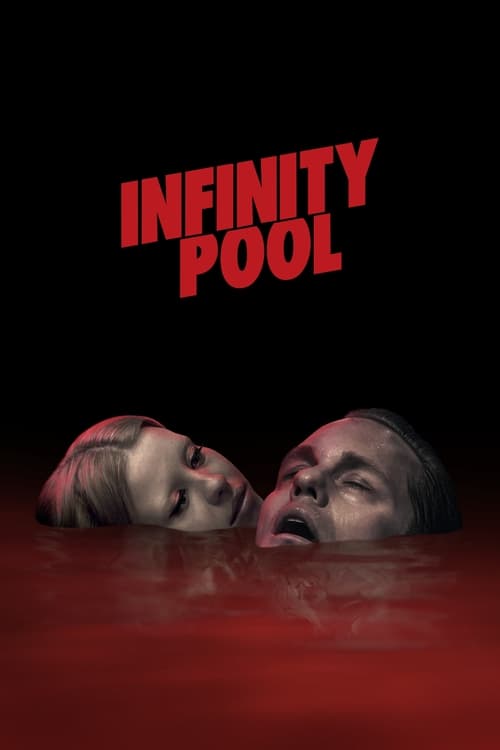
Infinity Pool (2023)
Written and directed by Cronenberg, Infinity Pool follows blocked novelist James Foster and his wife, Em, during a stay at an exclusive resort in the fictional country of Li Tolqa. After James crosses paths with the dangerously enthusiastic Gabi, he discovers that wealthy foreign offenders can pay to have duplicates executed in their place. It is a viciously efficient setup: punishment has not disappeared, but privilege has made it transferable. Someone still suffers; money simply decides who.
Infinity Pool turns impunity into a tourist attraction
The film’s best idea is also its simplest. Li Tolqa’s duplication system transforms the usual protective bubble around wealthy tourists into a grotesque legal mechanism. James and his new companions do not merely behave badly because they assume their status will protect them. They receive proof that consequences can be outsourced, packaged and purchased like another resort upgrade.
That makes Infinity Pool an acidic companion to films about rich people consuming supposedly authentic experiences while remaining insulated from the damage they cause. Unlike the more controlled dining-room satire of The Menu, Cronenberg does not build toward an elaborate punchline. He treats privilege as an intoxicant. Once James learns that even death can be delegated, the boundary between liberation and self-erasure starts to collapse.

The duplicate is an especially effective symbol because it turns punishment into spectacle. James must confront a version of himself bearing the cost of his choices, but that confrontation does not automatically produce accountability. The movie is interested in what happens when remorse becomes another sensation available to the wealthy: frightening in the moment, perhaps, but survivable and therefore repeatable. That is a nasty, productive idea, and the early movement of the film gives it room to bite.
Cronenberg is less interested in conventional suspense than in seduction and contamination. James does not charge into this nightmare as a decisive hero. He drifts, submits and allows stronger personalities to define the next boundary. That passivity can be maddening, but it is central to the film’s design. Infinity Pool is not asking whether James can defeat the system. It is asking whether the system reveals something already hollow inside him.
Mia Goth and Alexander Skarsgård embrace the degradation
Mia Goth gives the movie its volatile energy. Gabi can make an invitation sound like a dare and a threat feel like a private joke, shifting from seductive approval to predatory contempt without losing control of the scene. Goth understands that the character’s power comes from unpredictability. Gabi appears to be enjoying herself, but her pleasure has an edge: she is always testing how far James can be pushed and how eagerly he will participate in his own undoing.
Alexander Skarsgård takes the less immediately showy role and makes James’s weakness painfully visible. This is a physically and emotionally exposed performance built around hesitation, shame and susceptibility rather than heroic resistance. James often seems to be watching himself make terrible choices from a few seconds behind, unable or unwilling to interrupt the process. Skarsgård gives that surrender bodily weight, preventing the character from becoming a mere delivery system for Cronenberg’s provocations.
The tension between the leads supplies the human stakes even when the film’s psychology dissolves into nightmare logic. Goth drives scenes outward with aggressive confidence; Skarsgård folds inward as James loses any stable sense of authority over himself. Their performances make domination and submission feel more revealing than the plot’s science-fiction mechanics. The movie is at its strongest when a look, posture or humiliating command tells us more about James than another burst of grotesquerie could.

There is a useful comparison here with the bodily transformation and social pressure in Raw. Both films use physical extremity to attack a character’s idea of a coherent self. Infinity Pool, however, is colder and more deliberately alienating. It offers little comfort and even less companionship. Its social circle is not a found family of outsiders but a predatory club whose membership depends on surrendering ordinary moral limits.
The hallucinations have real physical texture
For me, the film’s strongest achievement is its visual texture. Cronenberg repeatedly fractures bodies, faces and sexual imagery through light, color and optical distortion, but the results do not have the frictionless quality of generic digital psychedelia. They appear smeared, reflected and projected through physical space. The images feel touched, stained and mechanically warped, which is exactly right for a story about identity becoming reproducible.
That physicality was built into the production. In a production interview about the film’s intense visuals, Cronenberg explained that the hallucination sequences used practical, in-camera techniques including gels, glass, projections, flares and purpose-built mirror boxes, with limited visual-effects work used mainly for cleanup. The method matters because it changes the effect: these sequences do not merely illustrate James losing control. They make disorientation seem like a material substance pressing against the lens.
The resort setting benefits from the same approach. It begins as a controlled enclave built to separate tourists from everything beyond its perimeter, but Cronenberg gradually makes that insulation feel diseased. Luxury does not provide safety here; it removes friction. The characters move through spaces designed to satisfy them, and that ease becomes sinister once they discover how thoroughly the local system can absorb their crimes.
The editing and visual distortions also create a punishing rhythm. Faces repeat, bodies overlap and moments of pleasure become difficult to separate from fear. Cronenberg wants the viewer to experience James’s destabilization rather than calmly decode it. At its best, this turns the film into a tactile argument: if identity can be copied and consequences can be purchased, then selfhood itself starts to look like another disposable luxury good.
Escalation eventually overwhelms the argument
The problem is that Infinity Pool keeps intensifying after its central point has landed. More degradation does not always produce more insight. As James is pushed through increasingly surreal displays of violence, sexuality and humiliation, the film’s initially sharp ideas about class, identity and impunity begin bleeding into one another. The experience becomes louder and stranger, but not necessarily deeper.
That relentlessness is clearly intentional, and viewers who want horror to behave like an endurance test may find it exhilarating. I like difficult films, and I do not need sympathetic characters or tidy moral instruction. But provocation still needs dramatic shape. Here, the accumulation of abuse sometimes feels less like development than repetition at a higher volume. Cronenberg keeps tightening the vice after the thematic pressure has stopped increasing.
The emotional coldness produces a similar tradeoff. It is essential to the film’s atmosphere: warmth would soften a story built around predation, purchased immunity and the reduction of human life to a transaction. Yet the distance also limits the impact of later turns. James’s passivity is revealing until it becomes the dominant rhythm of his character, while Gabi’s volatility is thrilling until the movie leans on it as a substitute for sharper escalation.
None of this makes the film dull. Infinity Pool is too visually aggressive and too well performed to become forgettable. Its problem is almost the opposite: it hurls so many charged images at the viewer that individual ideas lose definition. The class critique does not disappear, but it becomes one element in a broader assault built from sex, shame, doubling and bodily vulnerability. What begins as a scalpel eventually behaves more like a blender.
A memorable horror film, but not a fully persuasive one
Infinity Pool is worth seeing for adventurous horror viewers, particularly those drawn to hostile atmospheres, exposed performances and films that value destabilization over clean answers. Goth is electrifying, Skarsgård commits completely to James’s collapse, and Cronenberg’s practical visual experimentation gives the hallucinations an uncommon sense of weight. Few resort nightmares make luxury look this clammy.
The reservations are substantial, though. Viewers looking for conventional suspense, sympathetic company or a clean thematic payoff are likely to find the movie’s excess more tiring than illuminating. Its premise promises a savage examination of privilege and punishment, but its later escalation diffuses that focus rather than cutting more deeply into it.
I recommend Infinity Pool with caution rather than enthusiasm. It succeeds as a feverish experience of purchased impunity: tactile, cruel and difficult to shake. As an argument about the people buying that impunity, it is less disciplined. Cronenberg builds a nightmare with unforgettable surfaces, then keeps tearing at them until some of the meaning underneath is lost.
References
- INFINITY POOL: UNCUT
- Infinity Pool (2023) | Rotten Tomatoes
- Infinity Pool movie review & film summary
- Infinity Pool review – Brandon Cronenberg’s holiday horror has tremendous Mia Goth | Movies | The Guardian
- Infinity Pool Director Brandon Cronenberg on Vacation Horrors, Dealing With the MPA, and Creating Intense Visuals With His DP – M&E – Media and Entertainment
- Exclusive Interview: Brandon Cronenberg On INFINITY POOL